Econbrowser Questions CEA's Optimistic Read of US Manufacturing Data
Key Takeaways
- •The Council of Economic Advisers' October 2026 report credits the Trump administration's policies for manufacturing growth, job reshoring, and increased factory construction.
- •A November 23 Econbrowser post argues that alternative employment data sources, including ADP payroll estimates and the QCEW, suggest manufacturing employment is lower than the official BLS payroll survey shows.
- •The Econbrowser analysis acknowledges that gross manufacturing output, as measured by the manufacturing index, has increased.
- •The report's cited export growth relies on nominal figures unadjusted for price changes, which do not show whether exported volumes actually grew.
- •The imported component of US exports in 2026 is not yet known, so the domestic share of the export gain cannot be determined until lagged trade and input data are published.
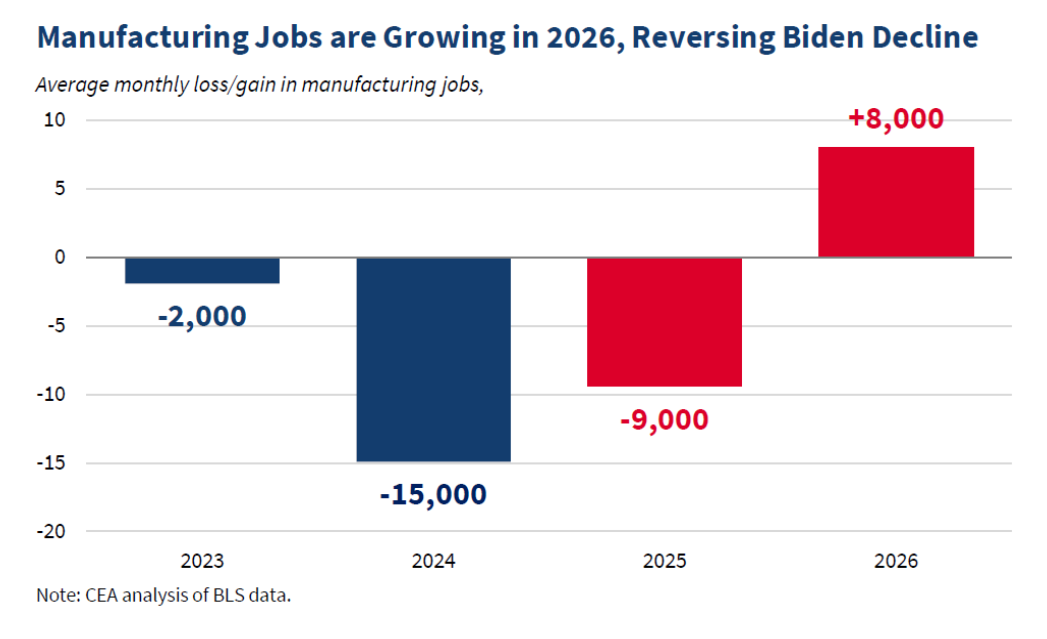
The Council of Economic Advisers (CEA), the panel that advises the White House on economic policy, released "The State of American Manufacturing" in October 2026, presenting the sector's recent performance as a broad vindication of administration policy. "…the data demonstrates that the manufacturing sector is seeing robust growth with the Trump Administration's pro-growth policies," the report states. "Manufacturing jobs are reshoring in America after the Biden Administration shipped over 200,000 American jobs overseas in its last two years, factory construction is soaring as President Trump's tariff policies incentivized companies to make their products here in the USA."
A November 23 Econbrowser post takes a closer look at the evidence behind those claims and raises questions on several points. Because the report's case rests on a small set of statistical series, how those series are chosen and adjusted matters for what they appear to show.
Employment: official series vs. alternatives
The CEA report relies on the official employment series, the Bureau of Labor Statistics' payroll survey. The Econbrowser author notes that measurement error is a known issue, and that additional information suggests manufacturing employment is lower than the official series indicates. Figure 1 in the post compares manufacturing employment across the official series, a preliminary benchmark, ADP payroll estimates from the private payroll processor, and the Quarterly Census of Employment and Wages (QCEW), a BLS count drawn from unemployment insurance tax records, seasonally adjusted using the Census Bureau's X-13 program, all expressed in thousands. Cross-checking a survey-based count against administrative and private sources is a standard robustness check on headline payroll data, and preliminary benchmarks are typically finalized in later revisions that fold in the underlying records.
Output and hours
The report also stresses production, output and investment. On this point, the Econbrowser analysis concedes ground: gross output as measured by the manufacturing index is indeed up. Figure 2 in the post plots manufacturing production and hours worked in manufacturing, both in logs indexed to January 2025 = 0 — a common baseline set at the start of 2025 — drawing on Federal Reserve Board and BLS data along with the author's calculations. Plotting output alongside hours lets readers see how the production gain compares with labor input.
Exports in nominal terms
Finally, the report cites rising goods exports in support of its resurgence thesis. The author points out that the report relies on nominal rather than real figures — totals that are not adjusted for price changes, so they do not by themselves show whether exported volumes grew — and flags an omission: the imported component of US exports in 2026 is not yet known, at a time when imports have surged. Because gross export counts include foreign-produced inputs, the domestic share of the export gain cannot be pinned down until that measurement is available.
The data most relevant to the disputed comparisons are still pending: preliminary benchmarks are finalized in subsequent revisions, and import-content measures depend on detailed trade and input data that statistical agencies publish with a lag.

