CBO Chief Says It's 'Probably Not Plausible' Growth Alone Can Steady U.S. Debt; Sees 5%-6% Growth Needed vs. Bessent's 3% View
Key Takeaways
- •CBO Director Phillip Swagel said it is probably not plausible that faster growth alone can steady the U.S. fiscal trajectory, because higher growth also lifts wages, Social Security outlays, and interest rates that raise debt-servicing costs.
- •Assuming interest rates of 4%-5%, Swagel estimated that stabilizing the debt would require nominal GDP growth of 7%-8% and real growth of 5%-6%, far above the latest quarterly real pace of 2.2% and even bullish Wall Street forecasts of 2.5%.
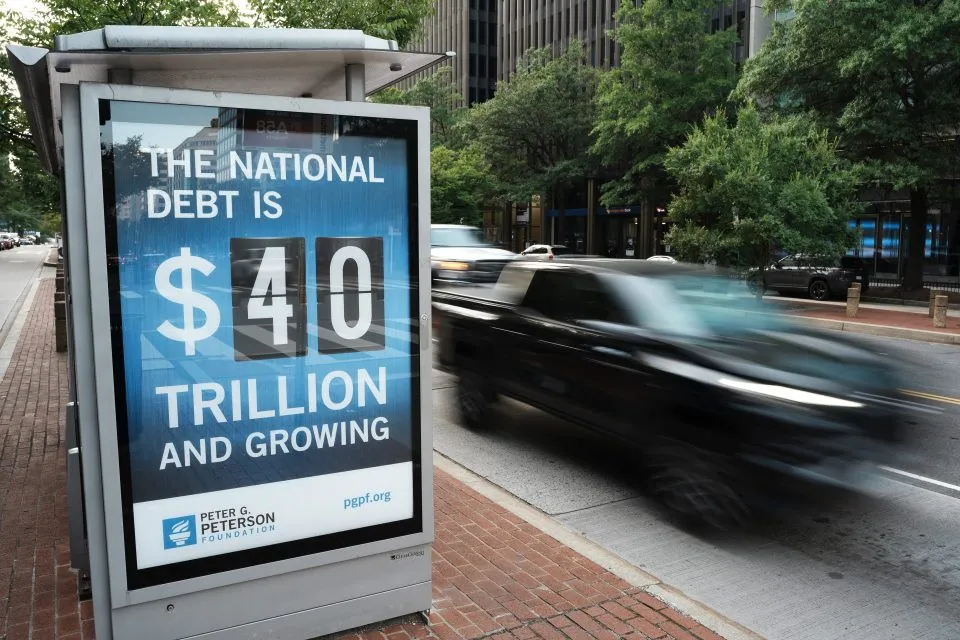
- •Gross federal debt now stands at $40 trillion, debt held by the public equals 100% of GDP, and the CBO projects the debt-to-GDP ratio will climb to 120% by 2036.
- •Treasury Secretary Scott Bessent has argued that 3% growth would let the U.S. grow out of its debt burden, while the Penn Wharton Budget Model estimates 3.5%-4% average growth over a decade would be needed to hold the ratio steady.
- •Swagel warned that an abrupt interest rate shock could set off a cycle in which higher rates enlarge deficits and debt, feeding back into rates, though the current debt effect on long-term yields remains modest at 0.015 percentage points per 1-point rise in the debt ratio.
Congressional Budget Office Director Phillip Swagel, whose agency produces the nonpartisan budget and economic projections used by Congress, said it is "probably not plausible" that faster economic growth alone can steady the United States' fiscal trajectory, even if output expands at more than double its current pace.
Speaking Thursday at a Minneapolis Fed conference, Swagel said stronger growth would help by lifting federal revenue, but the mechanics of the economy work against a simple fix. Federal spending itself boosts growth, which lifts wages and in turn drives higher outlays on Social Security benefits, he noted. A robust economy also tends to push interest rates higher, adding to the government's debt-servicing costs.
"So growth will help, but it's probably not plausible that growth alone will stabilize our fiscal trajectory," Swagel said. "So then we're left with changes in revenues and changes in spending, and those are inherently political choices."
The stakes are substantial. Gross federal debt—the broadest measure, counting Treasury securities held by government trust funds alongside those held by outside investors—now stands at $40 trillion, while debt held by the public, the gauge most often used to weigh the government's ability to service its obligations, equals 100% of GDP. Simply keeping that ratio flat—let alone reducing it—would require a massive and sustained boom. The CBO currently projects the debt-to-GDP ratio will soar to 120% by 2036.
Minneapolis Fed President Neel Kashkari asked whether artificial intelligence could supercharge growth enough to change the math. Swagel replied that the CBO has detected an increase in total factor productivity, a measure of the efficiency of labor, capital, and other inputs. The agency's next batch of economic forecasts, due early next year, will incorporate its views on AI and assume stronger future growth, he said. Even so, he warned, the budget deficit is so deep that even the extra AI-powered growth will not be enough.
Pressed by Kashkari on how much faster growth would need to run to stabilize the debt, Swagel cautioned against doing arithmetic on the fly but offered some back-of-the-envelope figures. Assuming interest rates of 4%-5%, he estimated that nominal GDP growth would have to reach 7%-8%, and real GDP growth would have to hit 5%-6%. The pairing reflects the arithmetic of debt dynamics: only when nominal growth outruns the government's borrowing rate does growth begin shrinking the debt burden relative to the size of the economy. That is more than double the latest real GDP pace of 2.2% in the second quarter, and it exceeds even bullish Wall Street forecasts, which put full-year growth at 2.5%.
Swagel's rough numbers also far exceed what Treasury Secretary Scott Bessent has said would be needed to overcome the debt. "With 3% growth, we grow our way out of this," Bessent said at Southern Methodist University last month. "We'll get to the other side of this Iran conflict, and the underlying economy is very, very strong, and I think reaccelerating." Other estimates fall somewhere in between: according to the Penn Wharton Budget Model, growth would have to average 3.5%-4% over a decade to hold the debt-to-GDP ratio steady. The spread between those estimates carries practical weight: the lower the growth rate an official assumes, the more of the adjustment falls on the tax and spending choices Swagel described as inherently political.
Swagel also flagged the danger of an economic shock that sends interest rates abruptly higher, setting off what he described as a vicious fiscal cycle. "So there's almost like a turbocharger," he explained. "An interest rate shock feeds into the deficit, feeds into the debt, feeds back into interest rates."
So far, the bond market has absorbed all of the debt the U.S. Treasury is issuing to fund the budget deficit, but long-term yields have surged to their highest levels in 24 years. Part of that reflects the strong economy, expectations for Fed rate hikes, and high oil prices keeping inflation elevated, as well as the flood of AI hyperscaler debt competing for bond market demand. But the enormous scale of U.S. debt is also a factor. Swagel said the effect is small for now—a 1-percentage-point increase in the debt ratio leads to a 0.015-percentage-point rise in long-term interest rates.
"So it's modest, but the fiscal trajectory is really quite challenging," he added. "It adds up, and of course there's that turbocharger type effect that I mentioned where it feeds back into deficits."
Video of the discussion can be viewed on YouTube.
This story was originally featured on Fortune.

