CBO Estimates Show FY2026 Budget Deficit Rising Despite Above-Full-Employment Economy
Key Takeaways
- •The projected U.S. federal budget deficit for fiscal year 2026 is expanding as a share of GDP even though the economy is operating above its estimated full-employment potential.
- •As of the second quarter of 2026, the U.S. economy was running nearly a full percentage point above its potential output according to the CBO's benchmark.
- •Mandatory spending on programs such as Social Security and Medicare, combined with rising net interest costs on federal debt, continues to grow faster than government revenues.
- •Higher interest rates in recent years have increased the cost of servicing the national debt, further compounding fiscal pressures.
- •The widening deficit during a period of economic expansion suggests that structural factors rather than business-cycle dynamics are driving the deterioration in federal finances.
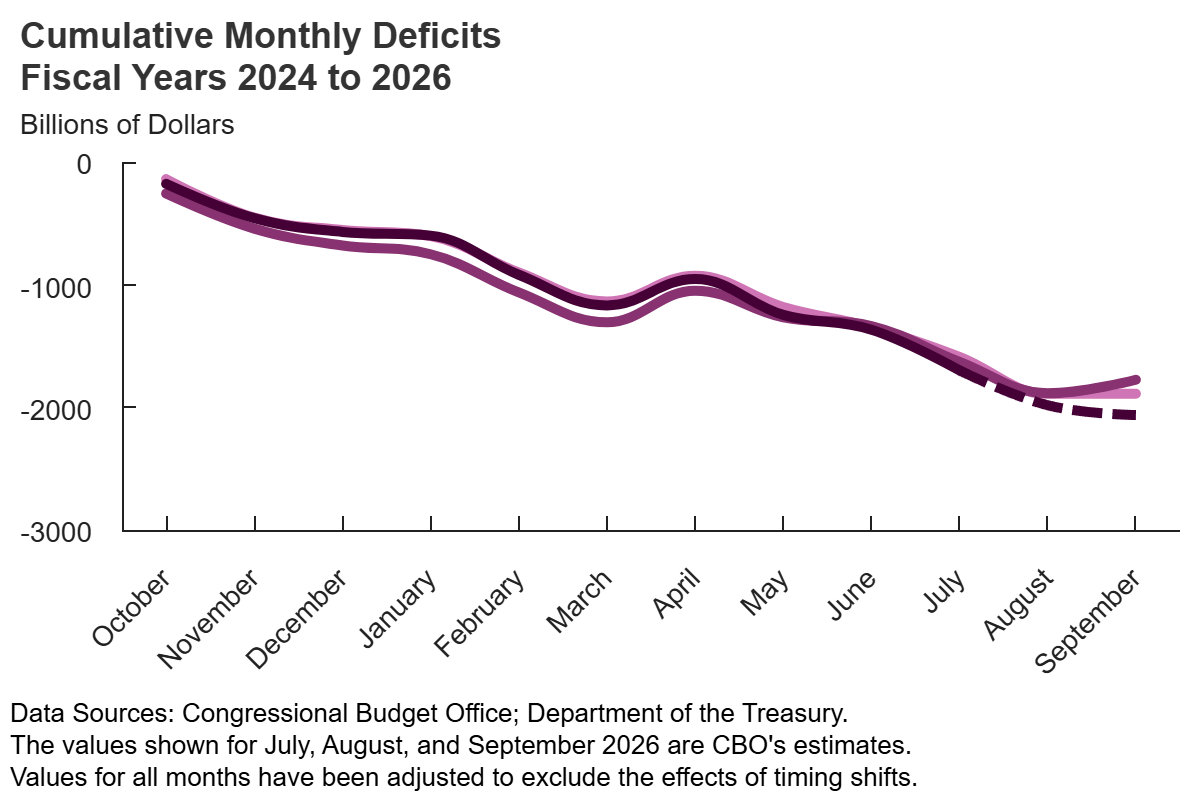
According to data from the Congressional Budget Office (CBO), the estimated U.S. federal budget deficit for fiscal year 2026 is tracking higher as a share of GDP, even as the economy operates above full employment.
Source: CBO.
In the CBO chart, solid light purple represents FY2024, solid dark purple represents FY2025, and the dashed black line represents the FY2026 estimate for the cumulative deficit.
As of the second quarter of 2026, the U.S. economy is running nearly a full percentage point above full employment, based on the CBO's estimate of potential GDP. Under typical macroeconomic conditions, a budget deficit would be expected to narrow when the economy exceeds its potential output, as stronger tax revenues and reduced countercyclical spending tend to improve the fiscal balance. The fact that the deficit is instead increasing as a share of GDP raises questions about the structural trajectory of federal finances.
The divergence reflects a broader pattern that CBO has identified in its recurring long-term budget outlook: mandatory spending programs such as Social Security and Medicare, along with rising net interest costs on the federal debt, continue to grow faster than revenues, driving deficits wider irrespective of the business cycle. Higher interest rates in recent years have further increased the cost of servicing the federal debt, compounding the fiscal pressure.
The Congressional Budget Office is the federal agency within the legislative branch responsible for providing Congress with objective, nonpartisan analysis of budgetary and economic issues. Its estimates of potential GDP serve as a benchmark for assessing whether the economy is operating above or below its sustainable capacity.
