From the Archives: How Carlin-Type Deposits Built Mining Majors
Key Takeaways
- •Carlin-type deposits contain microscopic gold within arsenic-rich pyrite, requiring new processing methods such as oxidizing treatment of refractory ores.
- •Geologist Ralph Roberts' 1960 six-page report on north-central Nevada ore deposits guided Newmont and Barrick's exploration of the Carlin trend.
- •Newmont's Carlin mine began production in May 1965 and yielded 3.8 million ounces of gold before being idled in 1987.
- •Discoveries along the trend, including Gold Quarry, Rain, Genesis and Eureka, helped Newmont grow into the world's largest gold producer.
- •Barrick's Goldstrike-related operations produced 44.4 million ounces through 2018, when they became part of the Nevada Gold Mines joint venture with Newmont, among the world's largest gold mining complexes.
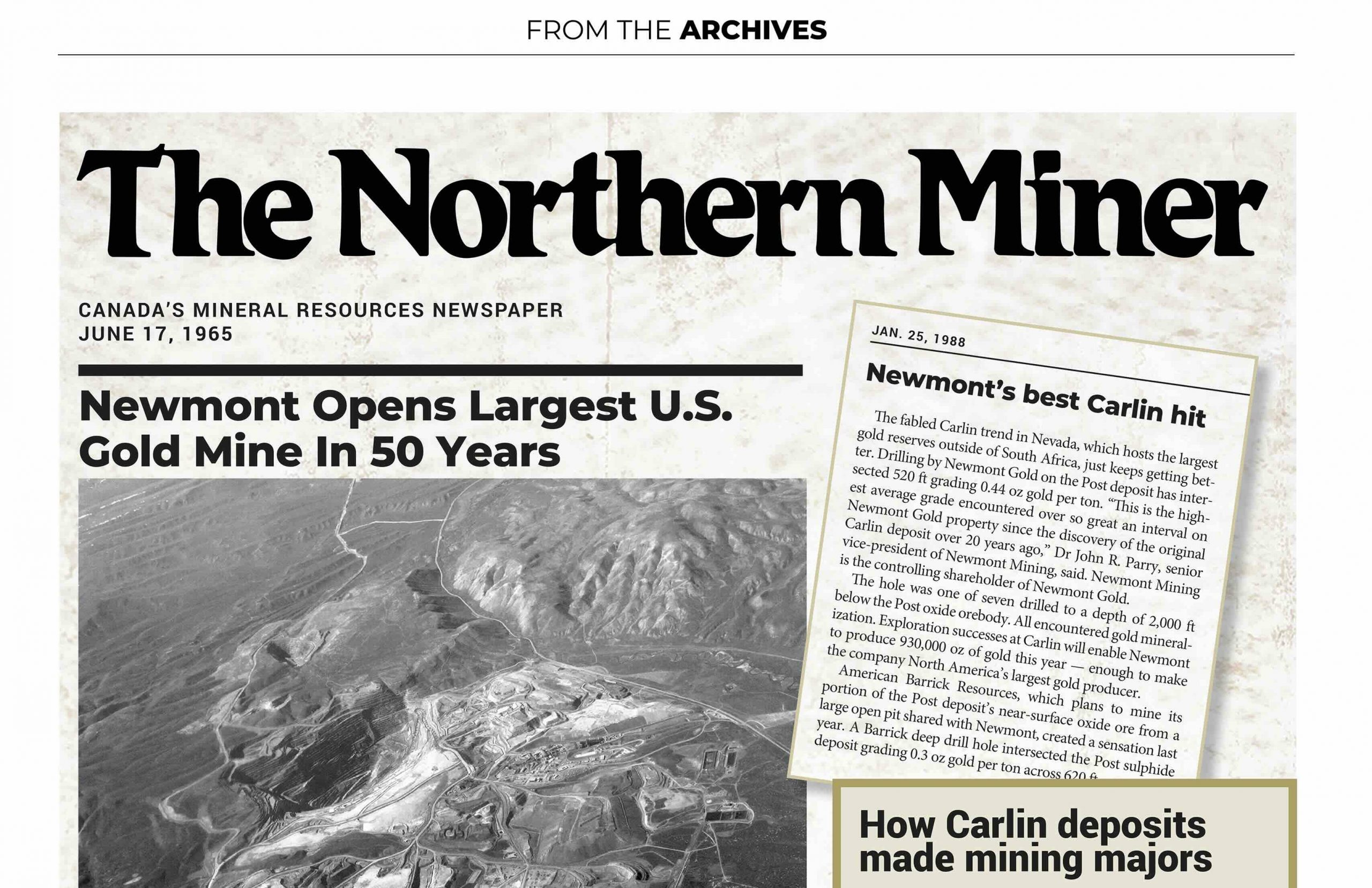
Among the Southwest United States' many claims to mining fame is the discovery of Carlin-type gold deposits, characterized by microscopic gold within arsenic-rich pyrite and named after the town of Carlin in northeast Nevada. Because the gold is invisible to the naked eye and locked within sulfide minerals, these deposits required new processing approaches, including oxidizing treatment of refractory ores, which evolved alongside the district's development.
Evidence of what were later recognized as Carlin deposits was observed as early as 1939. In 1954, American geologist Ralph Roberts mapped out ore deposits in north-central Nevada, publishing his observations in a six-page report in 1960. That report later served as a reference for Newmont and Barrick Mining as they explored the Carlin trend for gold.
Newmont accelerated staking and drilling in the early 1960s, establishing an initial reserve in 1963 and achieving first production at the Carlin mine in May 1965.
A Landmark Operation
"Newmont has begun production at the largest gold mine opened in the United States in half a century," The Northern Miner reported at the time, outlining open-pit production of 2,000 tons per day and 200,000 oz. of gold annually over a mine life of more than a decade.
"Plato Malozemoff, Newmont president, says the Carlin will be the second largest in the U.S., second to Homestake, and the fourth largest in North America."
Carlin produced 3.8 million oz. of gold before being idled in 1987.
Through the 1980s and into the 1990s, further high-grade discoveries along the trend led to additional mines, including Gold Quarry, Rain, Genesis and Eureka, laying the foundation for Newmont's growth into the world's largest gold producer.
The Carlin trend also helped transform Barrick, which acquired the Goldstrike project in 1987. Barrick later developed the Betze, Screamer and Rodeo deposits, eventually producing 44.4 million oz. of gold through 2018, when the operation became the Nevada Gold Mines joint venture with Newmont. Nevada remains one of the world's most prolific gold-producing regions, and the Nevada Gold Mines joint venture, majority-owned and operated by Barrick, ranks among the largest gold mining complexes globally — a scale traceable directly to the Carlin trend's development.
