CargoNet Reports $304.6M in Q2 Cargo Theft Losses Despite 26% Drop in Incidents
Key Takeaways
- •Cargo theft incidents decreased 26% year-over-year to 677 in Q2, while estimated losses more than doubled to $304.6 million.
- •Metal theft incidents rose from 54 to 80 year-over-year, with copper remaining the most frequently targeted material for two consecutive years.
- •Industry experts cautioned that the quarterly decline does not constitute a lasting trend, as cargo theft figures have historically fluctuated.
- •Business email compromise remained a persistent threat in logistics, enabling criminals to access shipment details and impersonate trusted parties.
- •Recent law enforcement operations across multiple jurisdictions may have contributed to the quarterly reduction in theft incidents.
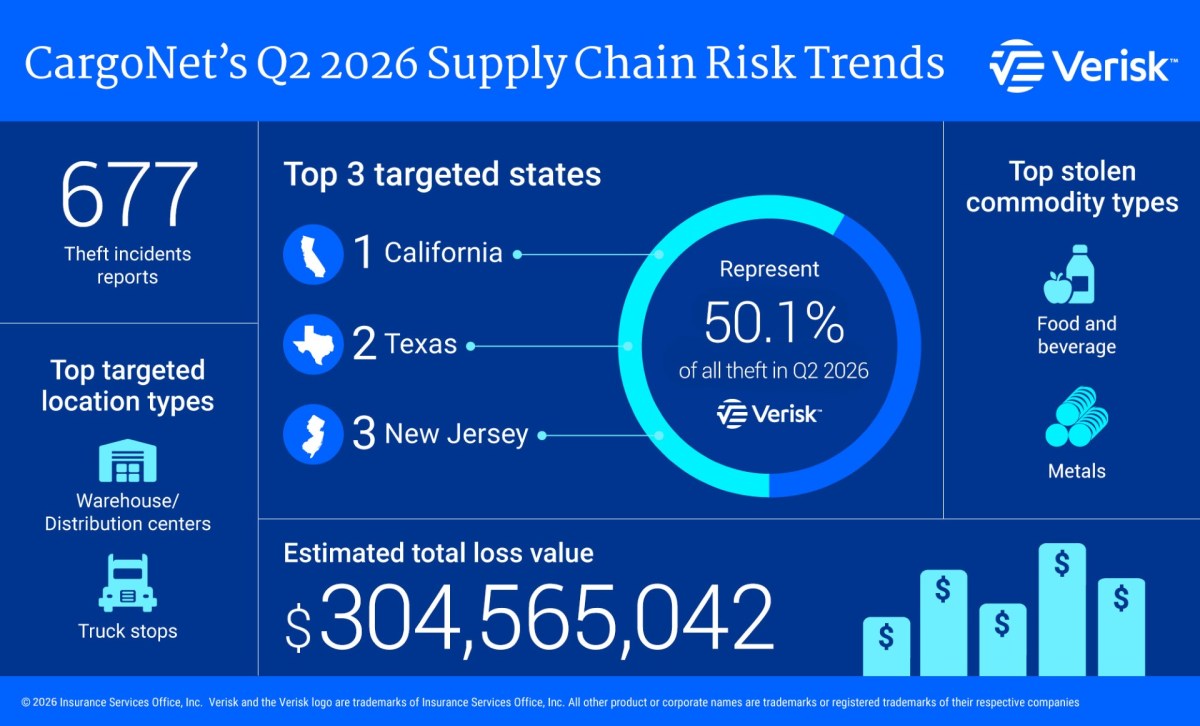
Fewer cargo theft incidents during the second quarter did not translate into reduced financial losses, according to Verisk CargoNet's analysis. CargoNet, a supply chain intelligence platform operated by Verisk Analytics, tracks reported theft events across the United States and Canada and is widely referenced by insurers, carriers, and law enforcement. The network documented 677 incidents — a 26% decline from Q2 2025 and a 14% drop from the previous quarter.
Despite the lower incident count, estimated cargo losses climbed to $304.6 million during the three-month period, more than doubling the $135.7 million reported in Q2 2025. The average reported commodity value reached $564,009, a figure heavily influenced by several multimillion-dollar thefts involving metals and enterprise technology.
"Lower incident volume should not be mistaken for lower risk," said Keith Lewis, Verisk CargoNet's vice president of operations. "The groups driving the largest losses are not necessarily trying to steal more freight; they are trying to identify the right shipment." Lewis identified metals and enterprise technology as prime targets for organized theft groups, given their high value and established resale opportunities.
One quarter does not establish a trend
Scott Cornell, EVP, Crime and Theft Specialist at SPG Cargo & Logistics and chair of TAPA Americas — the Transported Asset Protection Association, an industry organization that sets security standards for supply chain stakeholders — discussed the findings in a recent FreightWaves interview. He welcomed the quarterly decrease after years of elevated theft activity but cautioned against reading it as a lasting shift.
"It's not going to be a trend until we see it for maybe two or three quarters consecutively," Cornell said.
Cargo theft figures have historically fluctuated, Cornell noted. He suggested that recent law-enforcement arrests may have contributed to the quarterly decline, citing operations in New York, New Jersey, California, and Canada, along with FBI and Homeland Security investigations. He described the results of law-enforcement and private-sector cooperation as encouraging.
CargoNet's data revealed declines in physical thefts of loaded equipment and in non-delivery schemes — arrangements in which bad actors acquire established motor carriers, book freight under their operating authority, and then fail to deliver it. California and Texas recorded notable reductions in such activity. Theft classifications dropped from 488 events in Q2 2025 to 378 this year. Fictitious pickup incidents fell more modestly, from 165 reports to 158.
CargoNet also reported steady activity involving business email compromise and shipment misdirection. The FBI has consistently identified business email compromise as one of the most financially damaging cybercrime categories affecting U.S. businesses. In the logistics sector, compromised accounts can expose shipment details, contact directories, and transportation-management tools, enabling criminals to impersonate trusted parties or alter load information.
Metals and technology drove severity
Metal theft rose from 54 incidents in Q2 2025 to 80 this year. Copper remained the most frequently targeted metal, while aluminum, nickel, tungsten, and other specialized materials also drew increased attention. Cornell noted that CargoNet's figures ranked metals second among commodity categories, behind food and beverage. Sustained demand for copper in construction, electrical infrastructure, and renewable energy manufacturing has helped maintain robust resale markets for stolen material.
"Copper has been number one for two years now," Cornell said. "That's the longest stretch I've ever seen on copper." He urged companies transporting metals to strengthen controls around those shipments, describing targeting as a question of when, not whether, for many metal loads.
CargoNet also identified continued targeting of enterprise computer equipment, networking components, and cryptocurrency mining hardware — loads that can carry multimillion-dollar values while moving as conventional dry freight. Food and beverage thefts declined overall, including mixed grocery products and alcoholic beverages, though seafood thefts moved in the opposite direction, increasing by 11 events.
The $304.6 million in reported losses underscores that financial exposure remains substantial even as incident counts fall. For brokers, carriers, and shippers, the data points to a landscape where fewer but more precisely targeted thefts are concentrating risk in specific commodity categories — a pattern that industry professionals and CargoNet will be tracking through subsequent quarterly reports.

