Cardano's x402 Facilitator Passes Testnet Trials, But Mainnet Awaits
Key Takeaways
- •The Cardano Foundation published an open-source x402 v2 facilitator written in Java that enables API payments in ADA or Cardano native tokens.
- •The facilitator is non-custodial: it verifies and submits signed payments on a server's behalf but never holds private keys or signs transactions itself.
- •The build supports three transfer methods — a default address-to-address payment, Masumirow, and arbitrary Plutus smart-contract locks — and is backed by 166 passing unit tests.
- •Its only recorded demonstration ran on Cardano's preprod testnet, with a mainnet checklist in place because nothing in the repository has been executed on the production network.
- •Cardano currently appears only in the TypeScript column of the x402 SDK feature tracker, while Solana, which reports handling 76% of x402 transactions, and EVM-compatible networks are supported across TypeScript, Go, and Python.
Cardano Foundation Publishes Native Facilitator for x402
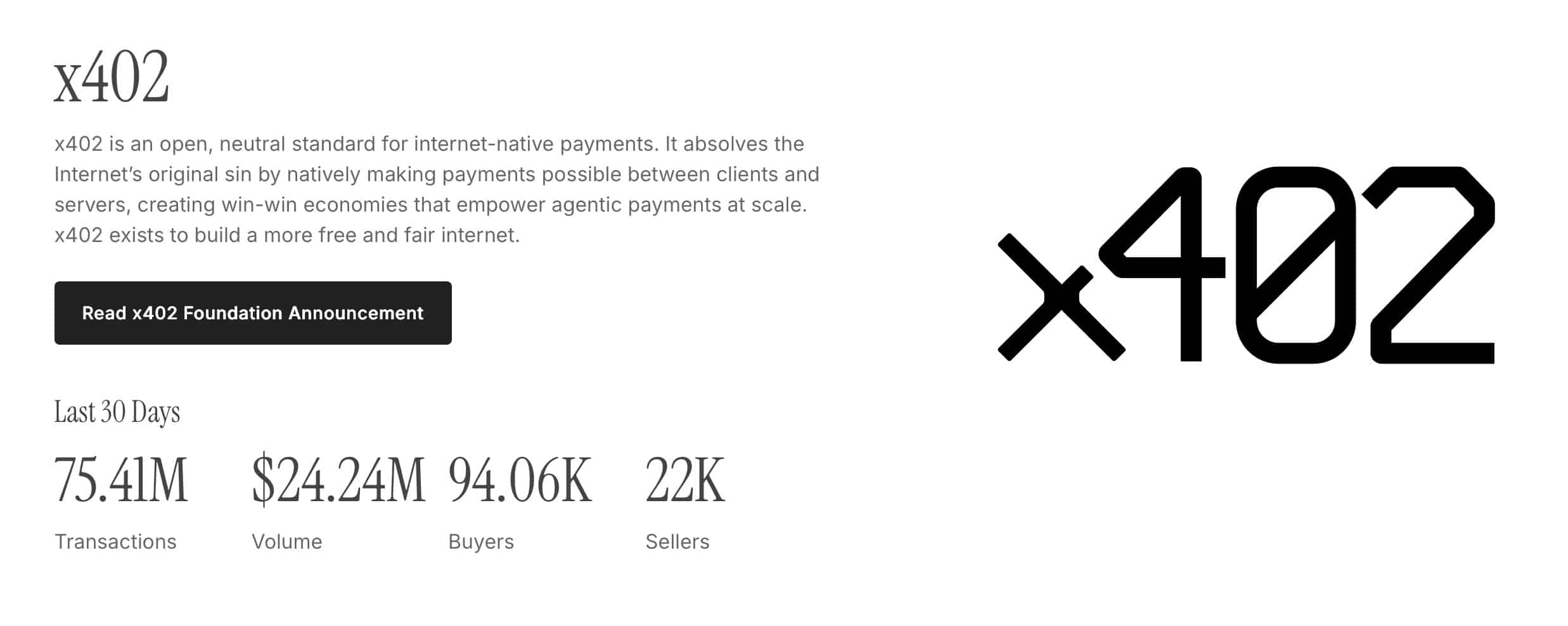
The Cardano Foundation has published a native facilitator for the x402 protocol, the emerging standard that repurposes the long-dormant HTTP 402 "Payment Required" status code — reserved in the HTTP specification since its earliest versions but never given a standard use — to let software pay for services in real time. Documented on GitHub as an x402 v2 facilitator written in Java, the implementation allows a resource server to quote a price for an API call, a client to settle it in ADA or a Cardano native token, and the server to hand over the data or service once payment clears.
Only one working demonstration is on record so far, and it ran end-to-end on Cardano's preprod test network — a public staging environment that mirrors mainnet's rules without real funds at stake — with a real on-chain transaction confirming the flow. Nothing in the repository has been executed against mainnet. That gap — working plumbing versus proof that it can move real money at scale — is the central story, and the distinction matters for anyone gauging how close autonomous payments for AI agents really are on this chain. The same question is playing out in XRP Ledger's own agent-payment push.
JUST IN: Cardano is now part of the official x402 SDK.
Any app or AI agent can pay for an API call in $ADA or any CNT over a web request. No account, no API key, no checkout page.
Every service already on x402 can switch Cardano on.
The agent economy just got a Cardano rail. pic.twitter.com/SWZHczf9oC
— Cardano Foundation (@Cardano_CF) September 21, 2026
This Is How Cardano's x402 Facilitator Works
The mechanics are simple even if the plumbing underneath is not. A resource server sets a price for an API call, a report, or a compute job; the client signs a payment and sends it along; the facilitator then answers two questions on the server's behalf — is this payment valid, and did it settle. Crucially, the facilitator never holds private keys and never signs a transaction itself. It only verifies what the payer already signed and submits it to the network, which means it cannot move funds on its own — a non-custodial design that lets resource servers rely on shared settlement infrastructure without ever surrendering control of their funds.
Developers interact with the service through four endpoints: POST /verify checks whether a signed payment is valid, POST /settle submits it and confirms it landed, GET /supported lists the protocol versions and networks the service serves, and GET /health provides a human-readable status check.
The Cardano build supports three transfer methods — a default address-to-address payment, a Masumi escrow arrangement (Masumi is a Cardano-based escrow protocol built for machine-to-machine payments), and arbitrary Plutus smart-contract locks (Plutus being Cardano's smart-contract language) — giving builders flexibility in how funds are held before release.
166 Tests and One Testnet Proof: What the Code Actually Delivers
The repository reports 166 unit tests, all passing, plus a single on-chain proof on Cardano's preprod testnet covering server-side submission of a payment. That proof walks through the full settlement ladder x402 expects: mempool acceptance, canonical block inclusion, and a confirmation depth of up to 20 blocks.
The settlement logic behind it appears carefully built. A PostgreSQL-backed journal, fenced state transitions, an asynchronous reconciler, and rollback detection are designed to handle messy edge cases, such as a transaction landing after the server has already responded, or a process dying mid-submission.
Other components remain unproven against a live provider. Client-side submission — where a payer broadcasts a transaction independently and the facilitator merely confirms it happened — is unit-tested but has not been exercised in a real-world setting. The full self-hosted Docker stack is not covered by continuous integration either.
The project's own documentation is blunt about scope: a mainnet checklist exists precisely because nothing has run against Cardano's production network, and the end-to-end test credentials are explicitly marked testnet-only. That is a normal stage for infrastructure rather than a red flag, but it does mean any claims of commercial readiness run ahead of the evidence.
ADA Joins the AI Agent Payment Race: Infrastructure Yes, Adoption Not Yet
JUST IN: Solana handles 76% of all @x402 transactions. 23.2M in four weeks. The next-largest network did 3.39M. pic.twitter.com/OJv35U4kXF
— Solana (@solana) September 22, 2026
Cardano is not first here. x402's own SDK feature tracker lists Solana and EVM-compatible networks as supported across TypeScript, Go, and Python, while Cardano currently appears only in the TypeScript column. The project is entering a broader contest with Solana and XRP Ledger to power machine-to-machine payments, a framing echoed across multiple outlets covering the announcement.
Still, appearing in a compatibility table is not the same as processing commercial volume. As with crypto-linked card spending, infrastructure adoption and transaction throughput are separate metrics, and conflating them overstates where a protocol actually stands.
What the primary source confirms is a working, tested facilitator with verification, submission, and settlement logic built specifically for Cardano's exact-payment scheme under x402. What it does not confirm is traction: there is no mainnet transaction, no reported volume, and no evidence of autonomous agents transacting at scale in production.
For the next wave of Cardano news, the milestone worth tracking is not another SDK release. It is whether someone runs this against mainnet and publishes the numbers — an achievement that would matter more for Cardano's 2026 trajectory than the code merge itself. Whether Cardano's footprint widens beyond TypeScript is the secondary signal worth watching alongside it.

