Cardano Proposes Common Stablecoin Compliance Standard as Post-Quantum Signature Plan Advances
Key Takeaways
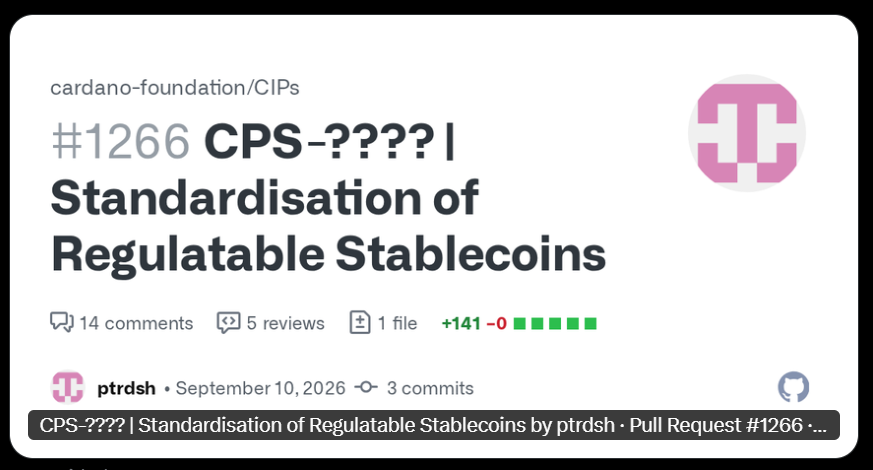
- •A draft standard published as pull request 1266 aims to establish consistent compliance requirements for regulated stablecoins built on Cardano's CIP-0113 framework, reducing duplicated integration work for wallet developers, exchanges, and payment services.
- •Quantova Inc.'s CIP-0206 proposal would add ML-DSA and SLH-DSA post-quantum signature verification to Plutus, both standardized by NIST under FIPS 204 and FIPS 205, and activation would require a network hard fork.
- •Contributors are reviewing whether the removal of CIP-0008 from the CIP-0169 governance metadata schema could affect compatibility with existing hardware-wallet signing methods, with the review spanning CIP-0100 and CIP-0108.
- •Completed documentation item CIP-0204 describes a mechanism for ADA holders to record Yes, No, or Abstain views on governance actions through signed transaction metadata, without replacing formal voting.
- •CIP-0113's mainnet implementation was announced in October, and its issuer-defined restrictions apply only to participating tokens rather than ADA holdings.
Cardano's Nov. 1 development roundup put the spotlight on two proposals moving through the network's improvement process: a draft standard for regulated stablecoins and a plan to add quantum-resistant signature verification to Plutus, Cardano's smart contract platform. Contributors also reviewed a governance metadata compatibility question and completed two documentation items. The proposals sit at different stages of technical review, and neither amounts to an activated network-wide upgrade.
Stablecoin Draft Seeks Common Compliance Rules
The stablecoin proposal, published as pull request 1266, covers assets built on CIP-0113, Cardano's programmable-token framework. Tokens using this framework can carry issuer-defined controls, including identity checks and restrictions on certain transfers.
The draft calls for consistent compliance requirements across issuers instead of separate technical arrangements for each stablecoin. At present, wallet developers, exchanges, and payment services may need to adjust their integrations to satisfy each issuer's requirements, creating duplicated effort for teams that want to support several regulated tokens. The proposal aims to define a common set of rules developers could apply when qualifying stablecoins across jurisdictions.
The authors have sought feedback from stablecoin issuers on regulatory requirements and from infrastructure providers on whether a single standard would be practical. Because the draft remains an open pull request, that input could shape revisions before any adoption decision.
Cardano announced CIP-0113's mainnet implementation in October, a development publicized through the project's official X account. The framework's restrictions apply to participating tokens, not to ADA holdings. Separately, the Cardano Foundation joined a Swiss tokenization group that recognized a CIP-0113 implementation for tokenized shares.
Quantum Proposal Adds Two Verification Methods
Quantova Inc. submitted CIP-0206, which would add ML-DSA and SLH-DSA signature verification functions to Plutus. Both algorithms are standardized by the U.S. National Institute of Standards and Technology under FIPS 204 and FIPS 205. ML-DSA relies on lattice-based methods, while SLH-DSA is built on hash-based cryptography. Both belong to the field of post-quantum cryptography, whose algorithms are designed to remain secure against attacks that could become feasible with quantum computers.
If adopted, the functions would allow developers to write Plutus contracts that check signatures created with either scheme. Quantova included reference code, encoding details, and test cases covering valid signatures, altered messages, and mismatched signing methods.
The proposal remained at the review stage as of November 1. Cardano would need a network hard fork before the new verification functions could run in the consensus-critical Plutus evaluator. CIP-0206 does not replace existing wallet signatures and does not introduce a network-wide quantum security upgrade; it concentrates on signature checks inside smart contracts. Any move toward quantum-resistant account keys or transaction signatures would require separate technical plans and network decisions. Developers have not announced an activation date for the proposed functions, so the milestone to watch is whether the functions are folded into a future hard fork plan — the mechanism that would bring consensus-critical changes to the network.
Governance Metadata Signing Under Review
Cardano contributors are also examining an issue involving signature records for governance metadata. Reviewers questioned the removal of CIP-0008 from the signing methods listed in the CIP-0169 metadata schema, with the discussion centered on whether that change could affect compatibility with existing hardware-wallet signing methods.
Contributors are weighing whether to restore the earlier entry and clarify how related governance specifications work together. The review spans CIP-0100 and CIP-0108, which address different parts of the system. Participants have not announced a final decision or a new rule for wallet providers. How the question is resolved could shape what signing methods wallet providers are expected to support as the governance metadata standards evolve.
Documentation Items Completed
The November 1 roundup also listed CIP-0204 and CPS-0037 as completed documentation items. CIP-0204 describes a mechanism for ADA holders to record their views on governance actions through signed transaction metadata. Holders could register Yes, No, or Abstain responses using their stake keys, creating public records of holder preferences. Those responses would not replace formal voting by delegated representatives, stake pool operators, or the Constitutional Committee.
At the time of writing, Cardano (ADA) traded at $0.1932, up 0.37% over the past 24 hours.
Source: The Market Periodical

