Cardano Price Prediction: TVL and Network Fees Continue to Slide
Key Takeaways
- •ADA traded near $0.22 on September 7 after rebounding from a June low of approximately $0.1381, but remains more than 80% below its highest point last year.
- •Cardano's total value locked has fallen to just over $65 million, its lowest since 2023 and far below its all-time high of more than $700 million.
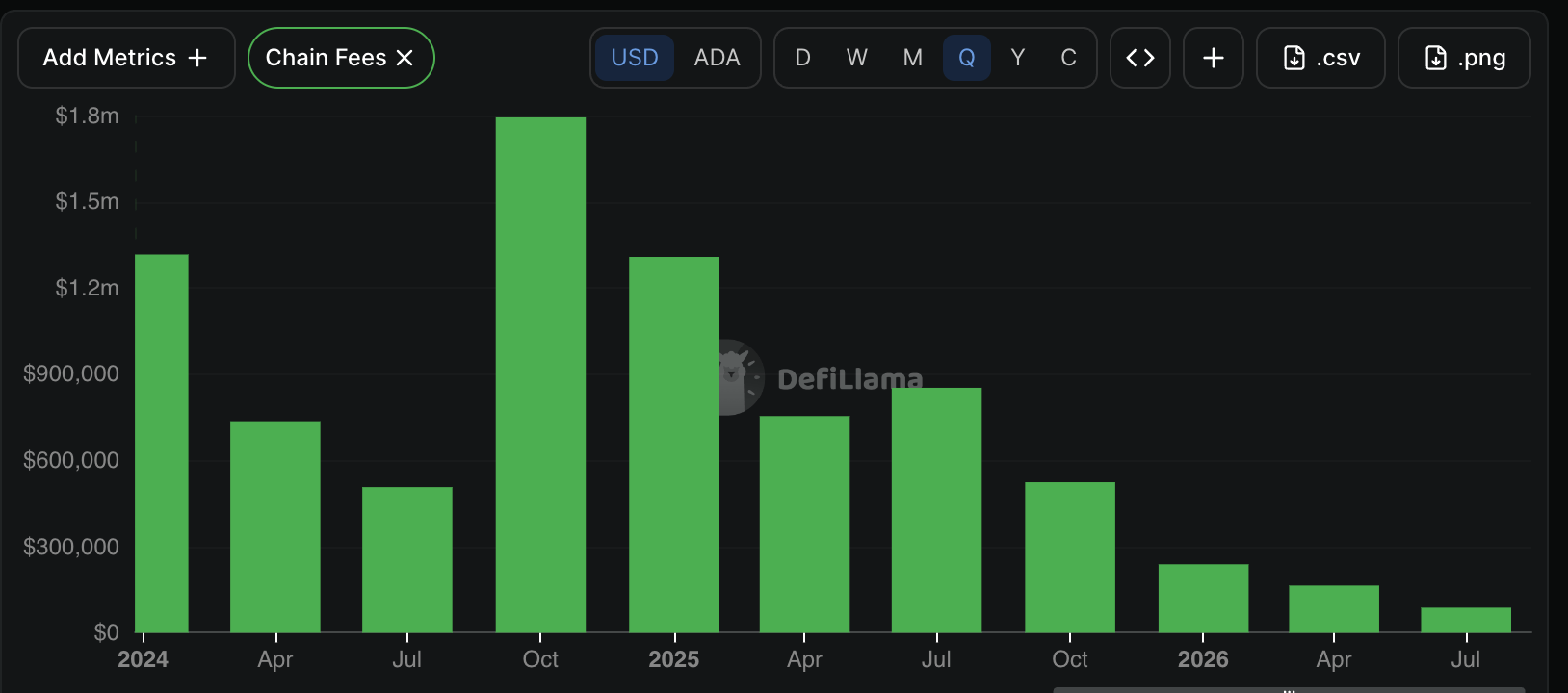
- •Quarterly network fee revenue fell to about $87,000, down from $164,000 in the prior quarter and nearly 95% below its peak of more than $1.79 million.
- •Robinhood Chain, launched in July, has overtaken Cardano with roughly $1 billion each in TVL and stablecoin supply and hundreds of dApps.
- •Technical indicators including a rising wedge pattern, prices below the 100- and 200-day EMAs, and bearish RSI/PPO divergences point to possible declines toward $0.1362 or $0.100.
Key Insights
- Cardano's price has formed an ascending channel over the past few months.
- The total value locked (TVL) in Cardano has continued to fall this month.
- Network fees and stablecoin supply remain under pressure.
Cardano's price held above its June low as ADA staged another recovery attempt in early September. Network metrics, however, continued to point to limited activity compared with larger smart-contract platforms. The gap matters because for smart-contract networks, usage indicators such as TVL, stablecoin supply, and fee revenue are among the main ways investors gauge real demand for a chain — and price rallies that lack corresponding on-chain activity have historically been harder to sustain.
ADA traded near $0.22 on Sept. 7, rebounding from a low recorded by TradingView at roughly $0.1381 on June 25. The recovery has taken place while Cardano's decentralized finance activity remains relatively subdued — a divergence that leaves the recent price rebound exposed to renewed selling pressure.
Cardano Price Recovery Faces Weak DeFi Activity
The ADA token has fallen by more than 80% from its highest point last year. The decline has coincided with the crypto winter, which has weighed on Bitcoin and most altcoins.
That downturn has also stunted the network's growth, turning it into what is often described as a "ghost chain" — a network with little to no meaningful activity. Years after its launch, Cardano still lacks mainstream decentralized applications (dApps). This stands in contrast to the broader smart-contract landscape, where competition for developers and liquidity has intensified, with newer chains able to attract large ecosystems within months of launching.
Cardano's total value locked (TVL) has dropped to just over $65 million, its lowest level since 2023 and far below the all-time high of more than $700 million. The network has notably been overtaken by Robinhood Chain, which launched in July and has already attracted hundreds of dApps, with close to $1 billion each in TVL and stablecoin supply.
Cardano's largest dApps — including Minswap, Liqwid, Dano Finance, Splash Protocol, and Indigo — see limited usage, in contrast to leading applications such as Uniswap, PancakeSwap, Hyperliquid, and Aave, which operate on Ethereum and other chains.
Stablecoin Supply and Fees Have Plunged
Further data shows that Cardano's stablecoin supply stands at just $64 million. While that is higher than a year ago, it is a negligible amount in an industry holding over $300 billion in such assets. Stablecoins have become a key measure of a chain's practical utility, since they underpin trading, lending, and payments activity, so a small stablecoin base typically signals limited real-world usage. Cardano has been overtaken by chains such as Robinhood Chain and Arbitrum.
The same pattern extends to other sectors. Cardano holds only a limited share of the real-world asset (RWA) segment, which has grown into a major part of the crypto industry.
As a result, the network generates little revenue — a striking figure for a cryptocurrency valued at over $8.2 billion. The network has earned just over $87,000 this quarter, down from $164,000 in the previous quarter. At its peak, Cardano generated more than $1.79 million per quarter. Fee revenue is closely watched because it reflects how much users actually pay to transact on a network, making the near-95% drop from the peak a key data point in the debate over Cardano's fundamental valuation.
These figures help explain Cardano's weak traction among retail and institutional investors. Notably, no major company has applied for a spot Cardano ETF despite the asset's popularity and large market cap, while ETFs now exist for coins such as Zcash, Hyperliquid, Dogecoin, and Litecoin. (Grayscale previously withdrew Cardano, Hedera, and Polkadot ETF filings.) The absence of an ETF pathway is notable at a time when such products have become a major channel for institutional crypto exposure.
Meanwhile, ADA's daily trading volume has slipped to roughly $480 million, below other coins including Zcash and XRP. A similar decline is visible in the futures market, where open interest has continued to fall.
Cardano Price Technical Analysis
On the daily chart, ADA has formed an ascending channel over the past few months. This channel resembles a rising wedge, a commonly cited bearish reversal pattern, and — appearing after a steep decline — also carries the characteristics of a bearish flag.
The coin remains below its 100-day and 200-day Exponential Moving Averages (EMA), a sign that sellers remain in control. The Relative Strength Index (RSI) and the Percentage Price Oscillator (PPO) have formed a bearish divergence pattern.
Taken together, the technical setup suggests the token could continue lower, potentially reaching the key support level at $0.1362, its June low. A break below that level would open the door to further downside toward $0.100. Whether that support holds is likely to be watched alongside the on-chain metrics above, since a recovery in TVL, stablecoin supply, or fee revenue would provide the kind of fundamental support the current rebound lacks.
This article is for informational purposes only and should not be considered financial or investment advice. Cryptocurrency markets remain highly volatile. Readers should conduct independent research and assess their financial circumstances before making investment decisions.
