Claude AI Predicts Cardano at $0.28–$0.32 by Year-End 2026, Warns Bulls Chasing the Next Rally
Key Takeaways
- •Cardano DReps approved allocating 120 million ADA from the treasury to DeFi applications on August 16.
- •The treasury allocation is intended to deepen on-chain liquidity and activity rather than fund overhead.
- •The regulated USDM stablecoin went live on Cardano’s Midnight privacy chain two days before the vote.
- •ADA reached its six-month spot-ETF eligibility milestone on August 9, while Grayscale later withdrew its Cardano ETF S-1 filing.
- •ADA fell 10.6% over the past week, and Claude AI identified $0.138 as a key downside floor with $0.13 as the next risk level.
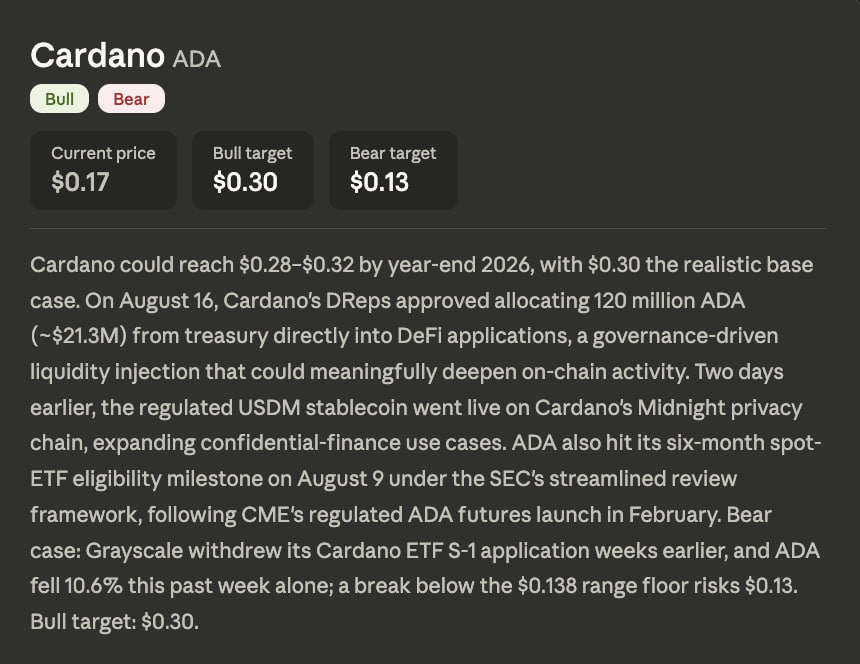
Cardano token holders have voted to commit $21.3 million of their own treasury toward fixing the network's liquidity problem. Claude AI's assessment of that decision points to an ADA price range of $0.28 to $0.32 by year-end 2026, with $0.30 as the realistic base case.
The vote came on August 16, when Cardano's DReps approved allocating 120 million ADA from the treasury directly into DeFi applications. DReps — delegated representatives whom ADA holders choose under the on-chain governance system activated by Cardano's Chang hard fork in September 2024 — share control of treasury withdrawals with the constitutional committee and stake pool operators, which is why the allocation required a formal vote. Claude describes the move as a governance-driven liquidity injection, with the stated purpose of meaningfully deepening on-chain activity rather than funding overhead. The treasury is built up from a share of transaction fees and monetary reserves, so the 120 million ADA comes from inside the ecosystem rather than outside investors. The gap it targets is well documented: Cardano's DeFi total value locked has long run at a small fraction of Ethereum's or Solana's, even as ADA has remained one of the larger proof-of-stake assets by market value.
Two days earlier, another development had landed: the regulated USDM stablecoin went live on Cardano's Midnight privacy chain. Midnight is the privacy-focused sidechain Cardano has developed alongside its main network, designed to keep selected data confidential while proving compliance-relevant facts on demand. The deployment expands confidential-finance use cases on a chain built for exactly that purpose, and the pairing of a regulated stablecoin with privacy rails remains an unusual combination. The regulated label also carries more weight than it did a year earlier: the GENIUS Act, signed into US law in July 2025, established the first federal framework for payment stablecoins.
Institutional access forms the third thread. On August 9, ADA hit its six-month spot-ETF eligibility milestone under the SEC's streamlined review framework — a step set up by CME's regulated ADA futures launch in February. Bitcoin and Ethereum spot ETFs drew tens of billions of dollars in inflows after their 2024 US launches, which is why procedural milestones for smaller assets draw close attention.
The bear case runs in the opposite direction. Grayscale withdrew its Cardano ETF S-1 application weeks earlier — an S-1 being the registration statement an issuer files with the SEC, and a withdrawal that takes the product off the docket without barring a future refiling — and ADA fell 10.6% this past week alone. A break below the $0.138 range floor risks a move to $0.13.
Cardano Price Prediction: Claude AI Predicts Token Holders Fund Their Own Recovery
The weekly chart is in a long decline with two failed rallies. ADA traded near $1.25 in 2022 before falling to $0.24 by that autumn. A 2024 recovery reached $0.80 and faded, and a late-2024 spike to $1.30 also gave way. Mid-2025 offered one more attempt near $1.00. Everything since has been a controlled slide.
Early 2026 broke below $0.30 and continued lower. Price bottomed near $0.14 before a shallow stabilization. The weekly close reads $0.172859, down 1.03%, a decline of $0.001804, with the weekly range covering $0.171123 to $0.177749.
Support sits at $0.17, followed by $0.15 and $0.138 — the floor Claude flags. Resistance appears at $0.20, then $0.25 and $0.30.
RSI reads 37.65 with its signal line below at 34.28. The oscillator leads by more than 3 points, showing selling pressure easing at low levels, though both lines remain well under the midline. Momentum is weak, although the downward slope has flattened.
Claude's base case requires a 74% move from current levels. Seeing the treasury money translate into visible DeFi volume is what would start closing that gap, according to the analysis.
Cardano Is Spending Its Treasury to Create Liquidity. LiquidChain Is Building for Liquidity That Already Exists.
Cardano's vote highlights the problem clearly: capital can exist on-chain and still fail to produce meaningful activity if the infrastructure around it is too fragmented.
LiquidChain is attacking that problem at the network level. Instead of trying to deepen liquidity inside one ecosystem, it is building a single execution layer across Bitcoin, Ethereum, and Solana. One deployment can reach all three networks, reducing the need for separate apps, repeated bridges, and the fees and slippage that come with moving capital between isolated chains. Cross-chain bridges have also ranked among the most-exploited pieces of crypto infrastructure, with individual exploits running into the hundreds of millions of dollars, which any interoperability design has to answer for.
That changes the bet. LiquidChain does not need to manufacture a new pool of crypto liquidity; it needs to make the trillions already sitting across major ecosystems easier to use together. The project's presale is currently priced at $0.01454, with just over $920,000 raised. The article contends that at that valuation, even modest adoption can matter far more than it would for established large caps.

