Meta AI Predicts Cardano Could Stage the Strangest Comeback of 2026
Key Takeaways
- •Meta AI's base case projects ADA at $0.68 by the end of 2026, within a range of $0.55 to $0.85, dependent on delivery of the Leios upgrade and resolution of the treasury audit.
- •Ouroboros Leios targets a 10-to-65-times increase in Cardano's Layer 1 throughput, with mainnet block production aimed for November 2026 and final Phase 1 delivery set for the end of 2026.
- •Grayscale withdrew its Cardano ETF on August 7, two days before ADA achieved six-month CME eligibility on August 9, while a rival filing remains possible by October 23.
- •The mid-August IOG treasury audit was promised to address $600 million in allegations, with early leaks indicating 99.2% voucher redemption, and August also saw the launch of a 2.5 million ADA Catalyst Pilot Fund for scaling projects.
- •ADA closed at $0.21349 with a 7.25% gain, and the stated bear case sees a retest of $0.16 to $0.19 if Leios slips to 2027 or the audit disappoints.
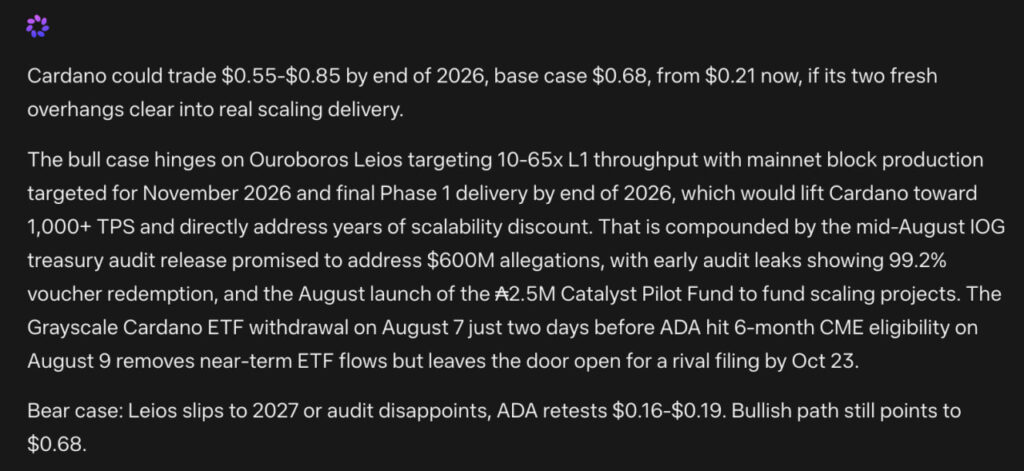
Cardano would need to more than triple from current levels just to return to where it traded last autumn. A price prediction generated by Meta AI says that round trip is on the table, with the model setting $0.68 as its base case for the end of 2026. The wider range runs from $0.55 to $0.85, and everything depends on two overhangs clearing into real scaling delivery. Meta AI is Meta's general-purpose Llama-based assistant rather than a market analytics product, so the number works as an AI-generated scenario built on the same dated milestones the market is watching, not as sell-side research.
The first overhang is technical. Ouroboros Leios targets a 10 to 65 times lift in Layer 1 throughput, with mainnet block production aimed at November 2026. Final Phase 1 delivery is set for the end of 2026. That would push Cardano toward 1,000 or more transactions per second and attack years of scalability discount head on. Leios has been in research and development at Input Output for several years as a reworking of the Ouroboros proof-of-stake consensus, reorganizing block production so transaction-carrying blocks and the blocks that endorse them can flow in parallel rather than sequentially. Throughput has been the most persistent criticism of Cardano relative to high-speed rivals since the last cycle, which is why a firm shipping date carries weight that another roadmap update would not.
The second overhang is trust. The mid-August IOG treasury audit release was promised to address $600 million in allegations, and early leaks show 99.2% voucher redemption. Funding is moving alongside it: August brought the launch of a 2.5 million ADA Catalyst Pilot Fund aimed squarely at scaling projects.
The ETF picture is messier. Grayscale withdrew its Cardano ETF on August 7, only two days before ADA reached six-month CME eligibility on August 9. The withdrawal removes near-term ETF flows, but it also leaves the door open for a rival filing by October 23. The context sharpens the sting: Grayscale pioneered the trust-to-ETF conversion route when its Bitcoin Trust became an ETF in January 2024, and spot crypto funds have since become the primary institutional on-ramp for US investors, which is why any Cardano filing is watched as a proxy for institutional appetite.
The bear case is simple and specific: if Leios slips to 2027 or the audit disappoints, ADA retests $0.16 to $0.19.
Meta AI Predicts Leios Closes the Discount
The ADA chart has been a one-way story for almost a year. ADA peaked near $0.90 in October 2025 and never printed a meaningful higher high afterward. February 2026 dragged the price down to $0.24. Spring brought a tight, low-volatility range roughly between $0.24 and $0.30, and June broke that too, bottoming near $0.145.
July and August built something different. Price ground out a rising base of higher lows, slow and unglamorous, until the latest session finally punched through. ADA closed at $0.21349, up $0.01443 for a gain of 7.25%, with a daily range from $0.19861 to $0.21799.
Resistance now stacks at the $0.21799 high, then the old $0.25 floor, then $0.30. Support sits at $0.19861 first; below that, $0.18 and the $0.15 base remain the structural lines.
RSI reads 71.94 against a signal line at 54.78. The 17-point spread is meaningful without being extreme. Readings above 70 are conventionally labeled overbought, and the signal line has been climbing since July rather than sitting flat, which points to accumulation rather than a single reflex candle, and momentum by this reading finally favors buyers. Whether ADA stretches toward $0.68 gets decided in a November mainnet window, not on this chart.
Cardano's Big Test Has a Date
ADA's recovery case now comes down to execution. Leios either reaches mainnet on schedule and starts closing Cardano's scalability discount, or another delay pushes the rerating further out. The calendar that decides it is explicit: the mid-August audit release, the October 23 filing window, and November's mainnet target.
Prediction-market platform Kalshi, a CFTC-regulated exchange, offers traders a way to position directly around that kind of event. The platform runs markets tied to real-world outcomes across crypto, politics, economic data, Fed decisions, and other catalysts that can move asset prices. Instead of buying ADA today and taking on every variable affecting the token, traders can focus on the specific event they actually have conviction on.
That distinction matters when a forecast depends on a clear November delivery window. By the time the market knows whether the upgrade landed, much of the reaction may already be reflected in price. Kalshi lets participants act while the outcome is still uncertain.
Source: 99Bitcoins

