ChatGPT AI Predicts Cardano at $0.35–$0.50 by End of 2026, With $0.42 Base Case
Key Takeaways
- •ChatGPT's AI model forecasts ADA reaching $0.35 to $0.50 by the end of 2026, with $0.42 as the base case and $0.12 to $0.15 as the bear case if funding fails to convert into usage.
- •Cardano PRIME, ratified on August 12 through on-chain governance, releases approximately 120 million ADA worth about $22 million into a 12-month DeFi liquidity program aimed at deepening markets.
- •Ouroboros Leios, a redesign of Cardano's consensus protocol targeting a major throughput increase, remains on testnet, with mainnet deployment this year cited as the condition for removing the scalability constraint.
- •ADA completed six months of CME futures trading on August 9, while Grayscale withdrew its ADA ETF filing on August 7.
- •ADA last closed at $0.181681, down 0.35%, with RSI at 50.37 well below its 61.55 signal line, support near $0.175, $0.16, and $0.145, and resistance at $0.20, $0.22, and $0.25.
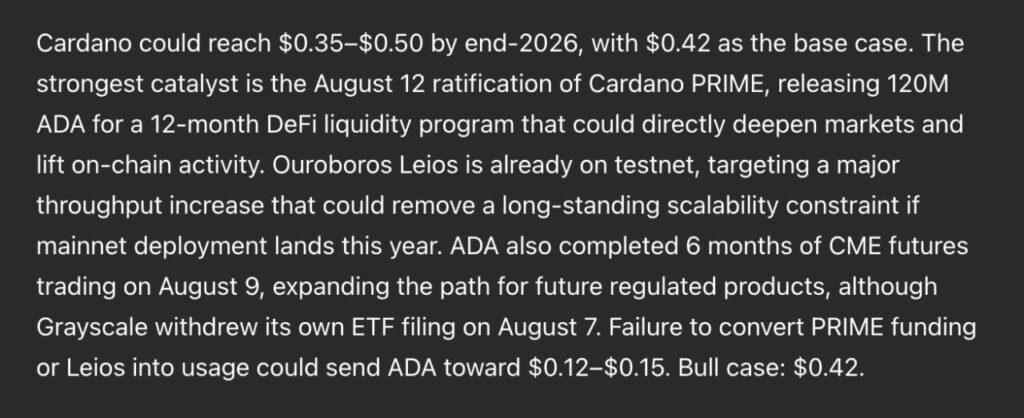
Approximately 120 million ADA is set to enter DeFi markets, and ChatGPT AI predicts Cardano will reach between $0.35 and $0.50 by the end of 2026, with $0.42 as the base case of the price prediction. ChatGPT is a general-purpose language model rather than a valuation tool, so its ranges are best read as a scenario built on the catalysts below rather than an independent forecast.
The ratification of Cardano PRIME on August 12 is identified as the strongest catalyst. Ratification runs through Cardano's on-chain governance, which since the 2024 Chang upgrade has given ADA holders and their delegated representatives a direct vote on network proposals. PRIME releases the 120 million ADA — worth roughly $22 million at the most recent close — into a 12-month DeFi liquidity program whose purpose is to deepen markets directly, with lifting on-chain activity cited as the outcome ChatGPT is watching for.
Ouroboros Leios sits behind it on testnet. Leios is a redesign of the Ouroboros consensus protocol developed by Input Output's research team, reworking how blocks are propagated so more transactions can settle in the same window. The target is a major throughput increase that removes a long-standing scalability constraint, and mainnet deployment landing this year is the condition attached to that outcome. Without it, the constraint stays where it is.
Regulated access forms the third thread. ADA completed six months of CME futures trading on August 9, which expands the path toward future regulated products. Precedent is part of why the venue matters: CME listed bitcoin futures in December 2017, more than six years before US spot bitcoin ETFs launched, and ether futures ran on the exchange for about three and a half years before ether's spot ETFs began trading in mid-2024.
The picture is not uniformly positive. Grayscale, which had filed for the fund earlier in 2025, withdrew its own ETF filing on August 7. The bear case is stated plainly: failure to convert PRIME funding or Leios into actual usage sends ADA toward $0.12 to $0.15.
Cardano Price Prediction: One Hundred Twenty Million Tokens Looking for a Purpose
The chart shows why usage matters more than announcements. ADA traded above $1.15 in late 2024 and has trended downward ever since. A summer 2025 recovery reached $1.02 before failing in October, a month that brought a vertical drop toward $0.42. Winter carried the price steadily lower to roughly $0.23 by February, and spring held a shelf near $0.25 until June broke it.
The June low sits around $0.145. July produced a bounce toward $0.20 that has already started to fade.
The most recent close reads $0.181681, down 0.35%, or $0.000636, on the session. The daily range covered $0.181248 to $0.183260. Support sits at $0.175, then $0.16 and $0.145 at the June bottom. Resistance appears at $0.20, then $0.22 and $0.25.
RSI reads 50.37 with its signal line well above at 61.55. RSI tracks the speed of price changes on a 0–100 scale, where 50 marks the line between building and fading momentum. That gap of more than 11 points is wide and shows momentum falling away quickly. The oscillator has dropped back to the midline after the July surge, and the buyers who pushed the bounce have stepped back.
ChatGPT's base case needs more than a double from current levels. Turning the liquidity program into visible on-chain volume is described as the only thing that closes the distance.
ChatGPT AI Predicts Cardano Is Trying to Create More DeFi Liquidity; LiquidChain Is Trying to Remove the Walls Around It
Cardano's next move depends on whether fresh liquidity actually turns into usage. LiquidChain starts from a broader problem: too much crypto capital is still trapped inside ecosystems that barely speak to each other. Bitcoin, Ethereum, and Solana each have deep liquidity, but moving between them still means bridges, extra fees, fragmented apps, and execution risk.
LiquidChain is building a single execution layer designed to connect all three, so developers can deploy once and reach multiple ecosystems without rebuilding the same product chain by chain. That makes the opportunity less about creating demand from scratch and more about capturing activity already happening across DeFi.
The presale currently prices LiquidChain at $0.01454, with just over $920,000 raised. At that size, it does not take institutional-scale capital to change the valuation dramatically if the infrastructure gains traction. Presales are early-stage offerings: pricing is set by the issuer rather than an open market, and the tokens generally carry no exchange price discovery until listing.
