Cardano Price Outlook: ADA Trades Near $0.165 as Forecasts Map 2026-2032 Range
Key Takeaways
- •ADA was trading near $0.165 on July 27 after giving back its July recovery toward $0.200.
- •Cryptopolitan identified $0.155 as a key support level and $0.175 to $0.180 as the resistance area needed to improve short-term momentum.
- •The source said the most likely near-term scenario was sideways trading within the $0.155 to $0.175 range while the market awaited a catalyst.
- •The Cardano Foundation welcomed the launch of OpenUSD on Cardano with Brale as the official launch partner.
- •Cryptopolitan’s headline-style price targets conflicted with its detailed 2026 to 2032 forecast ranges, which listed lower projected prices.
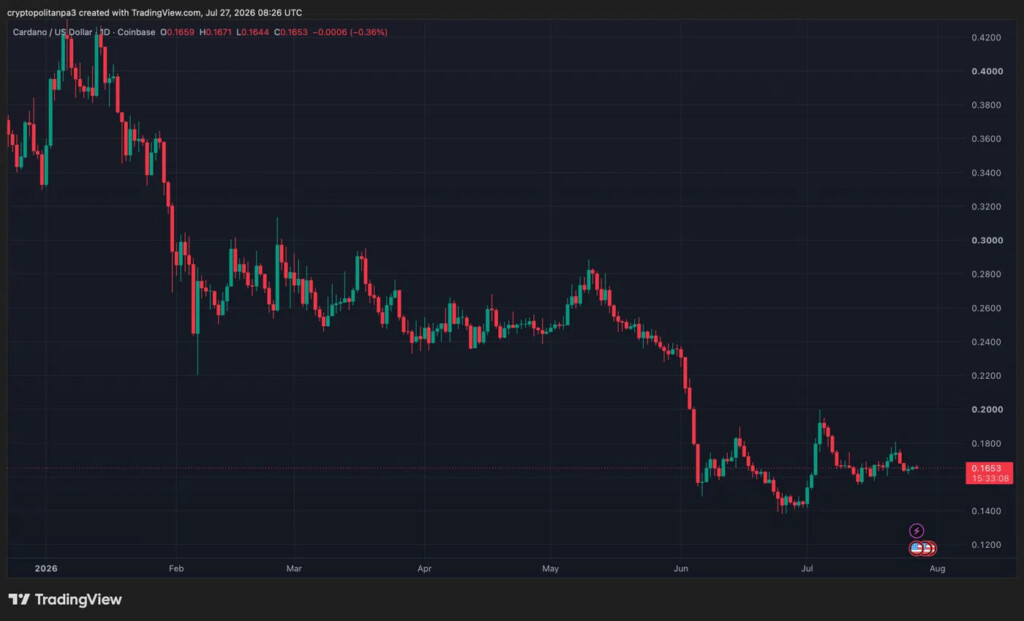
Cardano (ADA) was trading near $0.165 on July 27 as the token remained compressed in a narrow range after a failed July recovery toward $0.200 fully retraced, according to Cryptopolitan’s latest Cardano price prediction.
The article’s key takeaways state that Cardano’s price is expected to surpass $1.33 in 2026, that ADAUSD could reach $4.72 by 2029, and that Cardano might reach a maximum price of $4.46 by 2032. Later forecast sections in the same source list lower projected ranges for 2026 through 2032, making the internal inconsistency important context for readers comparing the headline-style targets with the detailed year-by-year tables.
Cardano is a third-generation blockchain platform launched in 2017 by Ethereum co-founder Charles Hoskinson. It is designed for decentralized applications and smart contracts and uses Ouroboros, a Proof-of-Stake consensus mechanism. Cardano’s two-layer architecture separates transactions from smart contracts, a design intended to support scalability and flexibility. Its native cryptocurrency, ADA, is used for transaction fees, staking, and governance, giving holders a role in decisions affecting the platform’s development.
Cardano technical analysis
Cryptopolitan said ADA was down 0.36% at $0.165, continuing to trade inside a tight $0.155-$0.175 range. The article said the failed July recovery to $0.200 had fully retraced, while both the one-day and four-hour timeframes showed indecision and reduced volume.
Both the 1D and 4H charts were described as confirming that the broader 2026 downtrend remained intact. ADA had given back most of its July bounce, and buyers had not pushed the price above the $0.175 resistance zone.
According to the analysis, a move above $0.175 would be needed to indicate renewed bullish momentum heading into August, while a loss of $0.155 would risk a quick return toward June’s lows near $0.140. In technical analysis, those levels matter because repeated failures at resistance and repeated tests of support can define the short-term trading range until volume or a catalyst forces a break.
One-day chart: ADA holds near $0.165 after failed $0.200 breakout
On July 27, Cardano traded at $0.1653, down 0.36% for the day, while continuing to consolidate near 2026 lows after its brief recovery to $0.200 faded. The one-day structure was described as deeply bearish, with ADA down more than 60% from its January peak of $0.42.
The price was trapped in a $0.155-$0.175 range. Cryptopolitan said the day’s marginal red candle reflected continued indecision and limited conviction from both buyers and sellers. The $0.155 horizontal support level was described as critical. A daily close below $0.150 was said to risk a return toward June’s lows near $0.140, while any meaningful recovery would require a confirmed close above $0.180 to shift short-term momentum.
Four-hour chart: ADA remains flat after rejection from $0.200
On the four-hour chart, ADA traded at $0.1649 on July 27 and was flat at 0.00%. The article said the price was compressing in an extremely tight range after the failed July move to $0.200 fully retraced.
The four-hour structure was described as reflecting ADA’s 2026 decline, from January’s $0.42 peak to a prolonged move lower, June’s $0.140 capitulation, and a July bounce that surrendered most of its gains. ADA was locked between $0.160 and $0.175, with small candles reflecting indecision and low volume. The $0.155 level was identified as the key support below. A four-hour close above $0.175 would indicate renewed buying interest, while losing $0.155 would risk a return toward June lows near $0.140.
Near-term outlook
Cryptopolitan said ADA was at a familiar and concerning point based on the 1D and 4H charts. The $0.155-$0.175 compression zone had been a recurring feature of July, with the price bouncing toward $0.200, facing rejection, and returning to current levels without clear directional conviction.
The article described the most likely short-term scenario as continued sideways trading between $0.155 and $0.175 while the market waits for a catalyst. It cited the OpenUSD stablecoin launch and anticipation around a GADA ETF as positive fundamentals, while noting that they had not been sufficient to sustain the price above key resistance. For Cardano, those developments sit alongside broader ecosystem questions because stablecoin availability, exchange-traded product discussions, developer activity and governance outcomes can all affect how investors assess network utility beyond short-term chart levels.
A break above $0.175 followed by a hold above $0.180 would signal that buyers were gaining control heading into August, according to the analysis. A breakdown below $0.155 would risk a quick return to June lows near $0.140 and potentially lower levels. The article said the next 48-72 hours were important for ADA’s July monthly close.
Why Cardano was down on the day
The source said ADA was down on the day based on both charts. The 1D chart showed a 1.42% decline, with the price falling from an open of $0.16498 to $0.16262 and touching a low of $0.16104. Cryptopolitan said this showed July recovery momentum fading after the failed rejection at $0.200.
The 4H chart was nearly flat at +0.04%, with ADA at $0.16293. The article characterized this as micro-consolidation at depressed levels rather than evidence of strong buying interest. Overall, the source said the brief July recovery had stalled, sellers were defending the $0.165-$0.175 zone, and buyers were showing little conviction heading into late July.
Investment and long-term questions
Cryptopolitan described Cardano as presenting a mixed investment profile. It said Cardano is a third-generation blockchain that aims to address scalability issues and improve security through Proof-of-Stake. The article noted that some analysts predict significant price increases by 2030, while others caution that ADA remains high risk because of cryptocurrency market volatility. It also said Cardano’s future performance remains uncertain and depends on market conditions and technological development.
On whether Cardano can recover, the article said recovery potential depends on market sentiment and adoption. It added that projected price growth in 2026, potentially reaching $1, had strengthened confidence in ADA’s outlook.
On whether ADA can reach $5, the source said the level appeared achievable relative to past prices, noting that Cardano’s all-time high was around $3.10 and that $5 would require a move about 60% above that peak. It said a strong bull run and significant adoption could drive the unit price to $5.
On whether ADA can reach $10, the source described the target as a long shot. It said Cardano’s all-time high was around $3.10 in 2021, meaning $10 would be more than triple that peak and more than 13 times current prices. The article said such a move would require major adoption and a bull run beyond what was seen in 2021.
On whether ADA can reach $50, the source used conflicting language, saying the level was “extremely likely” while also stating that ADA’s current supply of around 35 billion tokens would imply a market capitalization of approximately $1.75 trillion and that such valuations do not typically occur for altcoins even in major crypto bull markets.
For 2040, the article said any Cardano price forecast is highly speculative and depends on adoption, regulation, technological progress, and macroeconomic conditions. It said that if Cardano continues to develop smart contracts, decentralized applications and blockchain efficiency, it could see broader adoption and higher prices. Some optimistic projections were described as suggesting ADA could reach double-digit prices, possibly $10 to $50 or more, while a bearish scenario involving regulatory hurdles and competition could make it difficult for ADA to maintain high valuations.
For 2050, the source said the outlook is also highly speculative. It said Cardano’s price could appreciate significantly if blockchain adoption grows and Cardano successfully scales its smart contract ecosystem, while adding that the eventual number remains unknown.
The article said Cardano has a positive long-term outlook because of its technological development and growing ecosystem. It cited the platform’s focus on scalability and partnerships with institutions, while adding that long-term success depends on regulatory scrutiny and challenges tied to developer engagement.
Cardano Foundation welcomes OpenUSD launch
The Cardano Foundation welcomed the launch of OpenUSD, a stablecoin described as built for the internet economy, and named Brale as its official launch partner on the Cardano blockchain.
OpenUSD was introduced by Open Standard on June 30 and is designed to serve businesses operating in the digital economy. The Cardano Foundation said it was also exploring additional integration options beyond the initial Brale partnership. The announcement had more than 110,800 views, 245 retweets and 1,000 likes, according to the source.
We welcome the announcement of OpenUSD and our partner @brale_xyz as a launch partner. We are exploring other integration options also and will share more in due course. — Cardano Foundation (@Cardano_CF) July 2, 2026
We welcome the announcement of OpenUSD and our partner @brale_xyz as a launch partner. We are exploring other integration options also and will share more in due course.
Stablecoins are commonly used in crypto markets for payments, settlement and trading pairs, so Cardano’s stablecoin integrations are relevant to the network’s practical use even when they do not immediately translate into sustained ADA price strength.
Cardano price prediction for July 2026
Cryptopolitan’s July 2026 forecast for Cardano placed ADA between $0.1206 and $0.1775, with an average of $0.1528. The forecast was linked to steady network development, including smart contract improvements and scaling upgrades.
The article said growing use of Cardano-based DeFi, NFTs and governance projects supported moderate bullish sentiment, while cautious market conditions and slow institutional momentum could limit faster price expansion and keep ADA within the projected range.
Cardano price prediction for 2026
For 2026, Cryptopolitan said ADA could reach a maximum price of $0.3517, with an average trading price near $0.3027 and a minimum price of $0.2536.
Cardano price predictions for 2027-2032
For 2027, Cardano’s price was forecast to reach a low of $0.0973. Analysts cited by the source said ADA was expected to decline and could reach a maximum of $0.1253, with an average forecast of $0.1113.
For 2028, the Cardano price forecast placed ADA at a minimum of $0.2313. The source said ADA could reach a maximum of $0.2925, with an average forecast price of $0.2619. It attributed this expected move to network upgrades, DeFi expansion and institutional integration strengthening ADA’s utility and demand.
For 2029, detailed market projections and historical trend analysis put Cardano at a minimum of $0.6142, a maximum of $0.8839 and an average price of $0.749.
For 2030, the forecast said ADA could bottom near $0.2764, reach highs around $0.3695 and average $0.3229, based on technical evaluation and market trends.
For 2031, the price of one Cardano was expected to rise slightly from previous years, reaching a minimum of $0.368, a possible peak of $0.4407 and an average of $0.4043.
For 2032, the ADA price forecast ranged from a minimum of $0.5928 to a maximum of $0.7499, with an average of $0.6713. The source said this outlook was supported by Cardano’s ecosystem maturity, large-scale enterprise integration and growing global adoption of decentralized applications built on the network.
Cryptopolitan’s Cardano projection
Cryptopolitan’s own projection said ADA could reach $0.35 in 2026. By 2027, the article said Cardano’s price could trade at a maximum of $0.51.
Cardano historic price sentiment
The source’s historical price section said ACH launched near $0.02 in 2020, surged to $0.1975 in August 2021, and then slid below $0.10 by the end of that year. During 2022 and 2023, it fell to $0.0133, later rebounded toward $0.049 and remained volatile. In 2024, it dropped to $0.0145, recovered above $0.02 and briefly reached $0.0397 in December. Early 2025 saw swings between $0.016 and $0.040 before weakening again toward $0.020 by mid-year. Late 2025 into early 2026 brought heavy losses to $0.0070-$0.0078, followed by stabilization near $0.0082. This section appears to refer to ACH rather than ADA, and is therefore separate from the Cardano-specific history that follows in the same source.
For Cardano, the source said ADA traded between $0.36 and $0.38 in early January 2026 as buyers attempted to stabilize the price after a December decline and defend support in the mid-$0.30s. By late January into February 7, the price slipped toward about $0.33-$0.34, showing continued corrective pressure and consolidation near a key support zone.
Cardano traded around $0.40 on Jan. 7, 2026, but declined steadily through the month, falling to about $0.29 by Feb. 1 as selling pressure increased across the broader altcoin market. The price briefly recovered afterward, rising from about $0.25 on Feb. 5 to around $0.27 on Feb. 7.
ADA began March near $0.29, attempting to stabilize after a sharp decline. The source said small consolidation candles formed near that level, while a brief 5.8% surge occurred on March 13 as broader crypto markets rallied. The recovery lacked strong follow-through, and the price remained below all major moving averages throughout the month.
By late March, Hyperliquid’s HYPE token had flipped ADA in market capitalization on March 18, adding bearish sentiment, according to the source. ADA then dropped 4.8% on March 25 as part of a worldwide market sell-off and closed the period around $0.24 by April 3, a decline of about 17% over the month.
ADA entered April 1 near $0.24 after losing about 17% through March. The move was attributed to broad market selling and bearish sentiment, with the month’s forecast range placed between $0.2251 and $0.3252. By May 2, ADA was virtually flat near $0.25 after consolidating in a narrow range, with 50% green days and 1.96% price volatility.
ADA entered May 2 trading around $0.25, near multi-month lows after a prolonged downtrend from January highs near $0.44. The source said bears remained in control and that the token struggled to hold above the $0.24-$0.25 support zone during the month.
By June 2, ADA had fallen further to about $0.23, down 2.56% on the day. Cryptopolitan said this followed the Cardano Foundation’s cancellation of its 2026 annual summit after a funding vote failed, which it said added negative sentiment and pushed ADA toward its lowest levels since 2020.
ADA opened June 2026 near $0.235 and then posted a 40% monthly decline. The source attributed the move to broad crypto market weakness, Federal Reserve hawkishness, a SecondFi exploit that drained $2.4 million worth of ADA from 374 wallets, and broader ecosystem concerns. The decline pushed the price to a 2026 low near $0.140 by late June.
By July 2, ADA traded at $0.1546, stabilizing after closing June at $0.1453 with RSI deep in oversold territory at 12.11. The source said whale wallets accumulated during the selloff, increasing their supply share from 37.66% to 38.13%, which it described as a potential early signal of accumulation at depressed levels.

