Cardano Slips Below $0.19 as Bearish Derivatives Data Signals Further Losses
Key Takeaways
- •Cardano traded around $0.188 on Tuesday after slipping below a rising support trendline that now acts as resistance near $0.218.
- •ADA's long-to-short ratio stood at 0.8248, approaching its lowest reading in more than a month, indicating short positions outnumber long positions.
- •Cardano's funding rate turned positive at 0.0097%, showing that some traders still maintain leveraged long exposure despite the overall bearish tilt.
- •CryptoQuant data recorded large whale orders alongside overheating signals and sell-side dominance in both ADA's spot and futures markets.
- •ADA trades below its 50-day EMA at $0.216 and 100-day EMA at $0.215, with an RSI near 30 and a slightly negative MACD, leaving it vulnerable to a decline toward the next major support at $0.155.
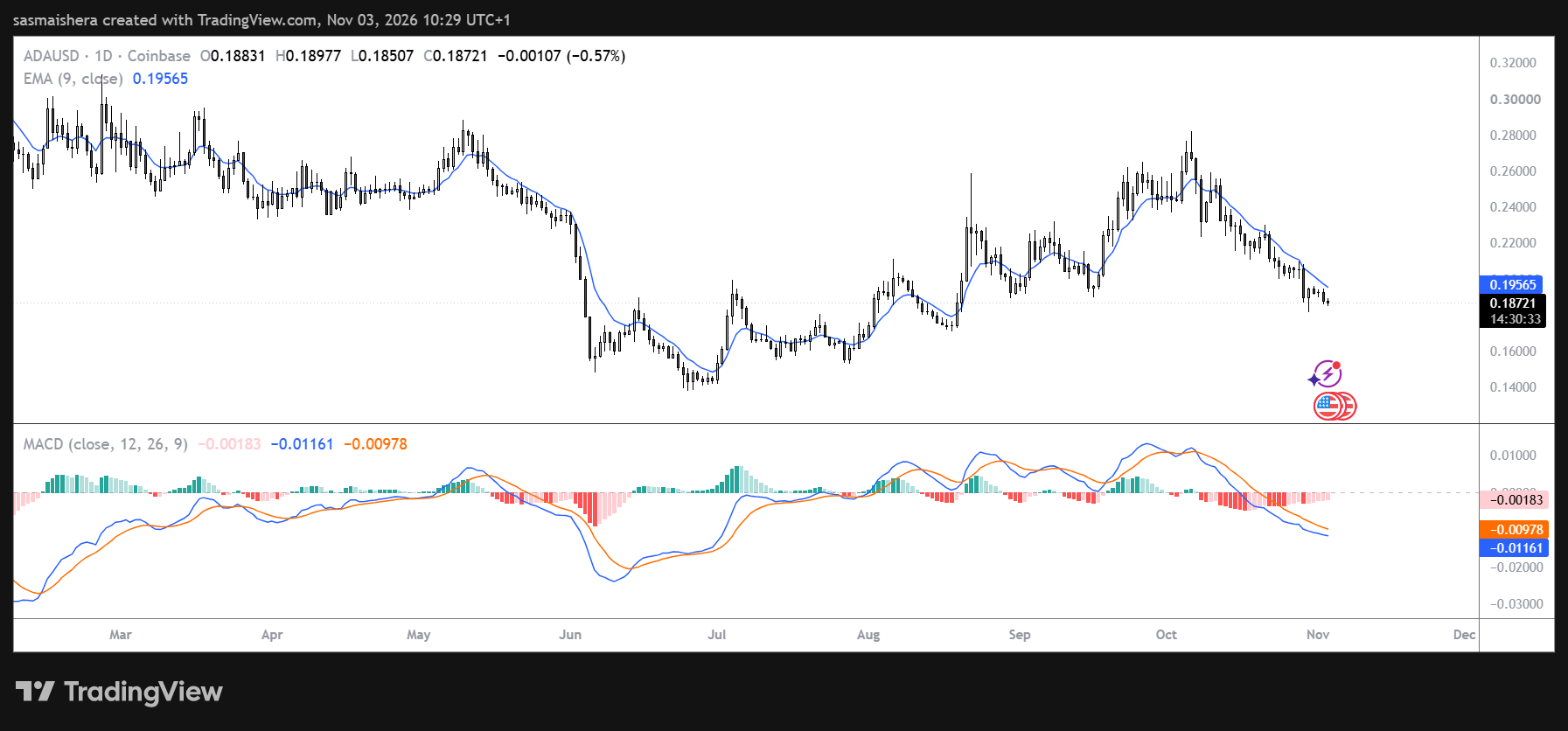
Cardano (ADA) remained under pressure on Tuesday, trading around $0.188 after losing an important support level in the previous session. The asset has struggled to attract buyers, and weakening technical indicators suggest that its recent correction may not yet be over. Cardano itself is a proof-of-stake blockchain platform, and its native token has long ranked among the largest cryptocurrencies by market capitalization.
Derivatives data paint a mixed picture. While Cardano's funding rate has returned to positive territory, its long-to-short ratio shows that bearish positioning remains dominant. On-chain and trading activity indicators, meanwhile, point to continued selling pressure, leaving ADA vulnerable to further losses unless buyers can reclaim key resistance levels.
Derivatives Data Show Traders Remain Cautious
Cardano's derivatives market is showing signs of uncertainty as traders weigh the possibility of a price recovery against the risk of another decline.
According to CoinGlass, ADA's long-to-short ratio stood at 0.8248 on Tuesday, approaching its lowest reading in more than a month. A ratio below 1 indicates that short positions outnumber long positions in the measured market, suggesting that more traders are positioning for a decline than a recovery. The latest reading reflects a cautious outlook, particularly as ADA continues to trade below several important technical levels.
Funding rates, however, suggest that bullish traders have not completely abandoned the market. Cardano's funding rate turned positive on Tuesday, reaching 0.0097%. Funding is a mechanism specific to perpetual futures, the most heavily traded type of derivatives contract on crypto exchanges, where it is periodically exchanged between the two sides of the market. Positive funding means that traders holding long positions are paying those with short positions to maintain their leveraged exposure, indicating that some market participants remain willing to bet on a potential rebound despite the broader weakness in ADA's price.
The divergence between the two indicators suggests that traders remain divided over Cardano's next move. While the long-to-short ratio reflects a bearish tilt, positive funding shows that demand for leveraged long exposure persists. Such mixed positioning can contribute to volatility, particularly when sudden price movements force leveraged traders to close their positions. For now, however, the derivatives data offers little evidence of a decisive shift toward bullish sentiment. A long-to-short ratio climbing back toward 1.0, combined with sustained positive funding, would be among the earliest observable signs that positioning is turning less bearish.
Whale Activity Adds to Selling Pressure
Beyond derivatives positioning, Cardano's spot and futures markets are also showing signs of weakness. According to CryptoQuant's market summary, both markets have recorded large whale orders alongside indicators of overheating and sell-side dominance.
The presence of large orders suggests that major market participants remain active, although the accompanying selling pressure points to a cautious trading environment. Whale activity can exert considerable influence on price movements, especially during periods of weak liquidity or heightened volatility. When large orders appear alongside sell-side dominance, they can amplify concerns about further downward pressure. CryptoQuant's overheating signals also suggest elevated market activity, which may leave ADA more vulnerable to sharp price swings.
Taken together, these indicators suggest that sellers continue to hold an advantage despite the positive funding rates seen in the derivatives market. However, whale orders alone do not confirm that large holders are selling their existing ADA holdings; a clearer picture would require additional data on exchange flows and wallet activity. Until buying demand strengthens, current market conditions could make it difficult for Cardano to establish a sustained recovery.
ADA Risks Further Decline Toward $0.155
Cardano trades around $0.187 on Tuesday, with its daily technical structure continuing to favor sellers. The cryptocurrency has slipped below a previously rising support trendline, which now acts as resistance around $0.218. Losing this trendline has weakened ADA's price structure, suggesting that buyers are struggling to defend levels that previously supported the market.
Cardano is also trading below its 100-day Exponential Moving Average (EMA) at $0.215 and its 50-day EMA at $0.216. Exponential moving averages weight recent prices more heavily than simple moving averages, which makes them quicker to reflect shifts in trend direction. Both moving averages sit well above the current price, forming a resistance zone that could limit recovery attempts.
Momentum indicators reinforce the cautious outlook. The Relative Strength Index (RSI), a momentum oscillator scaled from 0 to 100, is hovering near 30, placing ADA close to oversold territory. Although this suggests that selling pressure may be becoming stretched, it does not necessarily mean that a recovery is imminent, as cryptocurrencies can remain near oversold conditions for extended periods when bearish momentum is strong. Meanwhile, the Moving Average Convergence Divergence (MACD) remains slightly negative, indicating that sellers continue to dominate despite signs of weakening momentum.
On the upside, Cardano faces its first major resistance between $0.215 and $0.218. This area brings together the 100-day EMA at $0.215, the 50-day EMA at $0.216, and the former ascending support trendline near $0.218. A sustained recovery above this zone would be an encouraging sign for buyers and could open the door to a move toward $0.236. Beyond that, the 200-day EMA near $0.239 represents another important obstacle. If bullish momentum strengthens enough to clear these levels, ADA could extend its recovery toward the horizontal resistance at $0.245, followed by the higher barrier at $0.299. Such a move, however, would require a meaningful improvement in buying demand and broader market sentiment.
On the downside, the next major support level identified on the chart stands at $0.155. A continued decline toward this area would represent a significant extension of the current correction. The $0.155 level could attract buying interest, although a sustained rebound would depend on whether demand is strong enough to absorb the prevailing selling pressure.
This article originally appeared on CoinJournal.

