Cardano holds above $0.22 as falling futures open interest signals risk of further losses
Key Takeaways
- •Cardano traded above $0.2200 on Monday after losing roughly 12% over the past week and more than 10% so far in October.
- •Cardano futures open interest dropped to $465.87 million from $549.14 million within a week, an approximately 14.5% decline indicating reduced leveraged exposure.
- •Perpetual futures funding rates stayed positive at 0.0032%, with longs paying shorts, suggesting some traders remain positioned for a rebound.
- •Whale positioning was mixed, as wallets holding more than 100 million ADA edged up to 15.99% of supply while the 10–100 million cohort fell to 38.11%.
- •ADA remains below its 50-day EMA near $0.2290 and 200-day EMA near $0.2395, with an RSI around 41 reinforcing the bearish technical outlook.
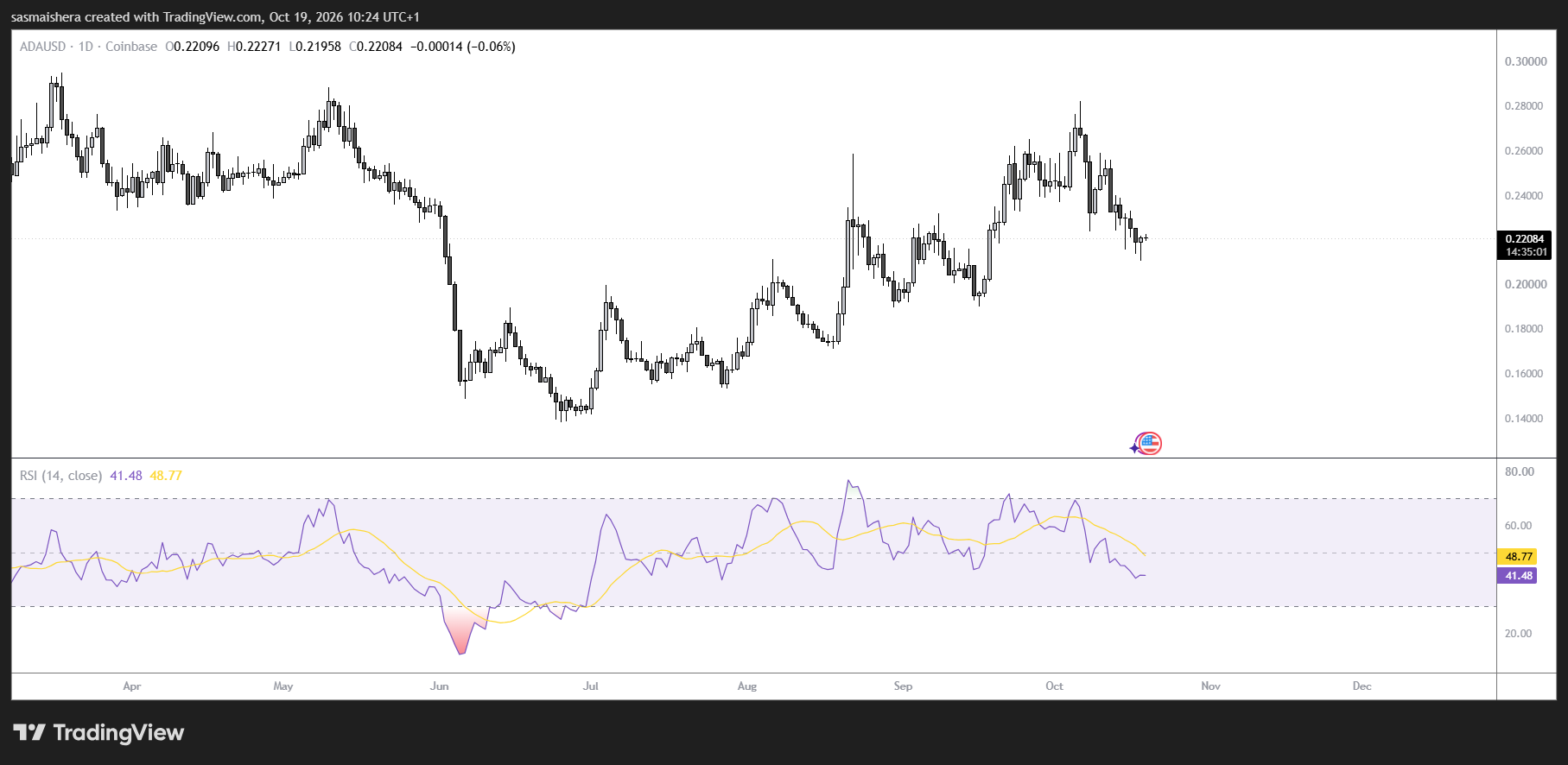
Cardano (ADA), the native token of the proof-of-stake Cardano blockchain, held above $0.2200 in Monday trading as buyers worked to steady the price following a decline of roughly 12% over the past week. The token has shed more than 10% so far in October, and weakening derivatives activity, combined with subdued positioning among large wallets, points to limited conviction behind a sustained recovery.
The daily chart remains under pressure after last week's break below trendline support near $0.2321. With ADA trading beneath its key moving averages, sellers continue to hold the near-term advantage.
Futures open interest falls as leveraged exposure recedes
Data from CoinGlass, a cryptocurrency derivatives data platform, shows that Cardano futures open interest declined to $465.87 million on Monday from $549.14 million a week earlier — a reduction of approximately 14.5% in the notional value of outstanding contracts. Open interest tracks the total notional value of derivative contracts left open and is a common gauge of leveraged activity in the market.
The drop indicates reduced derivatives exposure, though it does not prove that retail traders alone are exiting the market. Falling ADA prices can shrink dollar-denominated open interest, while voluntary position closures and liquidations can also contribute to the decline.
Perpetual futures funding rates remained positive at 0.0032%, meaning long positions were paying shorts in the tracked market — a modest tilt that suggests some traders are still positioned for a rebound. Funding levels alone, however, do not signal excessive leverage. Even so, a further price slide could place vulnerable long positions under strain and trigger additional forced selling.
Whale wallets show only modest shifts
On-chain figures indicate that large holders have made only limited changes to their exposure. According to Santiment, an on-chain analytics provider, wallets holding more than 100 million ADA accounted for 15.99% of circulating supply, slightly higher than the 15.95% recorded the previous week. Meanwhile, the cohort holding between 10 million and 100 million ADA 38.11% of supply, down from 38.27%.
Supply shares held by wallets of this size are tracked closely because such holders can trade in amounts large enough to affect market liquidity. The opposing movements here paint a mixed picture rather than a clear accumulation trend. They also do not, on their own, establish whether tokens were sold, transferred between wallets, or simply migrated across holding categories. Taken together with the lower futures exposure, the figures offer little evidence of renewed buying conviction.
Technical outlook remains bearish
ADA continues to trade beneath its 50-day exponential moving average (EMA) near $0.2290 and its 200-day EMA around $0.2395 — moving averages that weight recent prices more heavily and are widely used to frame trend direction. The loss of trendline support near $0.2321 compounds the weak structure, leaving several layers of resistance overhead.
Momentum indicators reinforce the bearish bias. The Moving Average Convergence Divergence (MACD) indicator remains below zero with a negative histogram, while the Relative Strength Index (RSI) hovers around 41, below the neutral 50 midpoint. That reading suggests sellers retain the upper hand, although ADA has yet to reach the conventional oversold threshold of 30.
Without a recovery through nearby resistance, the latest stabilization looks more like a pause within the ongoing correction than confirmation of a trend reversal.
The psychological $0.20 level stands as the immediate downside reference if selling resumes. Below it, the August 30 low near $0.1894 represents the next structural support — a move to that level would imply roughly 14%–15% further downside from the current price area.
On the upside, buyers must first challenge the 50-day EMA at $0.2290. The former trendline support near $0.2321 then presents the next obstacle, followed by the 200-day EMA at $0.2395. A sustained recovery through those levels would help weaken the bearish setup.
Until then, Cardano remains exposed to the risk of further losses as traders assess whether demand can strengthen around the $0.2200 level in the sessions ahead.
Source: CoinJournal

