Cardano Foundation brings ADA to x402 as AI-agent payment facilitator awaits mainnet
Key Takeaways
- •The Cardano Foundation added ADA support to the official x402 SDK, enabling developers to build applications and AI agents that pay for online services using the token.
- •Cardano joins 12 other network types already supported by the kit, including Ethereum-compatible chains, Solana, the XRP Ledger, Algorand, Stellar, Hedera and NEAR.
- •The Java-based payment facilitator passed 166 unit tests and executed one end-to-end transaction on Cardano's pre-production network, but has not yet run on mainnet.
- •The facilitator holds no keys and signs no transactions, so it can only verify payments a payer has already signed and submit them without moving funds independently.
- •Analyst data cited by Cryptopolitan found that as of December roughly 48% of x402 transactions and 81% of volume traced to wash trading, with AI agents making only limited proof-of-concept payments.
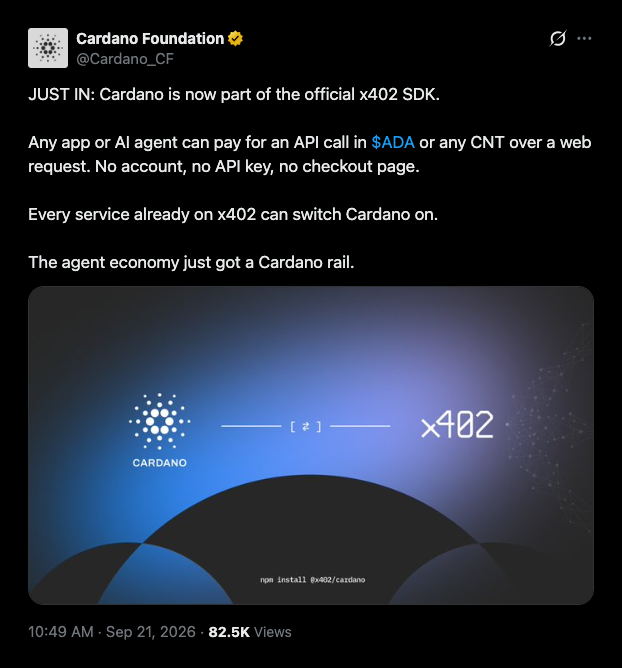
The Cardano Foundation has added ADA support to the official x402 software development kit, furnishing developers with the code required to build applications and AI agents that pay for online services in the token. The payment facilitator behind the integration, however, has so far operated only on a test network and has never been run on mainnet.
With the addition, Cardano is joining 12 other network types already supported in the kit, including Ethereum-compatible chains, Solana, the XRP Ledger, Algorand, Stellar, Hedera, and NEAR.
Coinbase's standard turns HTTP 402 into a checkout
x402 "revives HTTP 402 Payment Required as a real payment flow: a resource server quotes a price, a client pays, and the server serves," according to the facilitator's README. The status code has sat in the HTTP specification for decades, reserved for future use. Coinbase created the standard in 2025 and subsequently handed it over to a Linux Foundation-backed group whose members include Visa, Mastercard, Stripe, Google, and Amazon Web Services — a lineup spanning payments networks and cloud providers.
In a post on X, the Cardano Foundation declared that "The agent economy just got a Cardano rail." According to the post, any service already running x402 can switch on Cardano support.
Java facilitator passes 166 tests and one preprod payment
Foundation engineers began with a specification accepted in June, then developed client and server code alongside a facilitator. The facilitator tells the resource server whether a payment was valid and whether it settled, meaning the server itself needs no blockchain integration.
According to its GitHub repository, the Java-based facilitator has passed 166 unit tests and executed a real on-chain transaction end-to-end on Cardano's pre-production network. It has not yet run against mainnet, and the repository encourages developers to complete a mainnet checklist first.
The facilitator's documentation states that the service neither holds keys nor signs transactions. It can only verify transactions that a payer has already signed and submit them; it cannot move funds on its own.
Cardano support is currently available only in the kit's TypeScript package, @x402/cardano. A Python version is planned next, though no date has been announced — leaving that package, along with the completed mainnet checklist, as the two visible next steps for the integration.
A rail its competitors reached first
Cardano is arriving at a payment rail that rivals accessed earlier. In a review of analyst data published earlier this year, Cryptopolitan found that much of the x402 activity making headlines was exaggerated. That report, citing work by Artemis analyst Lucas and a16z crypto partner Noah Levine, said that as of December roughly 48% of transactions and 81% of transaction volume traced back to wash trading and self-dealing.
Over a 30-day span, x402.org logged $24 million in volume, Allium Labs reported around $3 million, and Artemis put the figure under $2 million. Levine attributed the spread to immature tracking infrastructure. In February, Cryptopolitan reported that AI agents were making only limited, proof-of-concept payments on x402, with most on-chain activity driven by regular trading bots. That gap between headline volume and verified agent payments is the backdrop against which Cardano's new rail arrives.

