Cardano's Dijkstra Phase 1 Targets Late-2026 Mainnet Rollout with Linear Leios
Key Takeaways
- •Linear Leios is the main scaling feature in Dijkstra Phase 1 and adds Endorser Blocks while keeping Cardano’s Praos security model in place.
- •Phase 1 also introduces Nested Transactions and prepares serialization, Plutus, and ledger changes needed for later Dijkstra-era upgrades.
- •Intersect says the Dijkstra Phase 1 target dates have not changed, but final activation could still shift because of testing, ecosystem readiness, and governance votes.
- •The Amaru Rust-based node already validates the chain and is targeting mainnet block production in November 2026, with earlier development milestones in September and October.
- •Input Output plans a constitutional amendment for the new Dijkstra protocol parameters and aims to submit it by Epoch 655, which begins on September 11, 2026.
Cardano developers are preparing Dijkstra Phase 1 for a mainnet rollout before the end of 2026, a release that will bring Linear Leios and Nested Transactions into the network's next ledger era.
Intersect says the agreed scope and target dates for the upgrade have not changed, and the Haskell node team aims to deliver Phase 1 this year. Testing, ecosystem readiness, and governance votes could still shift the final activation date. The roadmap treats the fourth quarter as a code-completion window while developers keep year-end mainnet delivery as their working objective — a distinction that leaves room for community testing without altering the current development target.
The milestone follows Cardano's completion of the van Rossem upgrade in July, which moved mainnet to Protocol Version 11.
Dijkstra Phase 1 Centers on Linear Leios
Linear Leios forms the main scaling component of Dijkstra Phase 1. The design adds Endorser Blocks that can reference additional transactions, with stake-based committees then certifying those blocks while Cardano retains its Praos security model. Praos is the Ouroboros proof-of-stake consensus that has secured Cardano since the Shelley era, so Leios layers its scaling changes on top of that existing security foundation rather than replacing it.
Phase 1 also introduces Nested Transactions and prepares new ledger structures for the Dijkstra era. The roadmap includes serialization changes, Plutus updates, and the protocol parameters required for later upgrades.
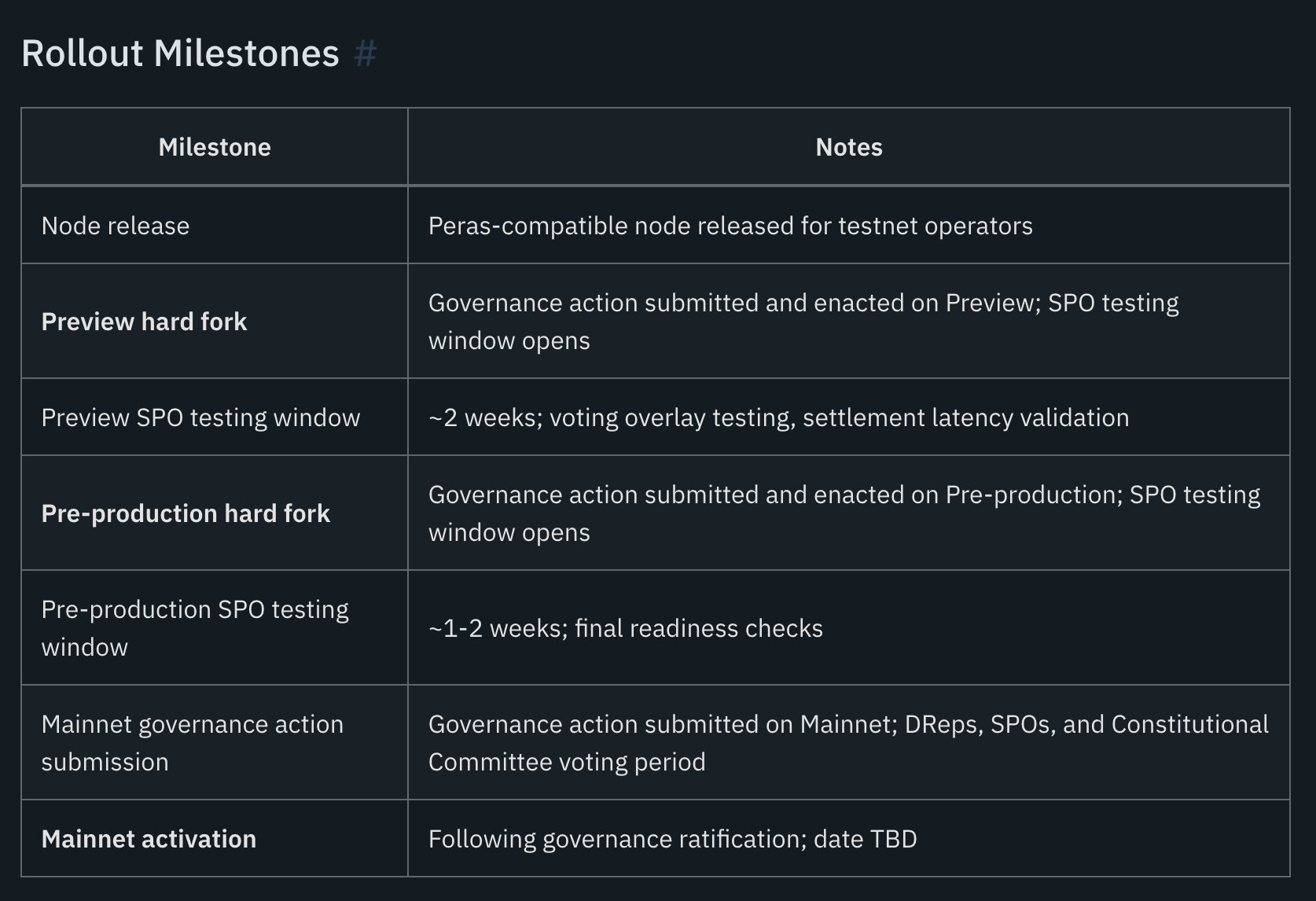
The same release will prepare Cardano for Ouroboros Peras without switching Peras on. Intersect plans a separate intra-era hard fork for Peras during the second quarter of 2027, a phase that will add a voting layer for faster chain settlement.
Intersect says Leios will enter a bootstrapping period after the Dijkstra hard fork. During that stage, stake pool operators will register BLS keys — BLS stands for Boneh–Lynn–Shacham, a signature scheme that supports compact aggregation — before taking part in Leios operations.
Amaru Targets Block Production in 2026
While Dijkstra work continues, Cardano is also expanding its node-client diversity. Multiple independent implementations reduce the risk that a bug in a single codebase can take down the entire network, the multi-client approach Ethereum runs on its execution layer, where several clients operate in production. Intersect says Amaru, a Rust-based node, can already validate the chain, synchronize to its tip, and operate as a relay.
The Amaru team targets mainnet block production in November 2026. Its public milestones place a general block-producer release on September 30, a Dijkstra-compatible release on October 29, and a Leios-compatible block producer on November 26. These dates track development goals rather than guaranteed Cardano activation dates.
Intersect has also invited alternative node teams to join weekly hard fork planning. That work gives Cardano an additional node environment for testing Dijkstra changes and future releases. Intersect has additionally started a readiness tracker covering testnet performance, ecosystem preparation, and deployment checks.
Governance Work Moves Toward September Deadline
Input Output plans a single constitutional amendment covering the new Dijkstra protocol parameters. Cardano's Constitution requires governance guardrails before the community can change new parameters after activation. The Constitution was ratified in early 2025 under the on-chain governance system activated by the 2024 Chang hard fork, and it defines the boundaries for what governance actions may do. The amendment will add those parameters and their permitted ranges without altering governance roles, voting thresholds, or constitutional rights.
Input Output targets submission no later than Epoch 655 — Cardano epochs last five days each — which begins September 11, 2026. Intersect has opened its Constitutional Amendment Portal for community discussion, and the portal had received four initial proposals by August 14. Developers will still need Preview and Pre-production testing before a mainnet governance action.
Hoskinson Releases Anthropies Watermark-Removal Tool
Separately, Cardano founder Charles Hoskinson released an open-source project called Anthropies. He described the project on X as a tool for removing Anthropic watermark signals from Claude output.
Hoskinson wrote, “I'm creating a new skill that can be used with most LLMs to strip out the Anthropic watermark.”
The GitHub project, released under an Apache 2.0 license, targets text wording, C2PA file metadata, and Claude Code attribution trailers. C2PA is a content-provenance standard maintained by a coalition that includes Adobe and Microsoft, and its credentials attach tamper-evident source information to media files.
Anthropic announced text watermarking for future Claude models on August 14. The system changes word-selection patterns without adding hidden characters. Anthropic plans global use at launch and says older models will receive watermarking over the coming months. Text watermarking is one of the main techniques AI developers have proposed for identifying machine-generated output as it spreads online.

