Cardano Rallies Past Long-Term Downtrend Amid Strong Derivatives Inflows and IBC Testnet Milestone
Key Takeaways
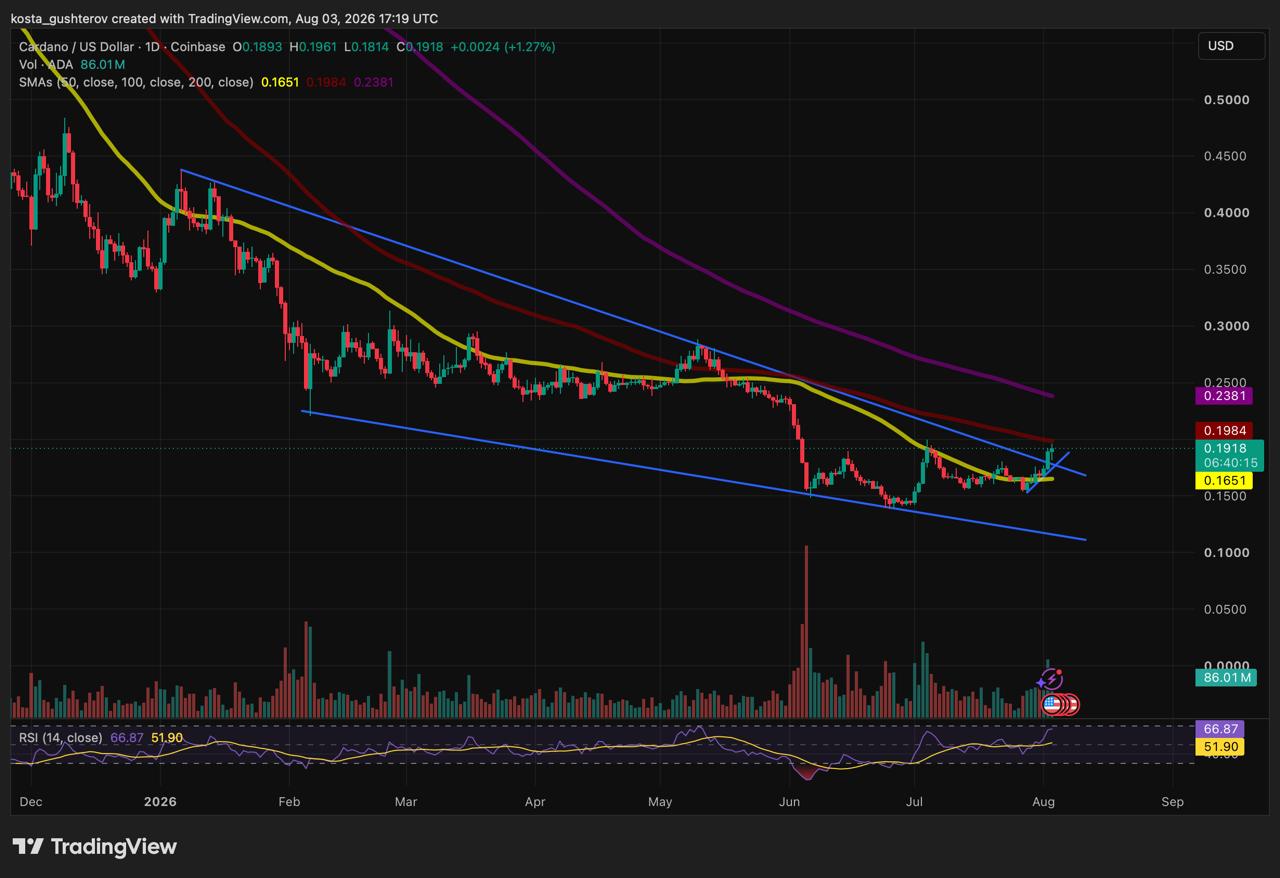
- •ADA traded near $0.19 and approached the 100-day SMA at approximately $0.198, a key resistance zone it has not reclaimed on a daily closing basis since May.
- •Large Cardano addresses increased their balances by more than 240 million ADA over five days, but the data cannot distinguish genuine accumulation from internal wallet transfers or custodial reshuffling.
- •Futures flows into ADA reached approximately $41.8 million over seven days while spot flows remained negative across most time windows, indicating the rally was driven more by derivatives leverage than direct token purchases.
- •The Cardano Foundation activated an Inter-Blockchain Communication protocol connection between Cardano and Injective on testnet, enabling transfers of test tokens but generating no immediate demand for mainnet ADA.
- •The Van Rossem hard fork activated on July 18 as Cardano's first fully on-chain governance-approved upgrade, advancing the network to Protocol Version 11 and paving the way for future enhancements including the Leios scaling solution.
Cardano Tests Key Resistance as Recovery Continues
Cardano's native token ADA climbed to an intraday high near $0.196 before paring gains, settling around $0.19 at the time of writing. The token now sits directly beneath the first major resistance zone of its late-July recovery, with the 100-day simple moving average (SMA) positioned at approximately $0.198 — close to both the previous swing high and the psychologically significant $0.20 level.
ADA continues to print higher lows and higher highs but has yet to secure a daily close above this overhead barrier.
Wedge Breakout Meets the 100-Day SMA
Cardano is holding above several key technical levels: the 0.236 Fibonacci retracement near $0.18, the rising trendline established during the recent advance, and the upper boundary of the falling wedge that constrained price action through much of 2026.
Breaking above the wedge ended a descending trendline that had repeatedly capped Cardano's recovery attempts. Maintaining position above the former trendline and the $0.18 level would preserve this structural improvement through an ordinary pullback.
A daily close in the $0.19–$0.20 range would reclaim the 100-day SMA for the first time since May. However, price would subsequently need to hold above that same zone during a later pullback to confirm that former resistance has flipped into support.
The current session did not achieve that confirmation. ADA approached the moving average before sellers erased a portion of the intraday gain.
A drop below $0.185 would weaken the short-term structure and raise the risk of price falling back inside the wedge. The next support level sits near the 0.382 Fibonacci retracement around $0.175, followed by the 50-day SMA near $0.165. The 200-day SMA near $0.24 remains the next major longer-term obstacle, though it is not an immediate concern while ADA trades below $0.20.
The daily Relative Strength Index (RSI) stood near 67. While momentum remains strong following the recent advance, the indicator is approaching the traditional overbought threshold of 70.
Large-Address Balances Increased by 240 Million ADA
Analyst Ali Martinez, citing Santiment data, reported that large Cardano addresses accumulated more than 240 million ADA over a five-day period. At approximately $0.19 per token, this increase represents roughly $46 million and coincided with a price gain of around 20%.
The figures confirm that balances within the monitored large-address cohort grew. However, they do not indicate whether the tokens were purchased on the open market, withdrawn from exchanges, or transferred between related wallets. Custodial reshuffling and internal exchange operations can also alter address balances without generating new demand.
A simultaneous decline in exchange balances or clearer wallet attribution would offer stronger evidence of genuine accumulation. If the increase reflected purchases followed by withdrawals into long-term storage, less ADA would remain readily available for sale. Internal or custodial transfers, by contrast, would have minimal direct impact on supply or price.
The data therefore signals heightened large-address activity during the rally but cannot establish causation or confirm intent to hold through resistance near $0.20.
Derivatives Flows Outpace Spot Demand
CoinGlass data shows positive ADA futures flows across the latest three-, five-, and seven-day periods, with the seven-day total reaching approximately $41.8 million.
Spot flows, meanwhile, remained slightly negative across the one-, three-, five-, and seven-day windows. Only the most recent four- and eight-hour readings had turned positive.
This indicates that capital entered ADA derivatives more consistently than the spot market during the rally. The flow figures do not reveal whether the new futures positions were long or short. Funding rates, open interest, and long-to-short positioning would be required to determine whether traders were building a clear directional bias.
Rising price alongside stronger futures activity is consistent with leverage contributing to the move, but it does not quantify how much of that activity stemmed from directional buying.
Spot demand carries particular significance because direct purchases require buyers to acquire actual ADA, whereas futures positions can be closed without transacting in the underlying token. A rally heavily reliant on derivatives can reverse rapidly when traders reduce exposure or face liquidations.
The latest positive short-term spot readings represent an improvement, but the longer windows remain negative. Sustained spot inflows would provide the breakout with a less leverage-dependent demand source.
Cardano–Injective IBC Connection Activated on Testnet
The Cardano Foundation announced on August 3 that Cardano and Injective are now connected through the Inter-Blockchain Communication protocol (IBC) on testnet.
JUST IN: Cardano and @Injective_ are now connected via @IBCProtocol_ on testnet. Injective is the first chain with a live on-chain IBC rail to Cardano. $ADA is coming to @Injective_. $INJ is coming to Cardano. Both assets will be usable across the two ecosystems.
— Cardano Foundation (@Cardano_CF) August 3, 2026
The connection currently enables test ADA and test INJ to move between the two development environments and allows developers to explore cross-chain applications. IBC provides a standardized communication layer, reducing the need to construct separate bridges or messaging systems for each application. Originally developed within the Cosmos ecosystem, IBC has become one of the most widely adopted cross-chain communication standards in proof-of-stake networks, and the Cardano connection represents an expansion of that framework into a non-Cosmos chain.
The Cardano Foundation has published a developer guide demonstrating how to transfer test ADA between Cardano's preproduction network and Injective's testnet.
The price rally was already underway before the announcement, meaning this development cannot account for the gains recorded in the preceding days. It also generates no immediate demand for mainnet ADA, as test tokens carry no market value and users cannot yet transfer real ADA or INJ through the route.
Van Rossem Hard Fork and Leios Scaling
The IBC announcement follows the Van Rossem hard fork, which activated on July 18 and advanced Cardano to Protocol Version 11. This marked the network's first hard fork proposed and approved entirely through its on-chain governance process — a capability introduced through Cardano's Voltaire-era governance reforms, which delegated protocol upgrade decisions to delegated representatives and a community voting framework rather than the prior off-chain coordination model.
Van Rossem introduced additional cryptographic functions and expanded capabilities for Plutus smart contracts while preparing the protocol for subsequent upgrades, including the Dijkstra era and Ouroboros Leios.
Leios is currently running on a public testnet, where developers and stake pool operators can evaluate its proposed approach to scaling Cardano's processing capacity without replacing the existing consensus mechanism.
The economic impact of these developments will remain difficult to assess until they reach mainnet. Meaningful evidence will come from applications utilizing the infrastructure, assets transferred through it, available liquidity, and sustained transaction activity.
Disclaimer: This article is for informational purposes only and does not constitute financial or investment advice. Moving averages, Fibonacci levels, wallet balances, exchange flows, and technical patterns do not guarantee future price performance.
Methodology: The analysis references the ADA/USD daily Coinbase chart dated August 3, 2026, including the 50-day, 100-day, and 200-day SMAs, Fibonacci levels, volume, RSI, and the long-term falling wedge. Market positioning is based on CoinGlass futures and spot flows. Large-address balance changes use Santiment data shared by Ali Martinez. Development context draws from Cardano Foundation publications covering the Injective IBC testnet connection, the Van Rossem hard fork, and the Ouroboros Leios public testnet.
Source: Coindoo

