Cardano Price Rises 7% as ADA Tests Key Resistance Near $0.28
Key Takeaways
- •ADA rose nearly 7% on Oct. 10 to around $0.256, outperforming major cryptocurrencies, but the move is a recovery attempt rather than a confirmed trend reversal.
- •Reported trading volume fell 34.86% during the rally, meaning the advance remains unconfirmed until market participation improves.
- •Daily active Cardano addresses reached about 27,500 on Oct. 7 and 27,200 on Oct. 8, roughly 1.7 times September's weekday average, coinciding with CIP-0113 going live on the mainnet on Oct. 7.
- •Cardano's price still fell about 13% from the Oct. 6 close through Oct. 8 despite the address spike, so the Oct. 10 bounce cannot be attributed to CIP-0113 without evidence linking buyers to the upgrade.
- •Analyst Giannis Andreou identifies initial support at $0.22–$0.25 and first resistance at $0.30–$0.35, with a conditional scenario toward $0.90 dependent on clearing each barrier in sequence.
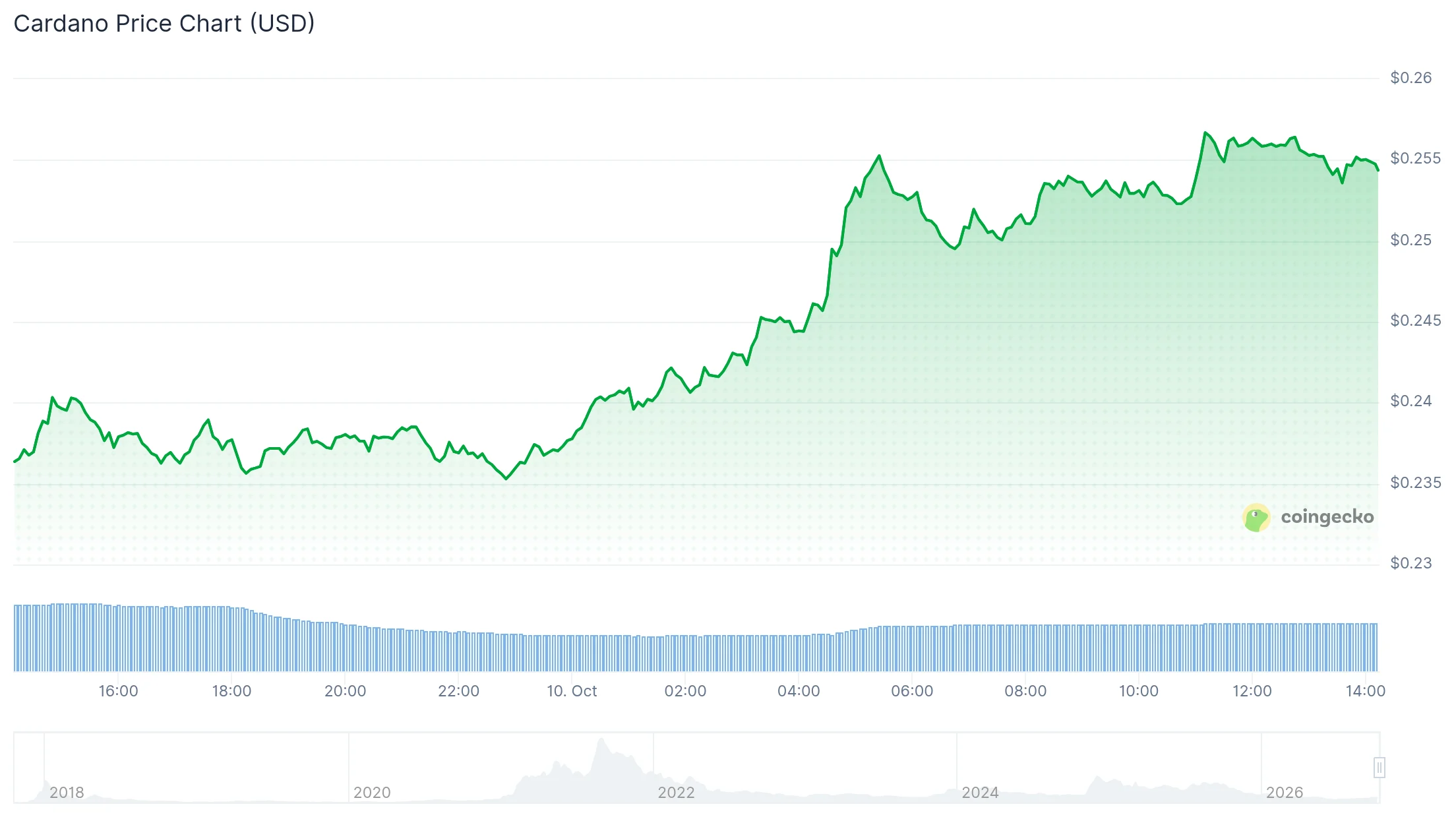
Cardano's native token, ADA, climbed nearly 7% on Oct. 10, trading around $0.256 as buyers stepped back into the market. The advance outpaced major cryptocurrencies during the session and carried the price toward key resistance near $0.28. Because the rebound followed an October decline, it stands as a recovery attempt rather than a confirmed trend reversal.
Reclaimed Levels Form a Short-Term Checkpoint
The move allowed ADA to reclaim its 30-day moving average near $0.2353 and the 50% Fibonacci retracement level around $0.2359. Fibonacci retracements, plotted from the span of a prior price swing, are among the most widely watched reference points in technical analysis, and reclaiming a key moving average is typically read as an early sign of stabilization. Those recovered levels now form a short-term checkpoint, and a drop back below them would weaken the breakout case.
The support band extends from $0.2359 down to $0.2276 and now serves as the first line of defense for the rebound. Holding that area could open the way for a test of weekly Supertrend resistance near $0.2762, a trend-following indicator that plots its line above or below price depending on trend direction. ADA would need a daily close above $0.256 to demonstrate that buyers can sustain the bounce; a rejection at that level would raise the risk of a false breakout.
Thin Volume Leaves the Rally Unconfirmed
Trading volume remains a key concern. Reported volume fell 34.86%, suggesting the rally drew less participation than its price move implied. The figure varies by exchange and measurement window, but the direction argues for caution, and the breakout still lacks strong confirmation until participation improves. Volume acts as the confirmation layer for price moves: advances backed by heavy trading are harder to reverse than those carried on thin turnover.
Elsewhere in the market, the Altcoin Season Index rose 5.17% to 61, pointing to stronger relative demand for alternative tokens, though the measure describes rotation and does not prove that capital will stay in ADA. The index gauges altcoin performance relative to Bitcoin, so the reading describes an ongoing rotation rather than a completed one. Bitcoin traded near $82,800, a level that matters for altcoins, while spot Bitcoin ETFs shed $729 million over two days, adding pressure to risk assets. Flows through those funds are closely watched as a gauge of institutional positioning in crypto. Renewed selling in that environment could again put ADA's support levels under strain.
The immediate test is therefore twofold: defend the reclaimed levels and attract stronger spot volume. Until both occur, the recovery remains technically constructive but unconfirmed.
Active Addresses Jumped After CIP-0113, Then the Price Fell
Network activity had increased earlier in the week. On-chain analytics firm Santiment reported on X that daily active Cardano addresses reached about 27,500 on Oct. 7 and 27,200 on Oct. 8, roughly 1.7 times September's weekday average. The increase coincided with CIP-0113 going live on the Cardano mainnet on Oct. 7.
The new standard enables programmable tokens with issuer-defined rules, meaning transfer conditions can be set by the issuer. According to the Cardano Foundation, issuers can add KYC checks, sanctions screening, and transfer restrictions to native tokens, while wallets and explorers can handle these assets like any other Cardano token. Deploying the standard required no protocol hard fork. Controls of that kind are routine in regulated finance, and making them available at the token layer aligns with the compliance requirements that shape real-world asset tokenization across the industry.
Coincidence, however, does not establish that the upgrade caused the address spike. Santiment's figures also showed Bitcoin and Ethereum addresses at or below September averages. Moreover, active addresses measure participation rather than intent: they cannot reveal whether users bought ADA, moved tokens, staked, or interacted with applications.
Indeed, the Cardano price fell about 13% from the Oct. 6 close through Oct. 8 despite the increase — a divergence showing that network use did not translate into immediate buying pressure. The Oct. 10 bounce arrived after both the activity increase and the selloff, and it should not be attributed to CIP-0113 without evidence linking buyers to the upgrade. A lasting signal would require elevated address counts to persist beyond the launch window.
Analyst Maps a Conditional Path Toward $0.90
Analyst Giannis Andreou identifies initial support at $0.22–$0.25 and first resistance at $0.30–$0.35. In his view, a weekly reclaim of that resistance followed by a successful retest would strengthen the recovery case, with higher zones at $0.40–$0.45 and $0.55–$0.65. The $0.90 scenario depends on clearing each barrier in sequence and therefore remains conditional, while a sustained break below $0.22 would undermine the setup.

