Cardano (ADA) Falls Below Rising Channel as $0.20 Support Comes Into Focus
Key Takeaways
- •Cardano fell about 1.4% to near $0.208 on Oct. 24 after breaking below the rising parallel channel that had guided its recovery from $0.138 to $0.28 since late June.
- •Analyst Ali Charts estimated ADA could decline roughly 20% toward $0.166 if $0.220 remains resistance, while a move back above $0.22 would be the first indication the breakdown was reversing.
- •Momentum indicators showed weakness, with the daily RSI at 36.53 near oversold territory and the MACD line at -0.0068 below its signal line at -0.0035.
- •On-chain activity was mixed, as weekly DEX volume fell about 28.6% to $6.76 million and stablecoin supply declined 1.7%, while transactions above $1 million rose from around 24 to 51.
- •Development advanced with Praos2 merged into the main branch and Node 11.2 expected to include Dijkstra hard-fork features, while the 21Shares Cardano ETP recorded estimated weekly net outflows of $181,450.
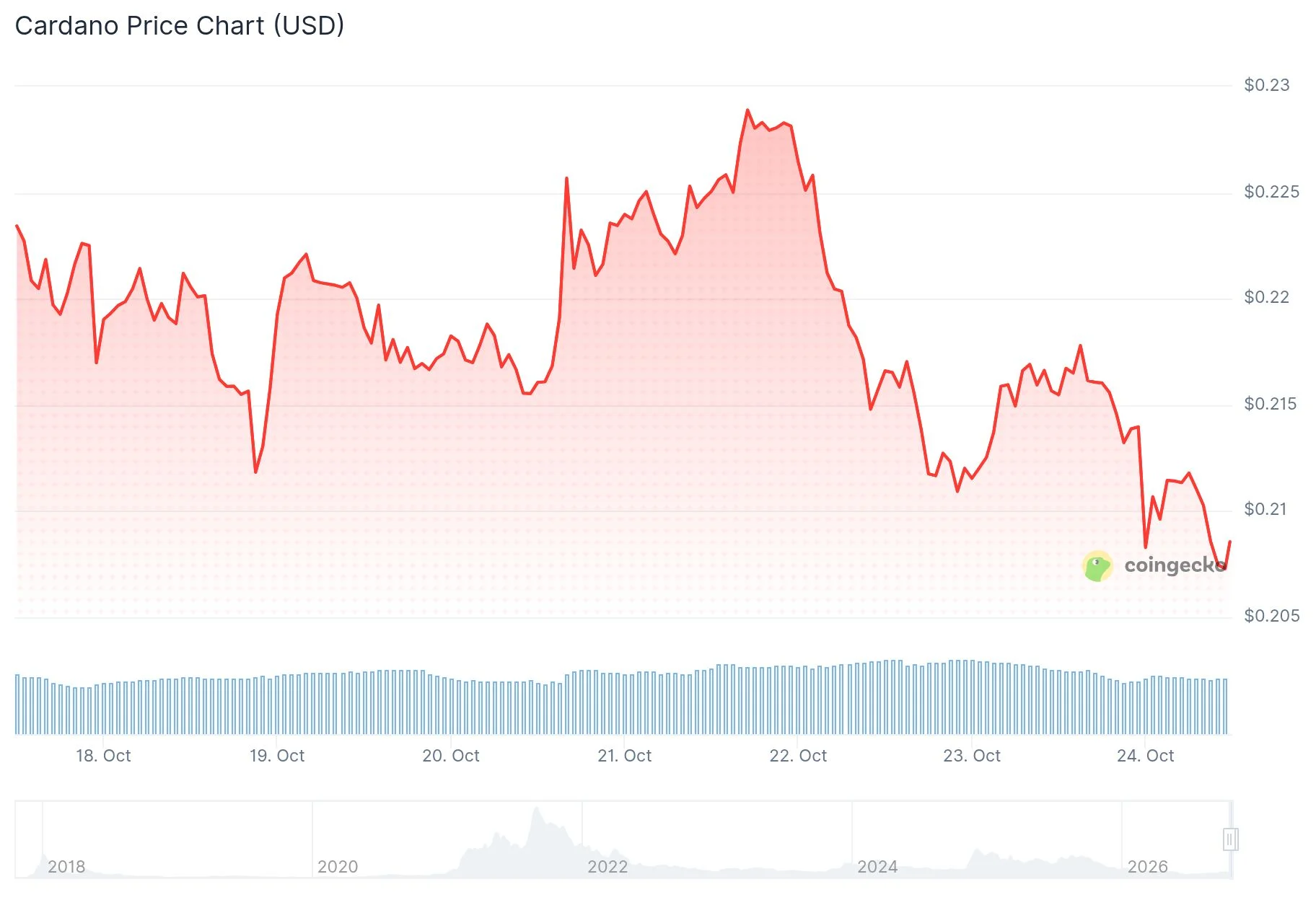
Cardano (ADA) was trading near $0.208 on the Oct. 24 Coinbase daily chart after another decline pushed the token below a rising channel that had guided its recovery since June. ADA was down about 1.4% at the time of reporting.
The token opened near $0.2106 and reached approximately $0.2122 before falling to roughly $0.2062 and recovering slightly. The $0.20 level is now the first major support area identified in the analysis.
Analyst Ali Charts described the move as a confirmed breakdown. Since late June, ADA had traded within a rising parallel channel that carried the token from a low of $0.138 to a high of $0.282. A rising parallel channel is formed by two upward-sloping trendlines that frame higher lows and higher highs, and chart analysts generally read a sustained move below its lower boundary as a sign that the preceding recovery has lost strength. Ali Charts said a sustained break below the channel’s lower boundary could lead to a deeper correction. If $0.220 remains resistance, the analyst estimates that ADA could decline about 20% toward $0.166 — a technical scenario tied to the $0.220 resistance level rather than a forecast.
CARDANO BREAKDOWN CONFIRMED Since late June, Cardano has been trading within a rising parallel channel that took $ADA from a low of $0.138 to a high of $0.282. Now, Cardano appears to have broken below the channel’s lower boundary, signaling that a deeper correction could be… pic.twitter.com/dhXqI3Ldhp — Ali Charts (@alicharts) October 24, 2026
ADA chart analysis
The break below the channel’s lower boundary is the main change visible on the daily chart. ADA had used that trendline as support throughout its recovery from June through October. The former support zone around $0.215 to $0.22 could now act as resistance.
Momentum indicators remain weak. The daily relative strength index (RSI) was 36.53, placing it near oversold territory but still above the 30 threshold. The MACD line stood at -0.0068, below its signal line at -0.0035, a configuration indicating bearish momentum in the reported analysis.
Market participants are watching $0.20 as the immediate level to hold, with $0.18 and $0.16 identified as lower levels. A move back above $0.22 would be the first indication that the breakdown was being reversed. Round-number levels such as $0.20 are widely treated by traders as psychological reference points, which is one reason they draw attention as potential support.
On-chain and ETF data
Cardano’s on-chain data was mixed. DeFi total value locked stood near $59.7 million, while stablecoins on the network totaled about $69 million, according to DefiLlama:
Total value locked and stablecoin supply are among the metrics commonly used to gauge liquidity and activity on a blockchain, so movement in either is often watched for shifts in user engagement.
Over the preceding 24 hours, the network recorded about 14,360 active addresses and 29,001 transactions. Decentralized exchanges processed approximately $1.05 million during the same period. Weekly DEX volume was $6.76 million, down roughly 28.6% over seven days, while stablecoin supply declined about 1.7%.
Large-wallet activity increased during the period. Transactions worth more than $1 million rose from around 24 to 51, according to TokenPost. Those transfers do not indicate whether large holders were buying or selling.
Cardano does not have a standalone U.S. spot exchange-traded fund. Grayscale withdrew its registration for a proposed Cardano ETF in August. Because the filing had not become effective, the withdrawal did not represent an SEC rejection.
Outside the United States, the 21Shares Cardano ETP (AADA) recorded estimated net outflows of $181,450 over seven days. Its 30-day flow remained slightly positive at approximately $33,740, according to ETF Llama. Net flows into exchange-traded products are frequently used as a gauge of investor demand, though any single week of flow data can be volatile.
Cardano development
Cardano’s Oct. 23 development report said Praos2 had been merged into the main development branch. Praos2 combines Praos with the Leios overlay. Work was continuing on Endorser Block selection and fetching for Leios. Leios is Cardano’s long-running research effort focused on scaling the network’s transaction throughput, and milestones on that track are often followed as a measure of the platform’s technical direction.
Node 11.2 is expected to include the Dijkstra hard-fork features without Leios. A subsequent 11.3 release is planned to combine Dijkstra with linear Leios. Earlier in October, CIP-0113 programmable tokens went live on mainnet.
The latest reported price data showed ADA holding near $0.208, just above the $0.20 support level. The original report is available from CoinCentral.

