“Unless you no get babe”: Nigerians debate saving on a ₦100,000 salary
Key Takeaways
- •Most young Nigerians interviewed said saving on a ₦100,000 monthly salary is nearly impossible because transportation, food, rent and family support consume the income.
- •Interviewee Toba reported monthly transport costs of ₦60,000 to ₦70,000, meaning up to 70% of a ₦100,000 salary can go toward commuting alone.
- •Some respondents said saving remains possible with discipline or automated deductions, including budgeting as if earning ₦80,000 instead of ₦100,000.
- •PiggyVest's 2025 Savings Report of 26,000 Nigerians found 68% rely on a single income source, while about 30% earn below ₦100,000 and 28% have no income.
- •Only 40% of survey respondents save money each month while 53% save nothing, and more than half begin each month uncertain their income will cover basic living expenses.
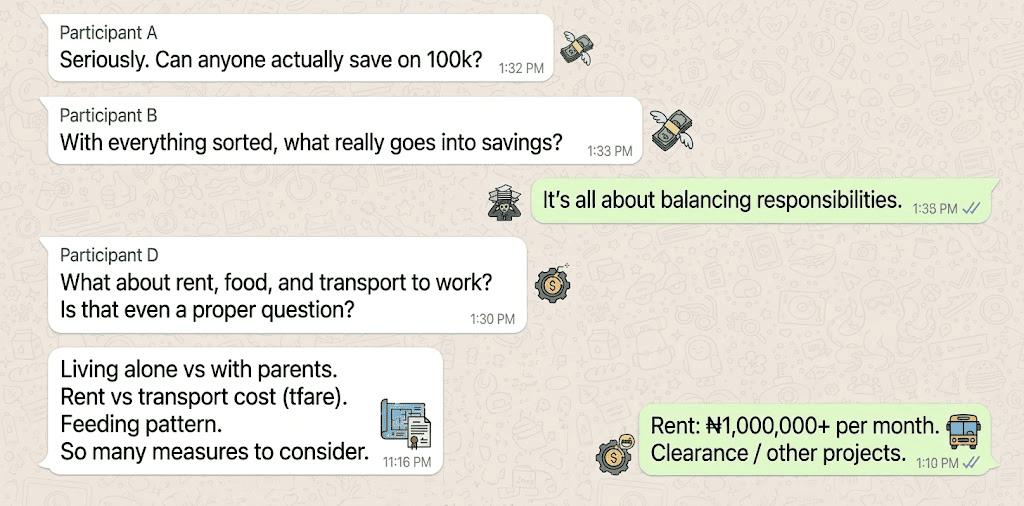
For many workers in Nigeria, payday feels less like a celebration and more like a countdown to financial stress. A monthly salary of ₦100,000 can look manageable at first glance, but once expenses such as transportation, food, internet, rent, family support and the occasional unexpected cost are factored in, the money tends to slip away quickly. That reality has fueled a wider conversation among young Nigerians about what it actually takes to save on such an income. The question carries weight beyond any single paycheck: it touches on how young earners absorb rising living costs, support extended families and plan for emergencies — pressures that survey data suggests are widely shared.
Bolatito, who earns ₦100,000 a month, believes saving is nearly impossible. “I can’t save out of my salary,” she said, describing the weight of constant bills and daily costs. She is far from alone: her experience fed into a broader discussion among young Nigerians about the reality of setting money aside on that salary.
Another respondent, Toba, put the frustration more bluntly. “Guyyyy. Save what? Yourself?” she said — a reaction that captures the mood of many who find the idea laughable when simply getting by already feels like a struggle.
Faysal, another interviewee, said he related to the challenge. Before his current job, he also earned ₦100,000 a month and spent about ₦25,000 on transportation alone. “It was tiring, honestly,” he admitted. For workers who commute daily, transport can consume a huge share of a salary, leaving little for food, rent or other essential bills — a reality that poses a significant challenge for many working-class Nigerians trying to make ends meet.
So where exactly does the ₦100,000 go?
Whether a worker can save depends heavily on personal circumstances. Where a person lives plays a major role, as does whether they live alone or share a space with family. Spending patterns on transportation and food, and the number of people depending on the income, are also significant factors.
Joshua, another participant in the discussion, emphasized those details. “Whether you live alone or with your parents, how much you spend on transportation, and what your eating habits are, there are many things to consider,” he explained. Even so, he remained unconvinced that saving was realistic. “Honestly, I don’t believe anyone can really save on 100,000 naira. It just doesn’t seem possible,” he said.
For someone living alone and paying rent, the financial squeeze can be even tougher. Monthly expenses add up quickly: average earners spend heavily on transportation, food, rent, electricity, data and black tax, and unexpected costs can surface at any moment. Then there is the “girlfriend budget” to consider. Balancing all of these demands makes saving especially difficult.
“Unless you no get babe”
One of the lighter comments in the discussion concerned how much harder saving becomes for people in relationships. One participant joked that it is only possible “unless you don’t have a girlfriend.”
The point is straightforward: a salary rarely covers only the person earning it. There are dates to plan, gifts to buy, outings to enjoy and, in some cases, transfers or allowances to a partner. When meeting one’s own needs is already a battle, adding another person’s expenses to the mix can sharply cut into any remaining capacity to save.
Not every relationship works that way, but the joke highlights a larger truth: many Nigerians carry financial responsibilities that extend well beyond their personal expenses. For some, that means sending money to parents or siblings. For others, it involves supporting a partner, contributing to household bills or stepping in when emergencies arise.
According to the PiggyVest Savings Report for 2025, a survey of 26,000 Nigerians, more than three out of five Nigerian earners either regularly or occasionally deal with what is commonly called “black tax” — the practice of financially supporting and relatives. For earners in that position, saving competes with obligations that exist before any paycheck arrives, which is part of why the debate turns on circumstances as much as willpower.
Some people still save, and the numbers back up the struggle
Not everyone considers saving impossible on a ₦100,000 salary. Faysal, who used to earn that amount, said he managed to put aside a little, emphasizing that the right mindset and discipline can make a real difference.
Boluwatife offered a practical tip: automate savings rather than waiting until the end of the month to save whatever is left. “You just have to find a way to think of it as if you’re earning ₦80,000 instead,” he explained, recommending automatic deductions so the process does not depend on manual effort each month. He added that how much a person can save ultimately depends on individual circumstances. “If I start earning, no matter how much it is, I’m going to save,” he said confidently.
Another respondent agreed that saving is possible, but only under certain conditions — for example, if a person lives with parents, gets free lunch at work and has minimal financial obligations.
Toba’s own figures illustrate how tight the math can be. She said her transportation costs could exceed ₦60,000 in a good month and climb to ₦70,000 in a difficult one. On a ₦100,000 salary, that would leave her with just ₦30,000 to ₦40,000 to cover everything else — meaning as much as 70% of the paycheck can go to commuting before food, rent or family support even enter the picture.
The challenge is not limited to people earning ₦100,000. According to the PiggyVest 2025 Savings Report, about 30% of 26,000 respondents earn less than ₦100,000, while 28% have no income — meaning nearly three out of every five people earn below that threshold or have no earnings at all. The report also found that 68% of Nigerians rely on a single source of income.
Even more striking, only 40% of respondents reported saving money each month, while 53% admitted they save nothing at all. Rising living costs were cited as a significant reason for the lack of emergency savings. For most people, food and groceries were the largest expenses, followed closely by clothing, personal upkeep, utilities, transportation and housing. More than half of those surveyed said they start each month uncertain whether their income will cover their basic living expenses.
That context helps explain why the debate over saving ₦100,000 is not simply a matter of discipline. It is also a question of margins: with most respondents relying on a single income and more than half unsure their pay will cover the basics, the room to save is often used up before the month begins.

