Can You Buy Less Than One Bitcoin? How Fractional Bitcoin Investing Works
Key Takeaways
- •One Bitcoin divides into 100 million satoshis, each equal to 0.00000001 BTC, making fractional ownership possible with purchases as small as a few dollars.
- •Leading exchanges such as Coinbase and Kraken accept fractional Bitcoin purchases, with Kraken's eligible instant purchases starting at $1, €1 or £1 while card and digital wallet purchases carry higher minimums.
- •Percentage gains and losses are identical whether an investor holds 0.001 BTC or 10 BTC, provided both positions are bought at the same price.
- •Grayscale reported on 9 March 2026 that the 20 millionth Bitcoin had been mined at block height 939,999, leaving fewer than one million coins yet to be created.
- •Fixed platform fees, quoted-price spreads and Bitcoin network fees can consume a disproportionate share of small purchases and transfers, making total percentage cost a key consideration for small investors.
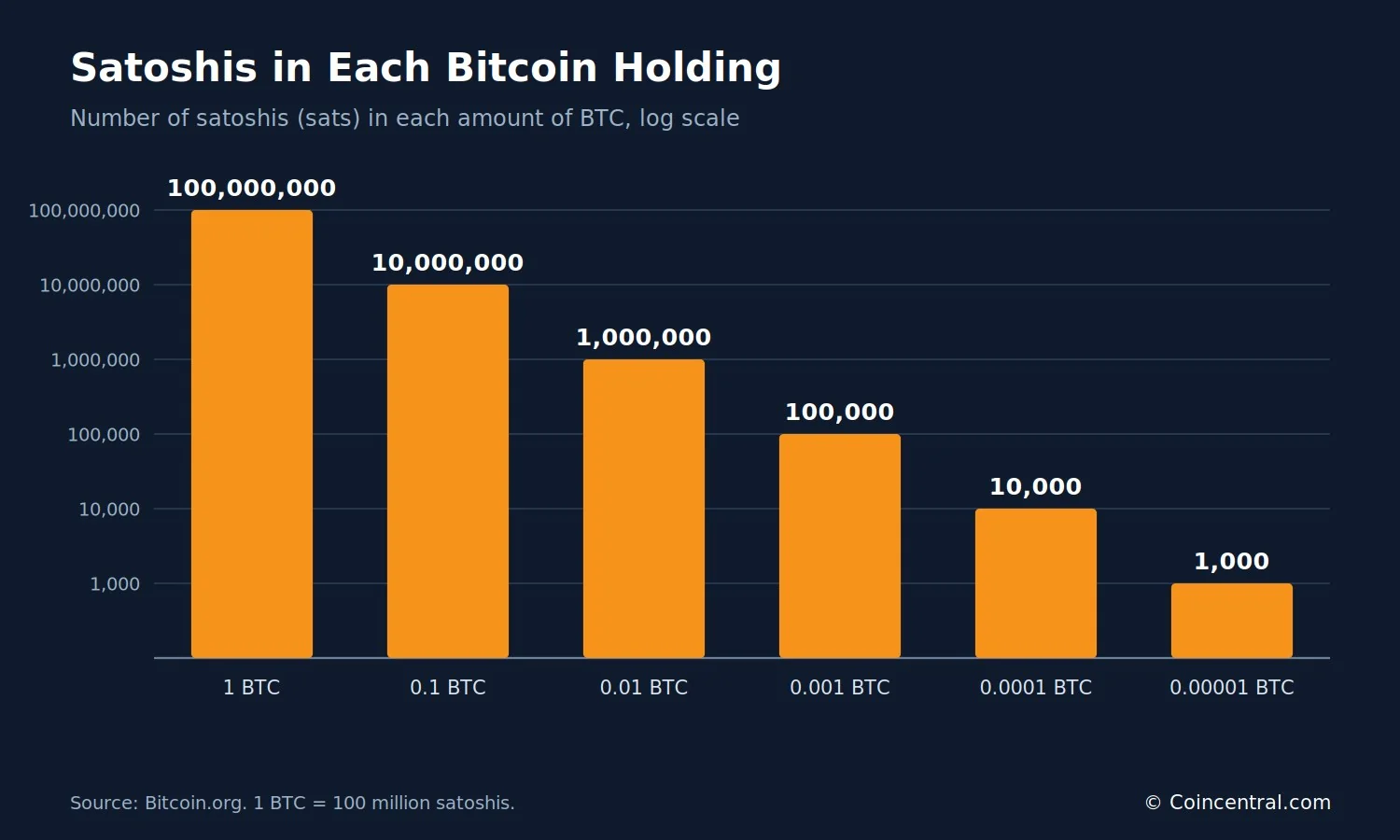
Yes, you can buy less than one Bitcoin. Owning a full coin is not a requirement for investing: Bitcoin (BTC) is divisible into 100 million smaller units, so a purchase worth just a few dollars represents a genuine holding of the asset.
The smallest of those units is the satoshi, named after Bitcoin's creator, Satoshi Nakamoto. One satoshi equals 0.00000001 BTC — one hundred-millionth of a single coin.
Leading exchanges, among them Coinbase and Kraken, accept fractional Bitcoin purchases, although minimum order sizes and fee structures differ across platforms.
Fractions have grown increasingly relevant because Bitcoin's price has risen sharply since 2009. In March 2026, the 20 millionth BTC was mined, leaving fewer than one million coins still to be created.
Scale does not change proportional outcomes: an investor who puts in $100 experiences exactly the same percentage price movements as one who commits $100,000, provided both buy at the same price. This guide explains how fractional Bitcoin works, what it costs, and which risks remain.
Note: this article was updated on 29 October 2026. All price examples use a hypothetical Bitcoin price of $100,000 and are not live market quotes.
What Is Fractional Bitcoin and What Is a Satoshi?
Fractional Bitcoin simply means owning less than one complete BTC. Unlike a physical asset that is difficult to divide, Bitcoin was designed from the outset to handle very small amounts.
According to Bitcoin.org, each Bitcoin can be divided into 100 million satoshis. The satoshi, often shortened to sat, is the smallest standard unit recorded on the blockchain. Its name honors Satoshi Nakamoto, who published the Bitcoin white paper in October 2008.
The arithmetic is straightforward: 1 BTC equals 100,000,000 satoshis. An investor holding 0.01 BTC owns one hundredth of a Bitcoin, while a holding of 0.001 BTC represents one thousandth.
These fractions are real Bitcoin, not a separate product. They can be stored in compatible wallets, sent between addresses and sold on supported exchanges, and the Bitcoin network makes no distinction between large and small holders.
The ability to measure a single satoshi, however, does not guarantee that an exchange will sell one. Trading minimums, network fees and platform rules can make very small transactions impractical.
How Much Bitcoin Can a Small Amount Buy?
The quantity received depends on Bitcoin's market price and the exchange's minimum order size. Because the price moves throughout the day, the same dollar amount buys a different quantity from one day to the next.
The examples below assume Bitcoin trades at exactly $100,000 and exclude trading fees and spreads.
A $100 investment would purchase 0.001 BTC. If Bitcoin subsequently rose to $150,000, that holding would be worth $150; if it fell to $50,000, the same holding would be worth $50. The percentage gain or loss is identical whether someone owns 0.001 BTC or 10 BTC — the only difference is how much money is invested.
Minimum Purchase Amounts and How to Buy
Bitcoin itself imposes no minimum investment. Exchanges set their own minimums, which can vary by product, payment method and country.
Kraken's support documentation, updated in September 2026, states that eligible customers can make certain instant purchases starting at $1, €1 or £1. Card and digital wallet purchases carry higher minimums, including $10, €10 or £8. Kraken Pro, the platform's order-book service, applies separate minimum order sizes, and a small instant purchase may not qualify as a standard Kraken Pro order.
Coinbase also supports fractional purchases. Its guidance notes that minimums vary by cryptocurrency and payment method, and that customers can view the applicable minimum and any charges before confirming an order.
Buying a Fraction of Bitcoin Step by Step
The process mirrors that of buying a whole coin:
- Choose an exchange. Select a reputable platform that supports Bitcoin in your country, comparing trading fees, payment methods, withdrawal limits and regulatory status rather than the minimum purchase alone.
- Create an account. Most regulated platforms require identity verification before purchases with traditional currency.
- Deposit funds. Options may include bank transfers, debit cards or supported digital wallets; bank transfers can sometimes cost less than card purchases.
- Enter an amount. Locate Bitcoin by its BTC ticker and enter the sum you wish to spend, such as $50, rather than a coin quantity.
- Review the fees. Check the exchange rate, trading fee, spread and the final quantity of Bitcoin you will receive.
- Confirm the purchase. The Bitcoin should then appear in your exchange account, and some platforms allow withdrawal to a personal wallet.
Is a Small Bitcoin Holding Worth It?
A small position can suit investors seeking Bitcoin exposure without committing significant capital. The size of the purchase does not alter Bitcoin's underlying risks: the price remains volatile, and there is no guarantee it will rise.
Fractional investing offers several clear advantages:
- Lower commitment: investors can start with a small amount rather than thousands of dollars.
- Flexibility: purchases can be matched to savings, goals and risk tolerance.
- Gradual buying: a position can be built over time instead of in one transaction.
- Identical percentage returns: a fraction tracks the market price exactly as a full coin does.
- A way to learn: small purchases teach beginners about wallets, trading and costs.
These benefits must be weighed against fees and possible losses. A 50% gain on a $20 investment produces a $10 profit before costs, so small purchases should not be expected to create large wealth.
What Could 0.01 BTC Be Worth?
Consider an investor who buys 0.01 BTC while Bitcoin trades at $100,000. The cost is $1,000, and the value of that holding moves in line with the market: if the price doubled after the purchase, the investor would double their money; if the price fell by half, the holding would lose half its value.
These are scenarios, not price predictions, and they exclude trading fees and taxes. Owning less than one Bitcoin does not reduce percentage volatility — it only limits how much money is exposed.
Can You Eventually Own One Whole Bitcoin?
Yes. An investor could add small purchases until the total reaches 1 BTC. Buying 0.01 BTC each month, for instance, would reach one full Bitcoin after 100 purchases, assuming no sales or deductions.
Buying a fixed quantity differs from investing a fixed dollar amount. At $100,000, 0.01 BTC costs $1,000; at $150,000, the same quantity costs $1,500. The time required to reach 1 BTC therefore depends on future prices and the amount invested, and in real markets the price would move throughout the accumulation period. For many investors, one whole Bitcoin is a long-term goal rather than a short-term one.
What Is Dollar-Cost Averaging in Bitcoin?
Dollar-cost averaging, or DCA, means buying at regular intervals instead of trying to predict the next price move. The investor commits a fixed dollar amount each week or month — for example, $100 on the first day of every month. When the price is lower, $100 buys more BTC; when the price is higher, it buys less.
In the worked example, four purchases leave the investor with 0.00405 BTC at an average cost of roughly $98,765 per BTC, before fees.
DCA removes the need to pick a single entry price. It does not guarantee a profit, and it does not always outperform investing a lump sum — in a prolonged bear market, regular buyers can still lose money.
Can You Automate Bitcoin Purchases?
Yes. Kraken's documentation confirms daily, weekly, fortnightly and monthly schedules, and Coinbase also supports scheduled purchases at eligible intervals. Recurring purchases can carry fees and spreads, so investors should compare those costs with manual buying through an exchange's lower-cost trading screen.
Do Small Bitcoin Purchases Cost More in Fees?
This is one of the central issues for small investors. When a platform charges a fixed fee, the percentage cost climbs as the purchase size shrinks.
Suppose an exchange charges a hypothetical fixed fee of $1 — these are illustrative examples, not the fee schedule of any exchange. A $1 fee on a $10 purchase consumes 10% of the money immediately, whereas a hypothetical 0.5% commission would cost just $0.05 on the same purchase.
Percentage fees are not the only cost. Some platforms build a spread into the quoted Bitcoin price. Coinbase says its simple buy and sell service includes a spread, while Coinbase Advanced uses order-book pricing without the same quoted-price spread. Kraken also discloses trading fees and spreads for its instant purchase service. For small investors, the total percentage cost matters more than the advertised minimum purchase.
Storing, Moving and Holding Fractional Bitcoin
Exchange or Wallet?
Many beginners leave their Bitcoin on the platform where they bought it. This is convenient because the exchange handles custody, but the customer then relies on the platform's security, finances and withdrawal rules.
Self-custody wallets let users control their own private keys, removing some exchange risks while adding personal responsibility: losing the recovery phrase can mean losing the Bitcoin permanently. Blockstream's wallet documentation explains that Bitcoin stays recorded on the blockchain and that the wallet manages the keys controlling it. Hardware wallets keep signing keys offline, while software wallets are generally easier for everyday use. For a very small holding, a hardware wallet could cost more than the Bitcoin it protects.
Network Fees on Small Transfers
Small amounts of Bitcoin can be transferred, but network fees can make doing so uneconomical. Fees pay miners to include a transaction in a block, and they depend mainly on transaction size and network demand — not on the dollar value sent. A $2 network fee represents 20% of a $10 transfer but only 0.2% of a $1,000 transfer, a distinction that matters for people who buy small amounts often and withdraw each purchase separately.
Bitcoin also tracks coins as unspent transaction outputs, known as UTXOs. Many tiny UTXOs can raise future costs, because spending them together requires more transaction data. Blockstream notes that very small UTXOs can become too costly to spend when fees rise.
Bitcoin ETFs Compared With Fractional BTC
Investors can also gain exposure through exchange-traded products. In January 2024, the US Securities and Exchange Commission approved the listing and trading of spot Bitcoin exchange-traded products (ETPs). These products generally hold Bitcoin and issue shares that track its price, allowing buyers to transact through a brokerage account without controlling the Bitcoin directly. Some brokers offer fractional shares, depending on the broker and the product.
In a September 2024 investor bulletin, the SEC warns that spot crypto ETPs are speculative and do not offer every protection of a traditional registered fund. Someone who wants to transfer, spend or self-custody Bitcoin needs actual BTC, while someone seeking price exposure inside an existing brokerage account may prefer an ETP.
Does Bitcoin's Limited Supply Matter for Fractions?
Bitcoin has a maximum supply of about 21 million BTC. On 9 March 2026, Grayscale reported that the 20 millionth coin had been mined at block height 939,999, meaning more than 95.2% of the maximum supply has been issued. The remaining coins will enter circulation slowly through mining rewards, with the final fractions expected around 2140.
A limited supply does not mean investors must compete for whole coins. Each BTC holds 100 million satoshis, providing an enormous number of smaller units. Splitting Bitcoin into fractions does not raise the total supply: buying 0.001 BTC creates no new Bitcoin and only moves ownership of an existing fraction.
Fractional Bitcoin vs Cheaper Cryptocurrencies
Some investors prefer coins with a low price per token because they can buy thousands of units, but the comparison can be misleading. A cryptocurrency with a far lower price per token is not automatically undervalued, nor does it have more room to grow. Token price depends on how many units exist; market capitalization, liquidity, use cases, supply schedules and demand are better points of comparison.
The arithmetic makes the point concrete: buying 10,000 tokens at $0.10 is a $1,000 investment, and buying 0.01 BTC at $100,000 is also a $1,000 investment. If either rises 20%, the gain is $200 before fees. The number of units owned does not change the percentage return.
Taxes and Risks of Fractional Bitcoin
Do You Pay Tax on Fractional Bitcoin?
In many countries, fractional Bitcoin is taxed under the same rules as whole Bitcoin, and the quantity owned does not usually decide whether a transaction is taxable.
In the United States, the Internal Revenue Service treats Bitcoin as property for federal income tax. Buying Bitcoin with dollars does not normally create an immediate taxable gain, but selling it at a profit can create a capital gains tax bill: someone who buys $100 of Bitcoin and later sells it for $150 may have a $50 gain, before transaction costs. Swapping Bitcoin for another cryptocurrency can also be taxable.
Moving Bitcoin between your own wallets is generally not taxable in the US, although using crypto to pay a transfer fee may have separate effects. Rules differ by country, so check guidance for your tax residence.
What Are the Risks?
Fractional ownership makes Bitcoin easier to access, but the main risks remain the same. Bitcoin's price can fall sharply in a short time, and fixed fees can eat into small investments. Other risks include exchange failures, compromised wallets, fraudulent platforms and rule changes.
The SEC warns that crypto investments can be highly speculative and volatile, while the Federal Trade Commission cautions consumers about crypto schemes that promise guaranteed returns. A small purchase is not a guaranteed path to wealth, and the usual principles of diversification and risk management still apply.
Frequently Asked Questions
Can I buy $1 worth of Bitcoin?
Yes. Some platforms support purchases of about $1. Kraken lists a $1 minimum for certain eligible instant purchases, though card purchases usually carry higher minimums.
Can I buy 0.001 Bitcoin?
Yes. A holding of 0.001 BTC equals 100,000 satoshis, and its dollar value depends on the market price.
Can you get rich with a small amount of Bitcoin?
A price can rise substantially, but turning a very small investment into large wealth would take extremely high returns. Those returns are uncertain and should not be assumed.
Is fractional Bitcoin real Bitcoin?
Yes. A fraction of BTC is the same asset as a whole Bitcoin, not a separate coin.
Can you sell a fraction of Bitcoin?
Yes. Supported exchanges let customers sell fractions, subject to minimums, fees and other rules.
Bottom Line
A whole Bitcoin is not a prerequisite for investing in cryptocurrency. Bitcoin divides into 100 million satoshis, so investors can buy fractions worth a few dollars, and major exchanges support fractional purchases, though minimums and fees vary.
Owning 0.001 BTC provides the same percentage exposure to Bitcoin's price as owning a full coin. Fees deserve close attention: a fixed charge can make a very small purchase costly, so comparing total costs matters more than finding the lowest minimum. For most beginners, a sensible approach is to start with an affordable amount, keep fees low and focus on long-term goals rather than the milestone of owning one complete BTC.
Sources
- Bitcoin.org: Bitcoin Frequently Asked Questions — Bitcoin divisibility, satoshis and maximum supply.
- Blockstream: What Is Bitcoin? — Fractional ownership and Bitcoin's monetary structure.
- Kraken (September 2026): Minimum Cryptocurrency Purchase Amounts — Instant purchase minimums and supported payment methods.
- Kraken (October 2026): Cryptocurrency Deposit and Trading Minimums — Platform trading requirements.
- Coinbase: How to Buy Cryptocurrency — Purchase instructions and variable minimum amounts.
- Coinbase: Cryptocurrency Pricing and Fees — Trading commissions, spreads and transaction costs.
- Grayscale Research (March 2026): The Final Million: Bitcoin Supply — Bitcoin's 20 million milestone and remaining issuance.
- Kraken (June 2026): Recurring Cryptocurrency Purchases — Dollar-cost averaging and automated purchase schedules.
- Blockstream: Understanding Bitcoin Transaction Fees — Network fees and UTXO management.
- Blockstream: What Is a Bitcoin Wallet? — Cryptocurrency custody and private key security.
- US Securities and Exchange Commission: Spot Bitcoin Exchange-Traded Products Investor Bulletin — Spot Bitcoin investment products and associated risks.
- Internal Revenue Service: Digital Asset Tax Guidance — Taxation of cryptocurrency purchases and disposals.
- Federal Trade Commission: Cryptocurrency Investment Scams — Consumer protection and investment fraud.
- Bitcoin.org: What You Need to Know Before Using Bitcoin — Wallet security, transaction irreversibility and volatility.
Disclaimer: This article is for educational purposes only and does not constitute financial or investment advice. Bitcoin prices, exchange minimums and transaction fees change. Readers should check current conditions and consider their own financial situation before buying cryptocurrency.
This article originally appeared on Blockonomi.

