Newsom Signs California Law Barring Public Officials From Issuing or Promoting Meme Coins
Key Takeaways
- •California has become the first U.S. state to prohibit public officials from issuing or promoting meme coins under Assembly Bill 1465, signed by Governor Gavin Newsom.
- •The legislation is designed to prevent officials from using their government positions to profit from launching or endorsing speculative tokens.
- •The ban does not stop officials from personally holding cryptocurrency or discussing blockchain policy, nor does it limit ordinary residents from buying, selling, or creating meme coins.
- •Federal scrutiny of tokens tied to political figures earlier in 2025 fueled debate that the California law addresses at the state level.
- •Because California hosts Silicon Valley and a large share of U.S. blockchain activity, the law may influence other states and federal ethics discussions.
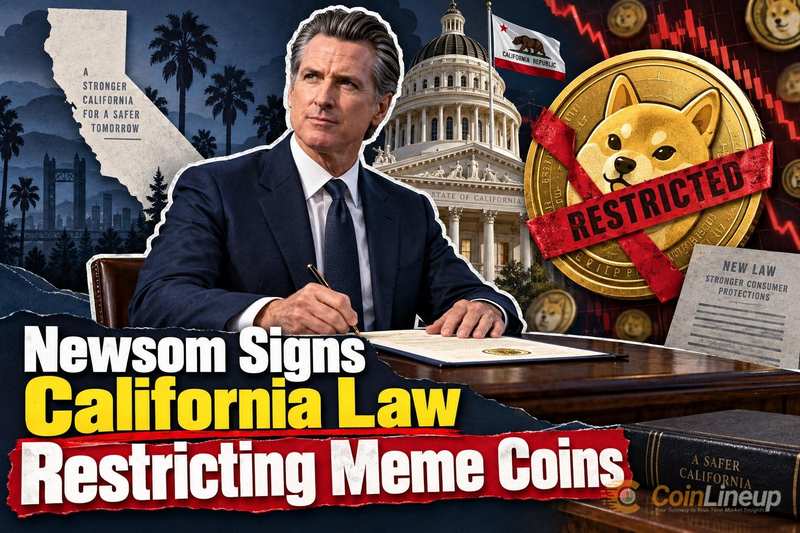
California Governor Gavin Newsom has signed Assembly Bill 1465 into law, making California the first U.S. state to ban public officials from issuing or promoting meme coins. The legislation, available on the California Legislative Information site, targets a specific conflict-of-interest risk: government officials using their public office to launch or endorse speculative digital tokens for personal gain.
The new measure, known as AB 1465, restricts covered officials from issuing meme coins — a category of cryptocurrency, or digital currency, that typically derives its value from internet culture, celebrity association, or social media hype rather than from underlying technology or utility. High-profile examples such as Dogecoin, which began in 2013 as a joke built around an internet meme, helped establish the category's defining trait: value driven by attention rather than fundamentals. The law draws a clear line between public service and token promotion: officials cannot use the credibility or reach of their government role to launch or back a speculative digital asset that could benefit them financially.
Why Meme Coins Create a Unique Ethics Problem for Government
Meme coins differ from other cryptocurrencies in one critical way: their price depends almost entirely on attention and hype. When a prominent public figure promotes one, followers often buy in quickly, driving the price up, while insiders who received tokens early can sell at a profit — a dynamic commonly known as a "pump-and-dump," in which latecomers are left holding tokens whose value can collapse once attention fades.
This pattern has drawn scrutiny at the federal level as well. Earlier in 2025, the launch of tokens connected to political figures sparked debate about whether officials could use their platform to enrich themselves through token markets. According to the bill's legislative record, California's new law addresses that concern directly at the state level.
The restriction carries weight beyond California because the state is home to Silicon Valley, major crypto exchanges, and a large share of U.S. blockchain activity. A rule from Sacramento carries a significance that a similar law from a smaller state might not.
What the Law Does and Does Not Cover
The law targets the act of issuing meme coins, meaning creating and distributing them to the public. It applies to public officials, a category that covers elected and appointed government roles, though the precise scope of covered positions is defined in the bill text itself.
The law does not appear to ban officials from simply holding cryptocurrency or discussing blockchain policy in their official capacity. The restriction is narrower: it targets the active promotion or issuance of a speculative token where an official could profit from public attention. That distinction matters for the many state lawmakers and regulators who may personally hold digital assets as investors, separate from their government duties — similar to how officials can own stocks without being barred from discussing financial regulation.
California has previously passed related legislation targeting meme coin issuance by public officials, making AB 1465 part of a broader state effort to define the boundaries between crypto markets and government ethics.
What Happens Next
With the governor's signature, the law moves to implementation. State agencies will need to clarify which officials fall under the restriction and how violations would be reported or enforced. Those open questions are typical for new legislation and will likely be addressed through regulatory guidance in the months ahead.
The bigger signal may be the precedent itself. Other states that often follow California's lead on tech-related policy may consider similar bills, and federal legislators debating ethics rules for officials involved in crypto policy could also reference California's framework as a model.
For everyday crypto holders, the practical effect is limited. The law does not restrict citizens from buying, selling, or creating meme coins. It draws a boundary specifically around the power and platform that come with holding public office, applying the same logic that prevents officials from using their position for other forms of financial self-dealing.
Disclaimer: This article is for informational purposes only and does not financial or investment advice. Cryptocurrency and digital asset markets carry significant risk. Always do your own research before making decisions.

