California Bans Public Officials From Issuing Meme Coins Under New Newsom Law
Key Takeaways
- •Assembly Bill 2409 bans California public officers and employees from issuing meme coins and prohibits digital asset service from listing official-linked tokens issued on or after January 1, 2027.
- •The law is enforced through civil actions, including injunctions and disgorgement, brought by the attorney general, district attorneys, city attorneys, and county counsels rather than through criminal prosecution.
- •The statute defines meme coins by their meme-based marketing and value drawn from public interest, speculation, or community engagement, so it targets official-linked tokens rather than imposing a blanket ban.
- •The state measure stands as the operative rule on official-linked tokens after the Senate failed to advance the federal Clarity Act, leaving federal crypto ethics provisions unresolved.
- •Newsom separately signed Senate Bill 1208, which extends money-laundering laws to digital asset transactions with seizure and forfeiture procedures, with those expanded provisions set to sunset on January 1, 2032.
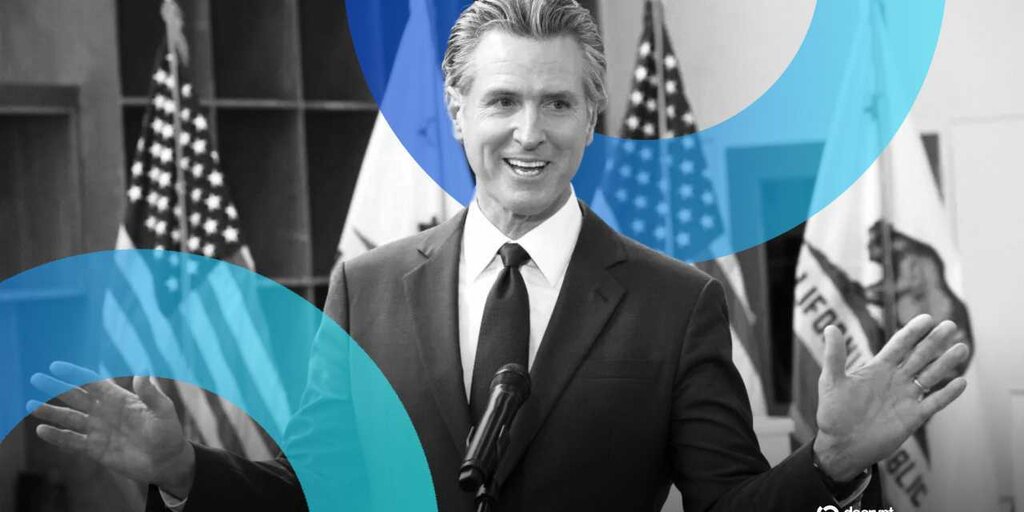
California Governor Gavin Newsom has signed a bill barring public officials in the state from issuing meme coins, adding new restrictions on political figures' involvement in the crypto market.
Assembly Bill 2409 (full bill text), authored by Assemblymember Aino Valencia (D-Anaheim), prohibits California public officers and employees from issuing meme coins. It also bars digital asset service providers from listing certain meme coins issued after January 1, 2027, if the tokens are offered by, or in partnership with, a federal, state or local public official.
In a post on X, the Governor Newsom Press Office announced the signing and framed the measure as a consumer protection step:
BREAKING: @CAGovernor Gavin Newsom just signed new legislation to prevent public officials from issuing meme coins, protect consumers, hold bad actors accountable, and recover money for victims. This comes while the Trump admin displays an unprecedented amount of and… pic.twitter.com/AveSyDJh9x
— Governor Newsom Press Office (@GovPressOffice) September 27, 2026
(Source: @GovPressOffice on X)
The law gives California's attorney general, district attorneys, city attorneys and county counsels the ability to bring civil actions to enforce the restrictions, including seeking injunctions and disgorgement of funds. That enforcement design routes oversight through civil litigation rather than criminal prosecution, and spreads it across several state and local legal offices.
The legislation comes amid growing scrutiny of politicians launching or profiting from crypto tokens, particularly as U.S. President Donald Trump and his family have built a substantial business presence in digital assets. In the X post, Newsom's press office explicitly linked the legislation to Trump's meme coin efforts, accusing the administration of "an unprecedented level of corruption." Newsom himself added in a follow-up tweet that "no official should profit off their office," while calling Trump a "scam."
California targets political meme coins
AB 2409 defines a meme coin as a digital asset marketed on the basis of its association with internet memes, characters, current events or trends, and whose value is primarily derived from "public interest, speculation or community engagement."
The bill specifically prohibits a "public officer or public employee" from issuing one. Its exchange restriction applies to meme coins issued on or after January 1, 2027, when the token is offered by or in partnership with a federal public official or a state or local public officer.
That means the law does not amount to a blanket ban on meme coins in California. Instead, it targets tokens connected to public officials and places obligations on digital asset platforms serving California residents. Because the definition hinges on how a token is marketed and where its value comes from, a token's treatment under the statute turns on those characteristics rather than on a fixed technical category.
Trump and meme coins
The California legislation arrives as federal lawmakers debate whether public officials should be allowed to launch or profit from crypto assets while holding office.
In July, Senator Kirsten Gillibrand (D-NY) renewed calls for legislation prohibiting politicians and their spouses from issuing or promoting digital assets, including meme coins. Her proposal came after Trump disclosed more than $1.2 billion in crypto-related earnings for the previous year, including more than $635 million attributed to his Solana-based TRUMP meme coin.
The issue has also become part of negotiations over the federal Clarity Act. A September version of the bill included provisions that would allow state attorneys general to enforce restrictions on covered officials issuing or sponsoring digital assets, while also requiring covered officials to divest certain crypto interests or place them in qualified blind trusts.
The Senate subsequently failed to advance the Clarity Act through a key procedural vote, leaving the federal ethics provisions unresolved. With those federal provisions stalled, AB 2409 now stands as the operative state-level rule on official-linked tokens in California, and the eventual shape of the Clarity Act's ethics language — including whether state attorneys general keep an enforcement role — remains an open thread ahead of the January 1, 2027 effective date.
Newsom has separately taken action against other ways public officials could potentially profit from information obtained through government service. In March, he signed an executive order prohibiting California public officials and appointees from using inside information to profit on prediction markets, or from helping others do so.
California expands crypto crime enforcement
The meme coin prohibition was one of several pieces of legislation Newsom signed addressing fraud, consumer protection and financial crime.
Senate Bill 1208 (bill text), authored by Senator Tim Grayson (D-Concord), expands California's money-laundering laws to cover transactions involving digital assets. The measure also establishes procedures for law enforcement to seize and forfeit digital assets connected to specified crimes, with provisions for distributing forfeited assets to victims. The expanded digital-asset provisions are scheduled to sunset on January 1, 2032.
Under the law, law enforcement can seek warrants to seize digital assets, wallets or accounts when there is probable cause that the assets represent criminal proceeds or were used to facilitate specified crimes. The legislation also provides procedures for freezing assets and resolving claims to seized property.
For the crypto industry, the rules add another state-level layer to an increasingly complicated U.S. regulatory landscape, even as Congress continues to debate a federal market-structure framework and regulators step in with rulemaking. Firms serving California users also have fixed dates to track: the listing restriction covering tokens issued from January 1, 2027, and the sunset of SB 1208's expanded digital-asset provisions on January 1, 2032, which builds a scheduled review point into the state's crypto crime framework.
Newsom's office has previously positioned crypto ethics as part of a broader campaign against conflicts of interest involving the Trump administration. In December 2025, the governor launched a website criticizing Trump's pardons of crypto figures including Binance founder Changpeng Zhao, Silk Road creator Ross Ulbricht and BitMEX executives.

