California Sends Plug-and-Play Balcony Solar Bill to Governor Newsom's Desk
Key Takeaways
- •California's legislature passed SB 868, the Plug and Play Solar Act, and sent it to Governor Gavin Newsom, who has 30 days to act on it.
- •The bill removes the need for a utility interconnection agreement before plugging in portable solar panels, though an Assembly amendment sunsets that exemption on January 1, 2030.
- •Systems must be certified by UL or an equivalent national testing lab, shut off automatically within seconds during grid outages, and are capped at 1,200 watts — a higher limit than Germany's 800-watt allowance.
- •Renters, who account for roughly 44% of California households, would gain access to household solar that permanent rooftop installations cannot provide.
- •Utah became the first state to remove balcony solar barriers in 2025, eight other states have since passed similar laws, and New York also has a balcony solar bill awaiting its governor's signature.
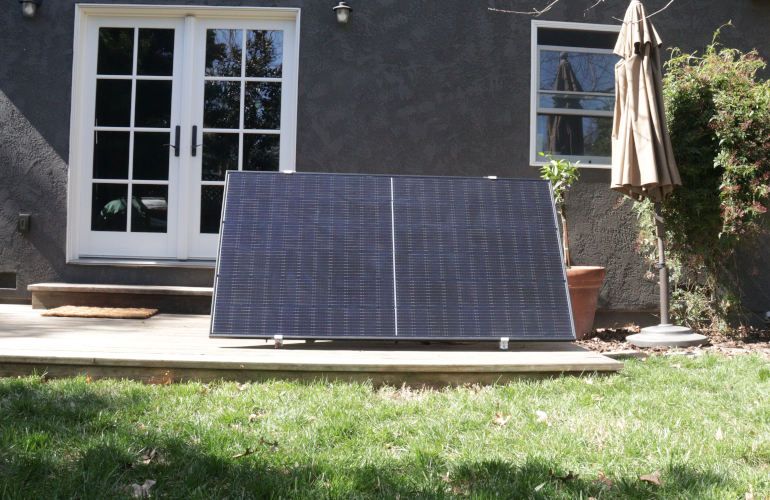
The California legislature has passed a bill that would allow residents to install balcony solar systems, sending the measure to the governor's desk for final action.
Senate Bill 868, known as the Plug and Play Solar Act, would eliminate the red tape that has kept small-scale systems out of apartments, condos and single-family homes. The legislation would also ensure the systems comply with strict safety standards.
The bill is authored by Sen. Scott Wiener (D-San Francisco) and sponsored by the Environmental Working Group (EWG) and the Abundance Network. SB 868 heads to Gov. Gavin Newsom for his signature upon concurrence by the Senate.
"This is the most exciting clean energy idea around," said Bernadette Del Chiaro, EWG's senior VP for California. "With this bill, California is poised to fling its doors wide open to a real, tangible affordability solution for everyday consumers."
The affordability pitch lands in a state where residential electricity rates rank among the highest in the contiguous United States.
Under SB 868, homeowners and renters could buy portable solar panels from retailers and plug them in without first having to obtain an interconnection agreement from their utility. The cost and time involved in securing that agreement has been a barrier to greater deployment of these systems. For renters — who make up roughly 44% of California households — plug-and-play units would offer a path to household solar that conventional rooftop installation has not, since they cannot put permanent panels on homes they do not own.
The Assembly amended the bill with a provision sunsetting the interconnection exemption on Jan. 1, 2030 — language sought by the utilities — but SB 868 gives the market four years to take off, and the Legislature has the opportunity to remove the sunset in the future.
The bill would also ensure plug-and-play systems meet strict safety standards. All systems must be certified by UL or an equivalent national testing lab. To protect utility workers and prevent electrical hazards, systems must automatically shut off within seconds if the grid goes down. System size is capped at 1,200 W — enough to power everyday appliances such as fridges, lights, Wi-Fi routers and AC units — a ceiling more generous than the 800 W allowance Germany set for its own plug-in solar devices.
California is not the first state to remove barriers to balcony solar. Utah became the first in 2025, and so far eight other states have enacted laws to do the same. California joins New York as another state with a balcony solar bill sitting on the governor's desk. The approach also has a track record abroad: Germany, where the concept is known as the "Balkonkraftwerk" — literally, balcony power plant — has hundreds of thousands of the systems installed and moved in 2024 to simplify their registration. Newsom has 30 days to take action on SB 868.
"California may not be the first out of the gates but we are the biggest prize," said Del Chiaro. "If Gov. Newsom signs this bill into law, the size of our market will radically transform and accelerate the adoption of this brilliant new way to tackle both climate change and energy affordability."
Source: Solar Power World | SB 868 – California Legislature
