Why Crypto Experts Say Buying and Holding Bitcoin Beats Trying to Time the Market
Key Takeaways
- •Bitcoin's annual performance is concentrated in a handful of trading days, with most of the year spent moving sideways, according to Bitwise Europe research head Andre Dragosch.
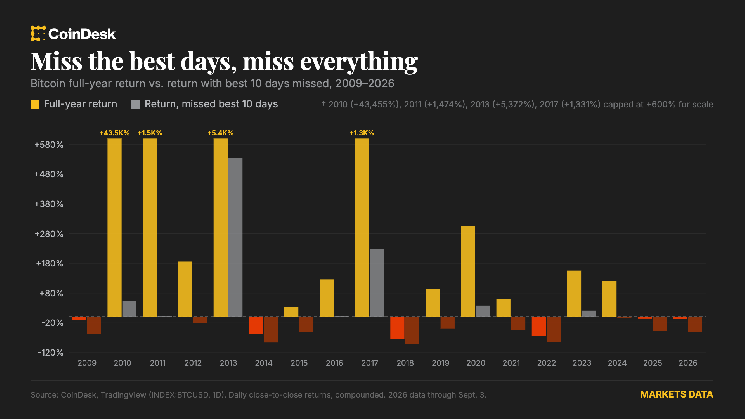
- •In 2026, bitcoin is down roughly 9% for the year, but excluding its five best-performing days would leave it down 36%.
- •In 11 of the past 18 years, removing just the 10 best trading days was enough to turn a winning year into a losing one, including 2019, when a 94% gain became a 40% loss.
- •2013 and 2017 were exceptions, remaining solidly positive even after removing the 20 best days, reflecting broad rallies rather than concentrated spikes.
- •Experts conclude that time in the market beats timing the market, as consistently capturing bitcoin's few explosive up days is nearly impossible.
Bitcoin ($BTC, $79,620.75) trades around the clock, seven days a week, giving traders and fund managers the ability to react to news and manage risk at any hour — including weekends and holidays. Yet of the roughly 365 trading days in a year, only a handful ultimately determine whether the year ends as a win or a loss. That is why some experts argue it is likely better to buy and hold than to attempt to time bitcoin's price swings for gains.
Consider 2026 as an example. Bitcoin fell about 9% for the year — a mediocre loss, not a disaster. But excluding the five best-performing days of the year, bitcoin would be down 36%.
Andre Dragosch, head of research at Bitwise Europe, said this is simply bitcoin's nature. "Bitcoin is actually a relatively boring asset," he told CoinDesk. "The majority of performance is usually made in a handful of days, while most of the time it moves sideways and consolidates."
The argument echoes a long-running debate in traditional finance, where studies of equity markets have similarly found that missing a small number of the best trading days can sharply reduce long-run returns — a point often cited in favor of passive, buy-and-hold strategies over active trading.
A pattern spanning bitcoin's history
This is not a one-off event. Going back through bitcoin's history to its earliest days in 2010, when it traded for mere cents, gains have consistently been concentrated in just a handful of trading days.
In 11 of the last 18 years, removing just the 10 best trading days out of roughly 365 was enough to turn a winning year into a losing one.
In 2019, bitcoin finished the year up 94%, meaning prices nearly doubled. Take away the 10 best days of that year, however, and it was down 40%. Similarly, 2011 delivered a staggering 1,474% return — but strip out its 10 best days and that shrinks to just 2.2%, essentially nothing.
There were a few exceptions. In 2013 and 2017, bitcoin stayed solidly positive even after removing the 20 best days from each year — genuinely broad, grinding rallies rather than a few violent spikes.
According to Dragosch, this pattern partially gave rise to the "c'mon, do something" meme — crypto Twitter's running joke about bitcoin sitting dead still for weeks on end.
Time in the market, not timing the market
The tendency for gains to cluster in just a handful of days makes precise market timing brutally difficult. A trader would need to enter a position exactly as a rally is about to begin, because missing the mark by even a week or two often means missing almost the entire move.
The stakes of that difficulty are compounded by bitcoin's well-documented volatility: sharp drawdowns between those clustered rallies mean a mistimed exit can lock in losses that are hard to recover when the market is flat for long stretches. The concentration of returns also has practical implications for fund managers and ETF issuers, whose products are judged on annual performance and who cannot easily ride out extended sideways periods the way a self-directed long-term holder can.
The conclusion, per Dragosch, follows naturally: time in the market beats timing the market, since consistently catching those few explosive days is close to impossible. Put another way, buying and holding bitcoin for the long haul is far easier — and often far more rewarding — than trading in and out of it or running a fund whose performance is judged year by year.
Source: CoinDesk
