Burns & McDonnell partners with Gritt on robotic solar installation aids
Key Takeaways
- •Burns & McDonnell and Gritt are partnering to assess AI-powered robotics for utility-scale solar projects.
- •The companies said the technology is intended to improve safety, predictability and efficiency on construction sites.
- •Gritt’s systems can be attached to standard construction equipment and are designed to automate tasks such as placing solar arrays, pouring concrete and laying rebar.
- •The partners said they have tested the technology at multiple utility-scale solar sites over the past year.
- •Gritt’s robotics are built for outdoor construction conditions and are designed to learn continuously from field operations.
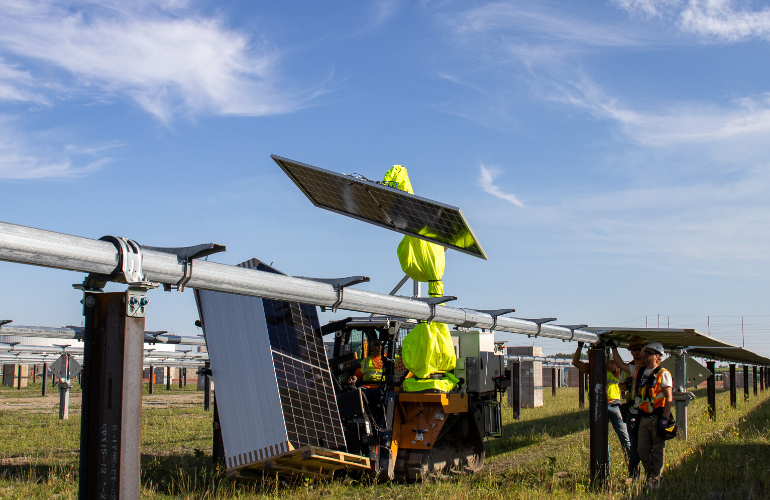
Burns & McDonnell and Gritt have entered into a strategic partnership to evaluate and deploy AI-powered robotics technology on utility-scale solar projects. The companies said the technology is intended to improve safety, enhance project predictability, and support construction teams as demand for new energy infrastructure continues to grow.
Gritt combines AI and robotics to automate labor-intensive tasks on construction sites. The company develops intelligent systems that can be attached to standard construction equipment and used to handle tasks such as placing and assembling solar arrays, pouring concrete, and laying rebar autonomously.
The partnership combines Burns & McDonnell’s integrated EPC capabilities with Gritt’s AI-powered software and robotics platform. The companies said the collaboration is designed to create new opportunities, address labor challenges, improve efficiency, and advance innovation in solar construction, where crews often handle repetitive and physically demanding work across large, outdoor job sites.
Over the past year, Burns & McDonnell and Gritt have worked together to evaluate robotic solar installation technologies in real-world construction environments. The companies said they have tested Gritt’s technology at multiple utility-scale solar sites.
“Solar construction is very repetitive work, lifting 80-lb modules day after day,” said Adam Bernardi, renewables business line director at Burns & McDonnell. “As solar installations continue to grow in scale, we have an opportunity to leverage technology in ways that help our teams work safer, faster and smarter. By helping crews handle some of the most repetitive and physically demanding tasks, Gritt offers a solution that can improve safety while helping us deliver projects more predictably.”
Unlike robotics systems designed for controlled factory environments, Gritt’s technology is built specifically for outdoor construction sites, where terrain, weather and site conditions can vary significantly. The company said its AI-powered systems are designed to assist crews with repetitive installation activities while continuously learning from field operations.
“The future of construction won’t be humans or robots; it will be humans and robots working together,” said Puneet Puri, CEO and co-founder of Gritt. “Our mission is to help civilization build infrastructure faster. Working alongside leading EPC firms like Burns & McDonnell allows us to deploy our technology in real project environments, learn from experienced builders and continuously improve the intelligence behind our systems. Together, we’re creating tools that can help the industry meet growing infrastructure demands while supporting the workforce that makes it all possible.”
Automation and robotics are becoming increasingly common in the solar industry, with companies developing construction aids and panel installation devices as developers and contractors look for ways to improve installation workflows on utility-scale projects. Recent examples include Xpanner’s devices for skid steers, the Maximo solar panel installation effort by AES, and the Terabase automated installer.

