Can John Healey Deliver Burnham's Make-or-Break Devolution Agenda?
Key Takeaways
- •Andy Burnham has established a £1bn 'Good Growth Fund' for Greater Manchester, financed through local government pension pots, government grants, and the National Wealth Fund, significantly exceeding London's £70m equivalent fund.
- •The UK ranks among the most fiscally centralised OECD member states, and regional inequality is more pronounced than in countries such as Germany and Sweden, which have devolved substantial tax powers to local governments.
- •A flat percentage model for sharing locally generated income tax would disproportionately benefit London, where Kensington and Chelsea alone generated approximately £4.5bn in income tax receipts in 2022 compared with £920m for Manchester City Council.
- •The Institute for Fiscal Studies has proposed an alternative pence-in-the-pound model across tax bands to avoid volatility and over-reliance on higher-rate taxpayers, while still incentivising local governments to raise pay broadly.
- •The Centre for Cities recommends that the initial devolution phase focus on metro mayors rather than local authorities, and estimates that devolving just one per cent of income tax would be sufficient to produce meaningful early effects.
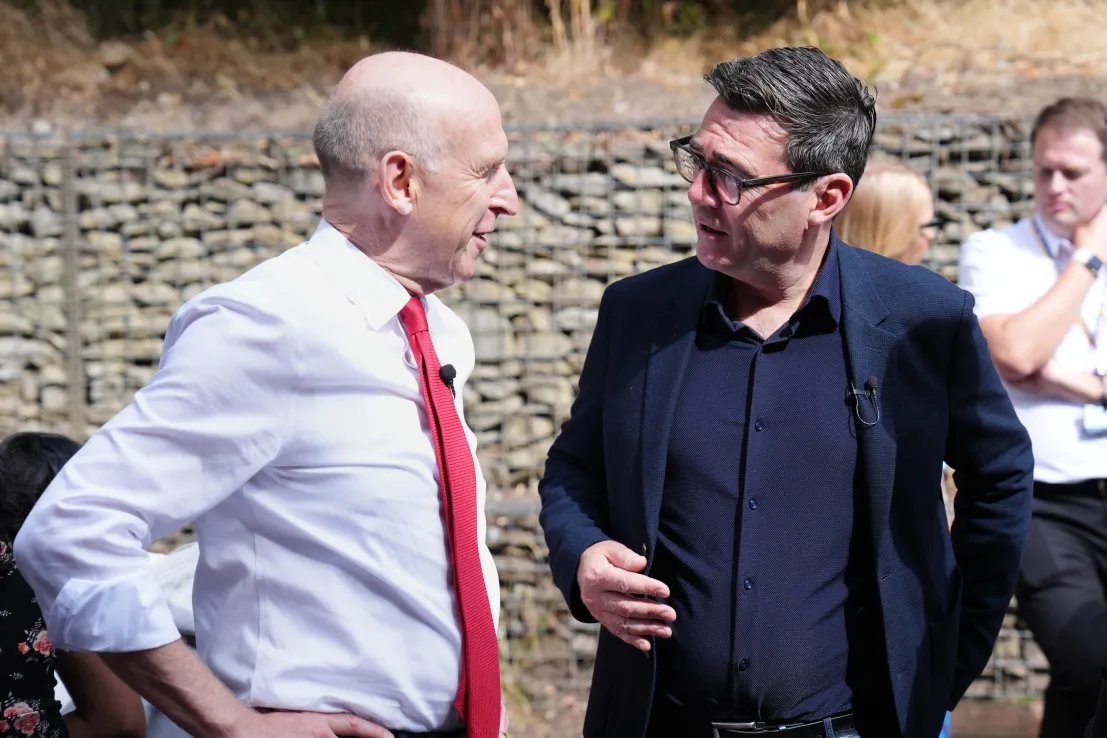
Devolution stands at the heart of Andy Burnham's economic strategy. Maurício Alencar examines whether devolution under Chancellor John Healey could revive Britain's regional economies — or deepen its divides.
In 1998, two of then-Chancellor Gordon Brown's closest aides produced a report on Britain's regional economic divide. The report, titled 'Towards a new regional policy: Delivering growth and full employment,' proposed creating what it called "regional development agencies" (RDAs) to encourage local leaders to "work with business" and boost investment. Over the following 12 years, these investment bodies spent billions of pounds.
The report's authors were Ed Balls and John Healey. Healey now leads the Treasury, armed with a renewed mandate from his new boss, Andy Burnham, to devolve fiscal power and deliver "growth in every postcode."
A Contested Legacy
The Balls and Healey vision attracted plenty of critics. The RDAs were eventually shuttered under George Osborne's cost-cutting programme starting in 2010. A National Audit Office report indicated that the bodies had generated returns of up to three times the investment in some areas, delivering both short- and long-term gains. However, the same report found they often muddled priorities, lacked accountability, and failed to meet over-optimistic projections. Detractors dismissed them as quangos redistributing public money.
Reflecting on the RDAs in 2021, Healey called the Coalition government's decision to abolish them "desperate" and accused Boris Johnson's 'Levelling Up' campaign of being "entirely specious." He argued that RDAs had driven a mindset shift in Whitehall, which had "never really" believed local leaders could shape economic policy. The case for devolution, he said, rested on "potential," greater creative thinking, and geography-based policymaking — an approach the business department had been "resistant" to.
Burnham's Devotion to Devolution
From his first day in Downing Street, Andy Burnham has championed devolution as the government's preferred growth lever. Burnham described opening Number 10 North as the "best day of my life."
In 2025, the former Greater Manchester mayor established a £1bn "Good Growth Fund" for the region, financed by local government pension pots, government grants, and money from Rachel Reeves' National Wealth Fund. The fund dwarfs the £70m equivalent established by London mayor Sir Sadiq Khan.
Currently, local governments and mayors receive approximately £83bn in government grants, while authorities also collect council taxes and retain a portion of business rate receipts. Mayors may impose additional charges. By international standards, however, UK local authorities retain an unusually small share of the taxes they raise — OECD data consistently ranks Britain among the most fiscally centralised of its member states.
Under plans being prepared for the Budget, mayors are set to receive a larger share of taxes "raised in a community," on the rationale that retaining more revenue will incentivise local leaders to drive growth.
Concerns over "postcode lotteries" and a loss of control over public finances have long unsettled the Treasury. Yet the UK, which has one of the world's most centralised governments, already suffers from greater regional inequality than countries such as Germany and Sweden, both of which have dispersed powers away from their capitals. Germany's federal states and municipalities, for instance, control significant shares of income and business tax, while Swedish local governments levy their own income tax — structures that economists have linked to more balanced regional development. Labour centrists argue that devolution, executed properly, is both ideologically coherent and economically beneficial. Critics view the agenda as a distraction from a broader pro-growth mission.
Devolution Nation
While fiscal devolution was merely an addendum to former Chancellor Rachel Reeves' March lecture on growth, it forms the central pillar of Burnham and Healey's governing mission. The two leaders have been warned, however: getting this wrong could deepen economic divides and entrench Britain's stagnation. The stakes are amplified by the UK's persistent productivity gap — output per hour in London and the South East has long outstripped that of northern regions, a disparity that successive governments have tried and failed to close.
"If you get it wrong the first time, unwinding it will be a nightmare. If you get it right first time, then investors will start to think, 'Actually, game on,'" said Professor Philip McCann, a specialist in urban and regional economics at the Productivity Institute.
Treasury officials face several landmines in designing a revenue distribution scheme. First, the funding model must not leave some regions behind due to structurally weaker growth. Second, reforms must endure over the long term and withstand potential cuts by a future government. Third, reforms must produce sustained gains rather than short-lived windfalls.
How exactly to distribute the money has become a contentious debate in Westminster.
The most straightforward framework would give each area a flat percentage of locally generated revenue. On the surface, this appears to be what Burnham and Healey envisioned when they said authorities would be able to retain a portion of income tax receipts.
Such a system, however, would overwhelmingly benefit London. As the accountancy firm BFN noted in 2024, Kensington and Chelsea generated approximately £4.5bn in income tax receipts in 2022, compared with £920m for Manchester City Council, which ranked 62nd on the income tax list — trailing scores of London councils.
The London Problem
Oxford Economics researcher Liam Sides observed that if London grew at a faster pace and retained more locally generated income, it would create a "self-reinforcing cycle of faster growth" for the capital. Central government could then claw back funds from London, redistributing them to lower-growth areas — effectively "punishing" the capital for delivering stronger returns.
"At which point," Sides said, "the whole purpose of incentivising growth is completely undermined."
Alternative models may therefore need to be based on more than just the absolute size of local income or its growth rate.
David Phillips of the Institute for Fiscal Studies has proposed a different approach. A framework based on sharing a flat portion of income tax receipts could prove volatile year to year and leave local tax systems overly dependent on higher-rate taxpayers. Instead, a flat pence-in-the-pound rate across each tax band would ensure that central government absorbed the cost of any tax rate cuts while incentivising local governments to raise pay across all income levels.
McCann of the Productivity Institute argued that any revenue-sharing model should account for investor risk in less economically productive areas, such as the North East of England. Public funds, he said, should be used to de-risk investments in these regions, attracting additional private capital that generates tangible growth. Revenue would then be retained in local investment pots as assets yield returns, with government support tapering over time — though ensuring that growth incentives persist would remain a complex challenge.
This logic underpins the state-owned British Business Bank and the larger National Wealth Fund, which provide smaller businesses with access to finance and give larger projects a measure of backstop support. McCann described both organisations as "critical" for regions managing their own investment funds. He cautioned, however, that the National Wealth Fund — formerly the UK Infrastructure Bank — had "lost its real sense of where it's going," pointing to its focus on green investments. The fund has also encountered teething problems since being renamed and expanded when Labour took office.
McCann suggested that Burnham's early moves indicate he was "getting it right," noting the former mayor's prior experience running a housing investment loans fund. This could be how Burnham's pledge to give Britons greater "public control" takes shape.
Devolution — But Not Like That
At some stage, Burnham and Healey's vision is likely to collide with political reality. Ben Houchen, the Conservative metro mayor of Tees Valley in the North East, pledged to use any additional income to deliver tax cuts for local residents — a move ministers swiftly ruled out.
Several think tanks and organisations wary of state expansion have written to the Treasury urging protections for taxpayers against unrestrained spending and new stealth taxes. Other left-leaning bodies, including the Labour-affiliated Institute for Public Policy Research (IPPR), argue that mayors should have borrowing powers to finance infrastructure projects.
Legal guardrails are expected to impose strict limits on how newly empowered policymakers can use public money. That means lawyers may become close allies of local leaders seeking to exploit loopholes.
Under-scrutinised local officials could land in serious trouble — local government has not always been synonymous with financial rectitude — and end up requiring government bailouts, further straining public finances. Local authorities in Nottingham and Birmingham, for instance, have already encountered financial difficulties stemming from overspending and failed investments in areas ranging from energy schemes to housebuilding. More recently, the Scottish government, which holds the power to alter income tax rates, faced criticism after the SNP's levy hike on higher earners resulted in a drop in revenue.
While a wholesale breakup of tax powers is unlikely to feature prominently in upcoming devolution plans, granting English or Welsh leaders greater authority over rate-setting could further complicate the broader system.
Risks on the Horizon
A comprehensive devolution programme will likely take years and may outlast both Burnham and Healey. The Centre for Cities — one of Burnham's preferred think tanks due to its focus on mayoral powers — recommends that the initial phase concentrate on metro mayors before extending to local authorities. This approach could leave regions such as the West Midlands or Cornwall lagging, but researchers at the organisation note that tax bases across mayoral strategic authorities vary less, and city leaders are not burdened with providing a wide array of essential services such as social care, unlike local councils. Mayors may therefore be better positioned to drive growth, particularly since cities tend to deliver stronger financial outcomes.
The think tank contends that devolving just one per cent of income tax would be enough to produce initial effects, though safety nets and a "contribution threshold" — whereby successful mayors who deliver higher gains share a portion of receipts with underperforming regions — would guard against widening regional inequalities.
Early missteps in designing the critical distribution formula could prove damaging. The Treasury has very little time to prepare, with the Budget just two months away. But after thirty years of anticipation, local mayors will be hoping that Healey is finally ready to deliver on devolution.
