Buncombe County Records Sharpest U.S. Migration Reversal After Helene, Study Finds
Key Takeaways
- •Buncombe County's net domestic migration swung by 3,824 people — from 1,768 net arrivals before Helene to 2,056 net departures afterward — the steepest reversal among the 620 U.S. counties with at least 100,000 residents.
- •Census estimates show Buncombe County's population fell by 1,810 residents as of July 2025, marking its first annual decline since at least 2000.
- •Active home listings in Buncombe County rose 103 percent, from 886 to 1,799, compared with 25 percent nationally, while typical home values fell 5.6 percent against a 1.1 percent national increase.
- •Buncombe's civilian labor force shrank 5.8 percent to 135,287 by July 2026, far outpacing the 1.2 percent statewide decline, with unemployment standing at 3.4 percent.
- •Across the 23 Helene-declared counties in western North Carolina, net domestic migration fell 54.5 percent, from 9,183 to 4,180, but stayed positive, with Henderson County gaining 1,089 residents.
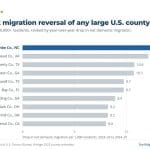
Buncombe County recorded the sharpest reversal in domestic migration of any large county in the United States in the year after Tropical Storm Helene, and the number of homes for sale in the county has doubled since the storm, according to a new analysis of public data by Asheville-based Dry Ridge Moving. The county is home to Asheville, the largest city in Western North Carolina, and shifts in who is moving in or out feed directly into housing demand, school enrollment and the size of the local workforce.
The study, released ahead of the storm's second anniversary on September 26 and 27, combines Census, IRS, Realtor.com, Zillow and Bureau of Labor Statistics data to show how movement into and out of Western North Carolina has changed since September 2024, when Helene struck the region.
Sharpest Swing Among Large Counties
Among the 620 U.S. counties with at least 100,000 residents, Buncombe's net domestic migration fell the most relative to its population between the year before the storm and the year after. Net domestic migration counts only moves within the United States, making it one of the clearest indicators of whether a county is gaining or losing existing residents. In the year before Helene, 1,768 more people moved into the county from elsewhere in the United States than moved out. In the year after, 2,056 more people left than arrived — a swing equal to 13.7 net movers per 1,000 residents, or 3,824 net movers in raw terms. The next-largest reversal was in Craighead County, Arkansas, at 12.1.
Census estimates released in March showed the shift left Buncombe with 1,810 fewer residents in July 2025 than a year earlier, the county's first annual decline since at least 2000.
Housing Inventory Doubles
The housing market has shifted markedly since the storm. Active home listings in Buncombe County rose from 886 in 2024 to 1,799 in August 2026, an increase of 103 percent, compared with 25 percent nationally, according to Realtor.com data published by the Federal Reserve Bank of St. Louis. For buyers, that means roughly twice as many homes to choose from as existed before the storm; for sellers, it means competing against double the inventory. The median listing spent 78 days on the market, up from 54. Zillow's typical home value in Buncombe County fell 5.6 percent between September 2024 and July 2026, while the national figure rose 1.1 percent.
Labor Force Contracts
The local workforce is also smaller. Buncombe County's civilian labor force — the number of people working or looking for work — stood at 135,287 in July 2026, 5.8 percent lower than in July 2024, according to preliminary Bureau of Labor Statistics figures. The statewide labor force fell 1.2 percent over the same period, meaning the contraction is concentrated in Buncombe rather than spread evenly across North Carolina. Buncombe's unemployment rate, which spiked after the storm, was 3.4 percent in July 2026.
Broader Region Still Growing, More Slowly
Across the 23 Helene-declared counties in North Carolina's mountains and foothills, net domestic migration fell 54.5 percent, from 9,183 to 4,180, but remained positive. Henderson County added 1,089 residents, a sign the slowdown was uneven across the region rather than universal.
IRS migration data from tax years 2022 and 2023, the most recent available, shows the pattern the storm interrupted. Those statistics track the addresses of tax filers between filing years, counting households rather than individuals. Florida was the leading out-of-state source of new households for Buncombe, Haywood, Henderson, Madison and Transylvania counties, with 1,315 households moving in. South Carolina, led by Greenville and Spartanburg counties, was the leading destination for households leaving the area, with 1,111.
Caveats and Next Data
The study notes that Census estimates are revised each year and may not fully capture temporary displacement, and that 2026 county labor force figures are preliminary. The next county population estimates, expected in spring 2027, will show whether the migration reversal continued, and IRS migration data for later tax years will eventually capture post-storm moves using the same filing-based method.
The full study, including methodology, charts and downloadable county data, is available on the Dry Ridge Moving website, and its charts may be republished with credit.

