Bullish Commits $100 Million to AI Credit Platform USD.AI, With GPUs Serving as Collateral
Key Takeaways
- •Bullish, the NYSE-listed crypto platform that owns Coindesk, is lending $100 million to USD.AI to support loans for AI and infrastructure businesses.
- •AI firms secure the financing by pledging their GPUs as collateral.
- •Bullish claims the AI-capex private credit sector has grown larger than legacy debt markets such as auto loans and home equity lines of credit.
- •Following the announcement, Bullish shares dipped 2%, though the stock has risen more than 44% over the past month.
- •The model faces risks from falling or outdated GPU values, and a borrower default would test whether lenders can liquidate the hardware at underwritten values.
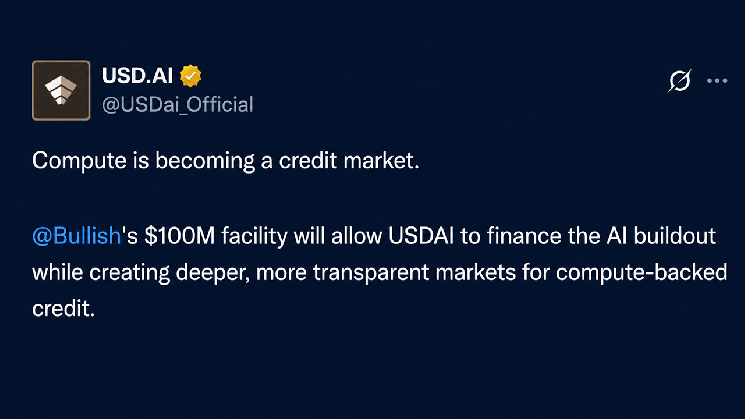
Two major trends appear to be converging: private credit for AI capital expenditure and the tokenization of real-world assets (RWAs). Bullish, the NYSE-listed institutional crypto platform and parent of the news publication Coindesk, announced this week that it is lending $100 million to USD.AI. The funds are intended to support loans to businesses building artificial intelligence and related infrastructure.
Under the arrangement, AI firms pledge their highly valuable computer chips (GPUs) as collateral. Bullish considers the market involved in this new type of lending to be enormous — larger, it notes, than many older and more familiar categories of borrowing. The deal reflects a broader pattern in which AI developers, facing massive spending on computing hardware, have increasingly turned to non-bank lenders and collateralized financing structures rather than equity markets to fund their buildouts.
"Bullish is targeting a capital-intensive sector that has rapidly emerged as one of the largest in private credit, with a scale that eclipses legacy debt markets such as auto loans and home equity lines of credit (HELOCs)," the company said.
A Bet on Bringing Real-World Assets Onchain
Bullish was established in Hong Kong in 2020 by Block.one co-founder and CEO Brendan Blumer. Following Friday's announcement, the company's NYSE-listed shares were down 2%, though five-day figures show a 10.5% gain, and the stock has climbed more than 44% over the past month.
Thomas Cowan, Head of Tokenization at Bullish, said the company strongly believes real, physical assets should be connected to digital money systems, and that this deal reflects that position.
"Our commitment to USD.AI reflects a conviction we've believed since our first investment in the protocol: that credible, well-structured real-world assets belong onchain," Cowan said. "USD.AI's onchain transparency gave us the visibility to underwrite this facility with the same institutional diligence we apply across our platform, and backing it is a meaningful step toward bringing tokenized assets to institutional scale."
The move also sits within the wider growth of tokenized real-world assets, a category — spanning tokenized Treasuries and other debt instruments — that has expanded markedly on public blockchains as institutions explore onchain alternatives to traditional settlement.
GPU Collateral Faces Its Stress Test
The concept does carry risks. GPU prices can fall rapidly, and the hardware becomes outdated quickly as newer models are introduced. As of Saturday, Aug. 29, 2026, GPU prices remain high — particularly Nvidia consumer cards with more VRAM — and valuations have been climbing again this summer rather than easing. The real test of the model would come if a borrower were unable to repay a loan, which would show whether lenders can actually liquidate specialized hardware at values close to those used in underwriting.
Source: Bitcoin.com
