Bull doubles supercomputer output at Angers as Europe scales up AI compute capacity
Key Takeaways
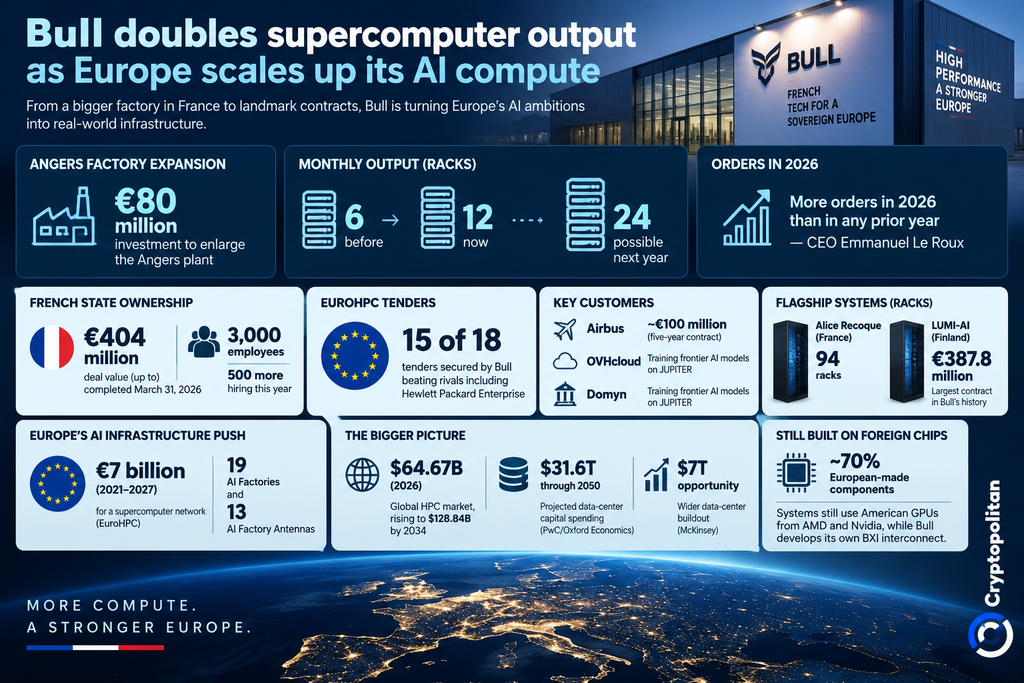
- •Bull has invested €80 million in its Angers facility, production from six to 12 racks per month, with the capability to reach 24 racks if demand rises.
- •France completed its €404 million takeover of Bull from Atos on March 31, and the company plans to hire 500 additional staff on top of its roughly 3,000 employees by year-end.
- •Bull has won 15 of the 18 EuroHPC tenders to date, outperforming competitors including Hewlett Packard Enterprise.
- •The expanded Angers plant is assembling France's 94-rack Alice Recoque system and Finland's LUMI-AI supercomputer in parallel, with LUMI-AI valued at €387.8 million as Bull's largest contract so far.
- •European-made components now account for about 70% of Bull's machines, up from 20–30% five years ago, but its highest-end systems still rely heavily on US-designed GPUs and CPUs.
Europe's push to build artificial intelligence computing capacity at home is moving from policy deliberation to production. Bull, the French state-controlled supercomputer maker, has doubled output at its Angers plant, ramping up production as demand for computing capability across the continent rises. The expansion is a practical marker of that shift: the Angers floor is now slated to assemble flagship systems for France and Finland, making domestic factory capacity a central piece of the continent's compute plans.
From six racks a month to twelve, with headroom for 24
Bull has spent €80 million on the Angers facility, according to Reuters. Production has risen to 12 racks a month, with the capacity to reach 24 racks if demand continues to grow. That headroom matters because the plant's output feeds directly into Europe's supercomputing pipeline, from publicly financed EuroHPC contracts to industrial deals.
Chief Executive Emmanuel Le Roux said Bull has completed more orders in 2026 than in any other year. France finalized its takeover of the company from Atos on March 31 at a price of €404 million. Bull has about 3,000 employees and is expected to hire 500 more by the end of the year, according to HPCwire, a headcount expansion that mirrors the doubling of output on the factory floor.
Winning 15 of 18 EuroHPC tenders
According to Le Roux, Bull has won 15 of the 18 EuroHPC tenders to date. The company has outperformed competitors including Hewlett Packard Enterprise, ensuring that a significant share of Europe's publicly financed supercomputing contracts goes to a European manufacturer. That record also explains why the Angers ramp-up carries weight beyond one factory the systems Bull wins, it must also build.
Separately, Airbus has activated Bull-built systems in Toulouse and Hamburg. The five-year deal is worth nearly €100 million and has tripled the planemaker's simulation capacity, showing that demand for European-built compute extends beyond public tenders into private industry.
Bull is also behind JUPITER, the first operational exascale supercomputer in Europe. OVHcloud and Domyn, which is backed by the European Commission, are using the system to test frontier-class AI models, an example of the frontier AI work now running on European-built machines.
Alice Recoque and LUMI-AI, assembled side by side
The expanded Angers factory now enables Bull to assemble France's 94-rack Alice Recoque system alongside LUMI-AI from Finland, something the old plant could not do. The parallel builds amount to the first major workload for the site's doubled capacity, putting two national flagship programs on the same factory floor at once.
LUMI-AI, Bull's largest contract to date, is worth €387.8 million, according to the company. The machine will run AMD Instinct MI430X GPUs and sixth-generation AMD EPYC processors at CSC's Kajaani data center.
Europe's compute gap and the gigafactory bet
The expansion aligns with a broader goal of reducing Europe's reliance on computing power from outside the continent. The European Union has allocated €7 billion over the 2021-2027 period to establish its supercomputer network.
EuroHPC currently manages 19 AI factories and 13 antennas and has launched the Gigafactory project, which is expected to mobilize roughly €30 billion, as Cryptopolitan previously reported. That pipeline is the kind of demand the expanded Angers capacity is meant to serve, giving the plant's 24-rack headroom a clear purpose if the buildout proceeds as planned.
The sector around that buildout is growing quickly. Fortune Business Insights estimates the global HPC market at $64.67 billion in 2026, with a forecast of $128.84 billion by 2034. McKinsey forecasts that global data-center spending will surpass $7 trillion by 2030, while PwC projects total capital expenditure of $31.60 trillion through 2050.
Still built on foreign chips
Europe is gaining more control over the systems themselves, but the most advanced processors still come from abroad. Reuters reports that European-made components now account for about 70% of Bull's machines, up from 20%–30% five years ago.
Bull is also developing its BXI interconnect to reduce reliance on Nvidia's Mellanox networking, but its highest-end systems still depend heavily on US-designed GPUs and CPUs. That leaves Europe in an in-between position: it is becoming better able to build and operate its own AI infrastructure, even as the chips powering that infrastructure remain largely foreign.
For Bull, the Angers expansion shows how quickly that balance is shifting. Europe may not yet control the entire AI hardware stack, but it is investing heavily in the part it can build at home—and working to make that footprint large enough to matter.

