El Salvador's President Bukele: The World Never Truly Escaped the 2008 Financial Crisis
Key Takeaways
- •President Bukele contends that the 2008 financial crisis was never truly resolved and that post-crisis policies only redistributed economic pain through debt accumulation, inflation, and monetary system changes rather than fixing underlying structural problems.
- •The Federal Reserve's balance sheet expanded from under $1 trillion before the 2008 crisis to over $4 trillion through quantitative easing, a pattern repeated and amplified during the COVID-19 pandemic.
- •Total global debt has surpassed $300 trillion in recent years according to the Institute of International Finance, as governments increased borrowing to support economies through successive downturns.
- •El Salvador became the first country to adopt Bitcoin as legal tender in 2021, and despite repeated IMF concerns, Bukele's administration has maintained its commitment to the policy including a government Bitcoin holdings strategy.
- •Economists remain divided on whether post-2008 policies successfully prevented a global depression or merely postponed confronting deeper structural weaknesses in the financial system.
El Salvador's President Bukele: The World Never Truly Escaped the 2008 Financial Crisis
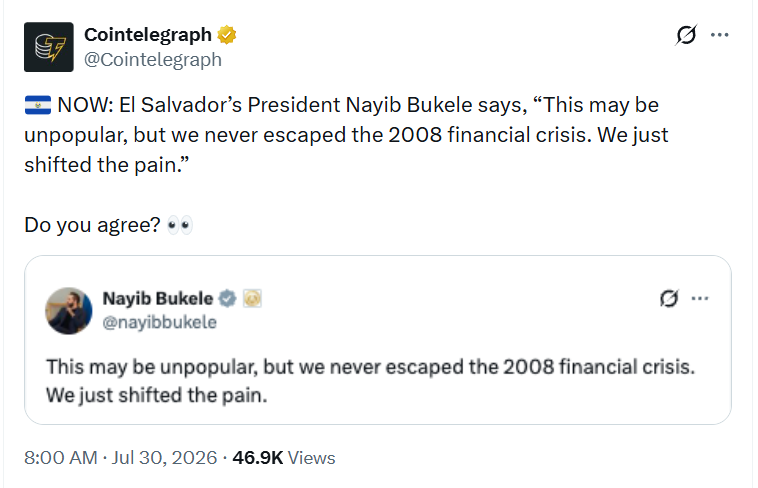
El Salvador's President Nayib Bukele has asserted that the 2008 global financial crisis was never genuinely resolved, arguing that governments and financial institutions merely managed symptoms while redistributing economic pain through new policies, increased debt, inflationary pressures, and monetary system changes.
Bukele's remarks, highlighted by Cointelegraph's X account (source post), have drawn attention from investors, economists, and cryptocurrency communities alike, reigniting debate over whether the global economy has fully recovered from one of modern history's most severe financial disruptions.
His statement arrives amid ongoing global concerns surrounding inflation, government debt, interest rates, and financial stability — concerns that were reinforced when several mid-sized banks collapsed in early 2023, including Silicon Valley Bank and Signature Bank in the United States and the emergency takeover of Credit Suisse by UBS in Europe. Those events prompted renewed comparisons to 2008 and tested post-crisis regulatory safeguards.
Questioning the Long-Term Impact of Post-Crisis Policies
The 2008 crisis was triggered by the collapse of the U.S. housing market, which sent shockwaves through global financial systems. Major banks suffered severe losses, credit markets froze, and governments worldwide introduced emergency measures to prevent deeper collapse.
Central banks responded with lower interest rates, large-scale asset purchases, financial support programs, and emergency liquidity measures. In the United States, the Federal Reserve's balance sheet expanded from under $1 trillion before the crisis to over $4 trillion through successive rounds of quantitative easing — a level of monetary expansion that would be repeated and amplified during the COVID-19 pandemic. These actions helped stabilize markets and avert a broader disaster. However, critics contend that some policies created new challenges, including elevated government debt and asset price increases that disproportionately benefited certain groups.
Regulatory reforms followed, including the 2010 Dodd-Frank Act in the U.S. and the international Basel III framework, which raised bank capital and liquidity requirements. Yet Bukele's argument reflects a broader criticism: the global economy avoided immediate collapse but failed to address the structural issues that caused the crisis in the first place.
From Crisis Management to Long-Term Economic Challenges
Following 2008, many governments prioritized restoring economic growth and rebuilding confidence in financial markets. Stock markets recovered, unemployment declined, and economic activity gradually improved.
Yet some economists argue the recovery generated new imbalances, including rising national debt, dependence on central bank support, wealth inequality, higher asset valuations, and increased financial risk. Critics of post-crisis policies maintain the system grew reliant on cheap money and sustained liquidity. When inflation surged years later, central banks faced difficult decisions about reversing those policies without undermining economic growth.
Inflation as a Persistent Global Concern
Rising inflation became one of the most significant economic challenges in the post-pandemic period. Supply chain disruptions, increased government spending, energy market volatility, and strong consumer demand all contributed to substantial price increases worldwide.
Central banks responded by raising interest rates. While higher rates slowed price growth, they also created difficulties for businesses, homebuyers, investors, and governments carrying large debt burdens. For critics of the current financial system, inflation represents yet another example of economic pressures being shifted rather than eliminated.
Bukele's Stance on Traditional Financial Systems
Nayib Bukele has frequently criticized traditional financial institutions and monetary policies. His administration has positioned El Salvador as a country actively seeking alternatives to conventional financial systems, most notably through Bitcoin adoption.
In 2021, El Salvador became the first nation to adopt Bitcoin as legal tender, drawing global attention and sparking significant debate. Supporters argued Bitcoin could provide greater financial inclusion, alternative savings options, reduced dependence on traditional banking, and expanded access to digital payments. Critics pointed to cryptocurrency volatility risks and adoption challenges.
The International Monetary Fund repeatedly expressed concerns about El Salvador's Bitcoin policy, urging greater transparency and risk management during loan negotiations. Despite that pressure, Bukele's administration has maintained its commitment to the initiative, including a government Bitcoin holdings strategy and the development of infrastructure powered by geothermal energy from the country's volcanoes.
Bukele's latest comments are consistent with his broader argument that existing financial structures require fundamental reform.
The Bitcoin Debate and Financial Independence
Bukele's embrace of Bitcoin has made El Salvador central to discussions about cryptocurrency and monetary policy. Bitcoin advocates contend that decentralized digital assets offer an alternative to government- and central bank-controlled systems, citing concerns such as currency depreciation, inflation, excessive money creation, and banking restrictions.
Economists remain divided, however. Some view Bitcoin as a store of value and technological innovation, while others emphasize volatility and regulatory uncertainties.
Global Debt Levels Remain a Critical Concern
The continued growth of global debt has been among the most significant concerns since the 2008 crisis. According to data from the Institute of International Finance, total global debt surpassed $300 trillion in recent years. Governments increased borrowing to support economies through downturns, including during the COVID-19 pandemic. While borrowing can help address emergencies, sustained high debt creates long-term challenges.
Key questions persist: how governments will manage debt obligations, whether economic growth can sustain current borrowing levels, how inflation affects purchasing power, and what policies central banks will pursue. Bukele's comments echo concerns shared by economists who view debt accumulation as a major vulnerability in the global economy.
The Ongoing Debate: Resolution or Postponement?
Economists continue to disagree on whether the 2008 crisis was truly resolved or merely managed. Supporters of post-crisis policies point to lower unemployment, stronger financial regulations, improved banking systems, and market recovery as evidence that governments successfully prevented a global depression.
Critics counter that deeper structural issues remain unaddressed. They argue emergency measures tackled immediate problems without fully reforming the financial system. Bukele's statement reflects this perspective, suggesting the global economy postponed difficult decisions rather than eliminating financial risks.
Financial Markets Remain Sensitive to Uncertainty
Investors continue monitoring major economic factors including interest rate decisions, inflation trends, government debt, currency stability, banking sector health, and global economic growth. Markets remain highly sensitive to signals from central banks and policymakers, with monetary policy shifts influencing stock markets, bond yields, cryptocurrency prices, commodity markets, and currency values.
This environment has heightened interest in alternative financial assets, including cryptocurrencies.
Crypto Community Response
Bukele's comments have resonated strongly with cryptocurrency supporters, many of whom share his concerns about traditional monetary systems. Some Bitcoin advocates argue that repeated financial crises underscore the need for decentralized alternatives that give individuals greater control over their finances.
Critics note that cryptocurrency markets face their own challenges, including volatility, regulatory uncertainty, and adoption barriers, reflecting a larger ongoing conversation about the future of money and technology's role in global finance.
A Broader Debate Beyond Cryptocurrency
The discussion extends beyond Bitcoin to fundamental questions: Who controls money? How should financial systems operate? What role should governments play? How can economies maintain stability? How should individuals protect wealth?
These questions have grown increasingly relevant as digital payments, blockchain networks, and decentralized finance challenge traditional notions of banking and money management.
Implications for Investors
For investors, Bukele's statement underscores persistent macroeconomic uncertainty regarding future inflation, monetary policy, government spending, and financial market stability. This has contributed to growing interest in alternative assets such as Bitcoin, gold, and other investments beyond traditional portfolios.
Nayib Bukele's claim that the world never truly escaped the 2008 financial crisis has reignited debate over the global economy's fundamental health. Supporters agree the financial system requires major reform, while critics maintain post-2008 policies successfully prevented a far worse collapse. Regardless of perspective, the discussion highlights a central question: whether current financial structures are prepared for whatever challenges lie ahead.

