Leading Beyond Uncertainty: Building a Workforce That Can Outlast Every Crisis
Key Takeaways
- •An NRI study of more than 1,000 employees across five Southeast Asian countries found a 17.5% annual attrition rate in the Philippines and elevated departure risk among 47% of Filipino employees.
- •The article identifies AI and human-centered skills, sustainability expertise, and leadership and analytical abilities as three major capability priorities for future competitiveness.
- •Organizations are encouraged to plan for critical capabilities over the next three to five years rather than focus only on current staffing levels.
- •Integrated learning systems, career development, coaching, mentoring, and succession planning are presented as important tools for improving retention and workforce readiness.
- •Leadership development is described as a business capability that helps distribute expertise and enables organizations to recover and scale more effectively after disruption.
By Diane Cordova
Every crisis exposes the same competitive divide. Some organizations emerge smaller, while others emerge stronger. The difference is rarely the crisis itself. It is whether the workforce was prepared long before the disruption began.
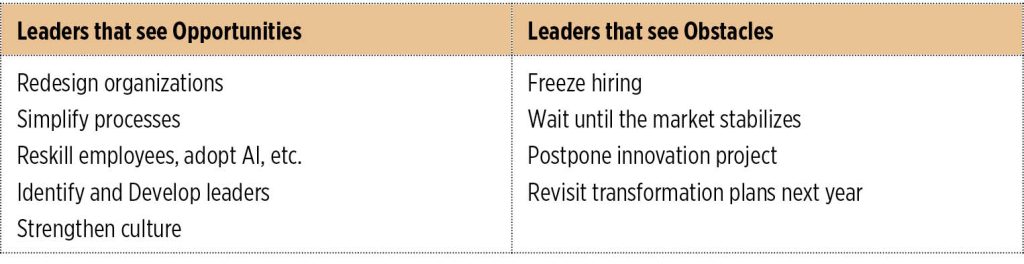
Crises reveal two types of leaders: those who conserve resources while waiting for certainty, and those who use periods of uncertainty to build organizational capabilities that competitors will struggle to match when growth returns.
When uncertainty rises, many companies instinctively freeze hiring, postpone innovation and transformation initiatives, and reduce investment. People programs are often among the first areas to be cut. Although this caution may protect short-term cash flow, prolonged inaction creates capability gaps that become difficult and costly to address.
Companies that use disruption to strengthen leadership, talent, technology, and organizational agility are better positioned to seize opportunities when market growth returns. Many organizations have become more capable of managing short-term disruptions. Far fewer, however, are building the workforce capabilities needed to respond effectively to an increasingly unpredictable future.
Building a future-ready workforce requires a deliberate shift: from reacting to change to intentionally building capability before it is needed. In conversations with chief executive officers (CEOs) and chief human resources officers (CHROs) across industries, we have observed that leaders who see uncertainty only as an obstacle often find themselves in survival mode. Those who see opportunities and ask, “How do we prepare our workforce for a future that keeps changing faster than our organizations can adapt?” are more likely to build crisis-ready organizations.
Beyond Attrition: The Growing Risk of Capability Erosion
Most organizations closely monitor their annual attrition rate. Far fewer pay equal attention to a more important indicator: attrition risk, or the proportion of employees who are considering leaving before they actually do.
This distinction matters. According to an Employee Engagement Study conducted by Nomura Research Institute (NRI) Singapore Pte. Ltd. – Manila Branch, a global management consulting firm headquartered in Tokyo, Japan, and presented at the Association for Talent Development (ATD) Asia Pacific Conference in Taiwan in October 2025, the Philippines recorded an annual attrition rate of 17.5%. More concerning, 47% of Filipino employees were at elevated risk of leaving within the next one to two years. The study analyzed responses from more than 1,000 employees across Indonesia, Singapore, Thailand, Vietnam, and the Philippines.
For CEOs and CHROs, the implication is clear: the 17.5% who have already left represent yesterday’s workforce issues, while the 47% who may leave represent tomorrow’s business risk.
Annual attrition measures current workforce stability, but intent to leave is a leading indicator of future capability risk. When experienced engineers, high-performing sales leaders, digital specialists, or potential successors leave, organizations lose far more than headcount. They lose the capabilities needed to protect the business from current crises and establish a strong foothold for what comes next.
Organizations that wait until resignations increase may find themselves reacting too late. The more strategic question for CEOs is not simply, “How many people are leaving?” but, “Which critical capabilities might leave with them?”
Closing the Capability Gap
Although resignations have moderated since the immediate post-pandemic “Great Resignation,” employee expectations continue to evolve rapidly. The decision to accept an offer or remain with a company is no longer based on compensation alone. Employees also ask:
- Will I continue learning here?
- Will my skills remain relevant five years from now?
- Will I have opportunities to grow?
- Does this organization have a future that I want to be part of?
Organizations that cannot answer these questions convincingly may lose not only top performers but also the institutional capability required to remain competitive.
Many organizations continue to address capability gaps with approaches designed for a far more stable business environment. These include:
- Static annual training calendars disconnected from business priorities;
- Leadership programs reserved only for high-potential employees;
- Recruitment focused on today’s vacancies rather than tomorrow’s capabilities; and
- Performance management centered on annual goals instead of continuous capability building.
These practices were effective when change occurred gradually. Today’s environment demands something different. Organizations need workforce systems capable of continuously sensing emerging skill needs, rapidly developing employees, and redeploying talent as business priorities evolve.
The Philippine labor market continues to experience one of Southeast Asia’s highest employee mobility rates. In conversations with CEOs and CHROs, many describe today’s workforce challenge as a talent shortage. In reality, the issue is broader and more strategic than scarcity alone. The central question is whether organizations are developing the capabilities they need to compete over the next five to 10 years.
The workforce is facing a widening capability gap driven by three powerful forces that are reshaping work faster than organizations can respond.
Blue Trend: The Rise of AI and Human-Centered Skills
Artificial Intelligence (AI) is transforming how work is performed across virtually every function. Yet technology alone rarely creates a competitive advantage. Organizations that outperform will be those that successfully combine AI with distinctly human capabilities, including critical thinking, collaboration, adaptability, and leadership.
As highlighted in NRI’s 2026 Human Capital Outlook, digital transformation is advancing faster than workforce capability development. At the same time, the Philippine Development Plan notes that the country continues to lag regional peers in foundational digital skills.
The implication is clear: AI transformation ultimately starts with people transformation.
Green Trend: Sustainability Is Becoming a Business Capability
Rather than viewing sustainability purely through an Environmental, Social and Governance (ESG) lens, organizations should recognize it as a capability agenda. Green skills are becoming increasingly important across operations, manufacturing, procurement, logistics, engineering, and leadership—not only in environmental functions.
As customers, regulators, and investors raise their expectations, organizations that embed sustainability capabilities into their workforce will be better positioned to improve efficiency, strengthen resilience, and remain competitive.
The International Labour Organization (ILO) has similarly emphasized accelerating green capability development across the Association of Southeast Asian Nations (ASEAN) to improve long-term competitiveness.
For Philippine businesses, sustainability should not be viewed merely as compliance. It represents an opportunity to build operational resilience, improve efficiency, reduce costs, and strengthen long-term competitiveness.
Red Trend: The Leadership and Analytical Skills Gap
The most underestimated capability gap lies in higher-order thinking skills. Across industries, organizations continue to struggle to find leaders who can think strategically, solve complex problems, make sound decisions, and lead through ambiguity.
Unlike technical skills, these capabilities cannot be developed through short courses alone. They require deliberate investment through leadership experiences, coaching, mentoring, and structured development over time.
Many organizations continue to report capability gaps in:
- Strategic thinking;
- Problem solving;
- Critical thinking;
- Business acumen;
- Decision making; and
- Leadership capability.
These shortages cannot be solved through short technical courses. They reflect deeper structural issues, including curriculum misalignment, uneven education quality, and limited exposure to workplace-based learning. As organizations become increasingly automated, these higher-order capabilities become even more valuable.
Capability gaps cannot be solved through isolated HR initiatives or larger training budgets alone. They require a different approach to workforce strategy. The organizations making the greatest progress are redesigning their people systems around future capability rather than today’s operational needs.
Four Strategic HR Shifts
Building a crisis-ready organization requires more than isolated HR initiatives. It demands an integrated human capital strategy aligned with future business needs. Progress should be assessed through the same business lens: whether critical capabilities are being identified early, developed continuously, and retained as priorities change.
1. Shift from Workforce Planning to Capability Planning
Traditional workforce planning asks, “How many people do we need?” Future-ready organizations instead ask, “What capabilities will we need three to five years from now?”
Rather than planning headcount alone, organizations should identify future-critical capabilities—AI literacy, sustainability expertise, data analytics, innovation, customer centricity, leadership, and cross-functional collaboration—and begin building them today. Capability planning should become a standing item in executive discussions alongside financial and operational planning.
2. Institutionalize Continuous Capability Building
Many organizations offer numerous learning initiatives that operate independently, including leadership programs, technical training, digital academies, management development, and succession planning. Employees often struggle to understand how these elements fit together.
Instead of isolated programs, organizations should develop an integrated learning architecture that:
- Provides a common leadership foundation for all people managers, not only high-potential employees;
- Aligns learning with leadership transitions and career stages;
- Combines classroom learning with coaching, stretch assignments, mentoring, and self-directed digital learning; and
- Integrates performance management, succession planning, competencies, and Individual Development Plans (IDPs) into one coherent development journey.
Learning should become an ongoing business process rather than a series of disconnected training events.
3. Compete Through Talent Growth and Development
The findings from NRI’s regional employee study suggest an important shift in employee expectations. While competitive compensation remains important, long-term retention increasingly depends on whether employees believe they can continue growing.
Organizations should therefore regularly assess whether employees experience:
- Meaningful career opportunities;
- Continuous capability development;
- Effective coaching from managers;
- Purposeful work aligned with organizational goals; and
- Confidence in the organization’s future direction.
Retention is no longer simply an HR metric. It reflects organizational confidence. When employees see no future, they begin looking elsewhere.
4. Treat Leadership Development as a Business Capability
Future-ready organizations recognize that leadership is not developed exclusively through HR programs. Managers themselves are the primary developers of talent. Organizations should therefore strengthen leadership capability through:
- Coaching cultures;
- Structured feedback;
- Cross-functional assignments;
- Project-based learning;
- Mentoring relationships; and
- Greater accountability for developing successors.
In an uncertain world, organizations with deeper leadership benches recover faster from disruption because capability is distributed rather than concentrated in a few individuals.
During economic slowdowns, some organizations deliberately accelerate leadership development, redesign roles around automation, and cross-train employees while competitors freeze investment. When demand recovers, these organizations can scale faster because the capability already exists.
Leading Beyond Uncertainty
For Philippine business leaders, the main consideration is no longer whether disruption will continue—it will. The real question is whether their workforce will emerge stronger each time it does.
Organizations that consistently outperform through economic downturns, geopolitical issues, technological disruption, and shifting workforce expectations share one defining characteristic: they build organizational capability before the business urgently needs it. While others respond to disruption by cutting costs, freezing hiring, or postponing development investments, these organizations continue strengthening the capabilities that will determine their next phase of growth.
This is where leadership becomes a strategic advantage. Leadership resilience creates organizational resilience—not because leaders can predict the next crisis, but because they build organizations that can respond, adapt, and evolve regardless of what lies ahead.
Technology can be acquired. Capital can be raised. Business models can be redesigned. But a workforce equipped with the right capabilities, engaged enough to stay, and led by people who can navigate ambiguity is built over years, not during a crisis.
Ultimately, leading beyond uncertainty is not about becoming better at crisis management. It is about creating an organization that becomes stronger because of disruption.
That begins with protecting critical talent before it walks out the door, investing in the Blue, Green, and Red capabilities that will shape future competitiveness, and developing leaders who multiply capability across the organization.
Markets will always recover. The question is whether an organization’s capability will recover faster than everyone else’s. The organizations that lead the next decade will not be those that waited for stability to return. They will be those that saw opportunities behind the obstacle and used it to build a workforce capable of outlasting every crisis.
Diane Cordova is the head of the Human Resources and Organizational Development sector, leading the Total Rewards Practice, at Nomura Research Institute – Manila branch. NRI is a leading global private think tank, systems integrator, and management consulting firm from Japan with branches in the world’s major cities. Before joining NRI, she was the HROD Director, Head of Organization Development and HR Business Partnering, at Unilab, Inc.

