BTCI ETF Pays 25.6% Distribution Rate, but Trails Bitcoin on Total Return
Key Takeaways
- •BTCI offers a 25.60% distribution rate and a trailing twelve-month distribution rate of 36.5%, paying investors a monthly dividend funded by call option premiums rather than direct Bitcoin ownership.
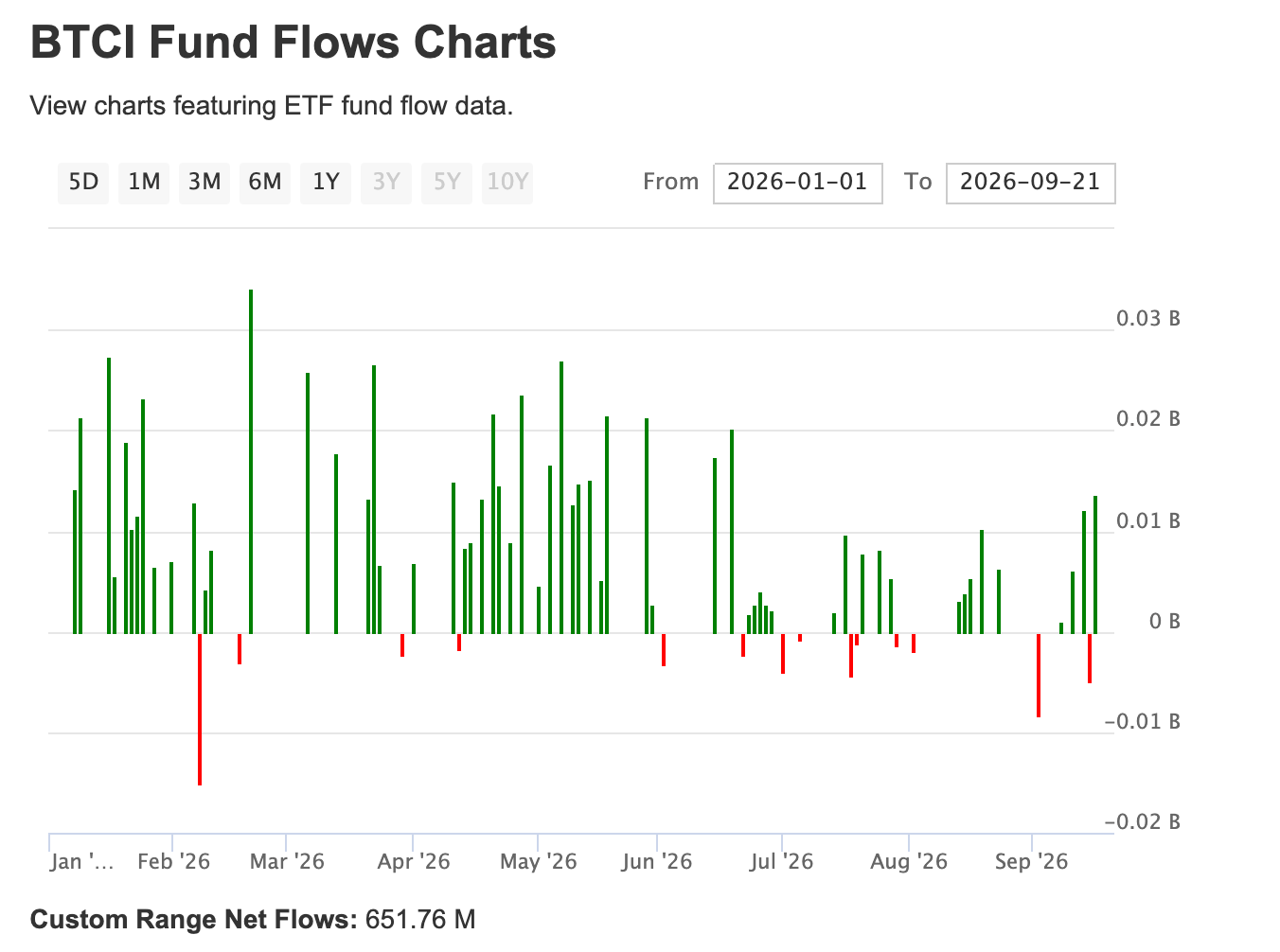
- •The fund has attracted more than $651 million in inflows this year, lifting its assets under management above $1.39 billion since its 2024 launch.
- •Rather than holding Bitcoin directly, BTCI invests in the iShares Bitcoin ETF (IBIT), the VanEck Bitcoin Trust (HODL), and short-term US Treasury bills.
- •BTCI charges a 0.98% expense ratio, far higher than IBIT's 0.25% and Morgan Stanley's MSBT at 0.14%.
- •Despite its generous payouts, BTCI posted total returns of -4.36% this year and roughly -23% over twelve months, trailing Bitcoin's -2.63% and -22% over the same periods.
Bitcoin exchange-traded funds are doing well this month, helped by the ongoing recovery in digital asset markets. The funds added more than $774 million in assets on Tuesday after pulling in $998 million on Monday. Net additions have reached $2 billion so far this month, following $3.52 billion last month.
Against that backdrop, one fund stands apart: the NEOS Bitcoin High Income ETF (BTCI), which pays investors a monthly dividend.
Key Points
- BTCI is a unique Bitcoin ETF that offers a distribution rate of 25.60%.
- Its inflows have jumped in recent months, lifting assets above $1.39 billion.
- The payout is funded by premiums from writing call options on Bitcoin ETF holdings, not by direct Bitcoin ownership.
- History shows the fund tends to underperform Bitcoin on a total-return basis.
Inflows Have Pushed Assets Higher
NEOS, a company that Goldman Sachs is acquiring in a $2.25 billion deal, launched the NEOS Bitcoin High Income ETF in 2024. The fund has continued to attract substantial inflows this year, even as the crypto winter accelerated, and its monthly dividend has distinguished it from conventional Bitcoin funds.
Data compiled by ETFdb shows that the fund has taken in more than $651 million in inflows this year, bringing its assets under management (AUM) to over $1.39 billion. That growth has made BTCI a notable income-oriented alternative in a field dominated by spot Bitcoin products.
BTCI differs from the spot Bitcoin ETFs offered by firms such as BlackRock, Fidelity, Grayscale, and Bitwise in one fundamental way: it does not own Bitcoin directly. Instead, the fund invests in the iShares Bitcoin ETF (IBIT) and the VanEck Bitcoin Trust (HODL), along with short-term US Treasury Bills. These holdings allow it to benefit whenever Bitcoin is rising. That structure matters for readers because it defines what shareholders actually own: exposure to existing Bitcoin ETFs and T-bills, rather than direct Bitcoin holdings.
At the same time, the fund taps the options market to generate returns. It sells (writes) call options on one or more Bitcoin-related assets, such as HODL or IBIT, and collects a premium, which it distributes to investors as a dividend. The mechanics carry a built-in trade-off: in exchange for the premium, a call writer gives up gains in the underlying asset beyond the option's strike price, which is why covered call strategies exchange upside potential for income.
Data on the fund's website shows a distribution rate of 25.60%, with a trailing twelve-month (TTM) distribution rate of 36.5%. Those are substantial figures: a $100,000 investment would have earned about $36,000 in dividends over the trailing twelve months.
The yield stands out because Bitcoin itself does not pay a recurring return, and neither do conventional Bitcoin ETFs such as IBIT, FBTC, and HODL. Unlike some other tokens, Bitcoin generates no ongoing payout for holders.
The Catch: High Fees and Lagging Total Returns
The main benefit of investing in BTCI is its substantial dividend. However, the fund carries several notable drawbacks.
The most prominent is cost. BTCI charges an expense ratio of 0.98%, a steep figure given that the Vanguard S&P 500 ETF (VOO) charges just 0.03% annually. The IBIT ETF charges 0.25%, while Morgan Stanley's Bitcoin ETF (MSBT) costs just 0.14%. That difference in expense ratios can be substantial over time.
Another challenge is that, despite its generous distribution, BTCI's total return has been lackluster. Total return measures what an asset generates from both price appreciation and dividends.
The fund has posted a total return of -4.36% this year, while Bitcoin has slipped 2.63% — meaning an investor who simply held Bitcoin earned a better overall result. The same trend has played out over the past 12 months, with BTCI returning minus 23% while Bitcoin dropped 22%.
BTCI is not alone in this pattern. A closer look at other covered call ETFs shows they tend to underperform their core assets — a pattern consistent with the strategy's structure, in which premium income replaces some of the underlying asset's upside. The MSTY ETF, which tracks Michael Saylor's Strategy, is a notable example, having consistently lagged its underlying asset over the years.
figures frame the trade-off at the heart of BTCI: elevated monthly income in exchange for overall performance that has trailed simply holding Bitcoin. The data points to track from here are concrete: each monthly distribution announcement will reveal how much premium income the fund is currently generating, and the completion of Goldman Sachs's $2.25 billion acquisition of NEOS remains the industry development that will establish who ultimately oversees the fund.

