Broadcom to Lend Anthropic Up to $42 Billion to Finance AI Chip Leases
Key Takeaways
- •Broadcom has agreed to provide up to $42 billion in financing for Anthropic's AI infrastructure, with the facility largely in the form of convertible debt that can later be exchanged for Anthropic shares after its IPO.
- •The financing could cover roughly 33% of Anthropic's $125.2 billion five-year TPU lease commitment, tied to an expanded collaboration with Google and Broadcom totaling 5 gigawatts of next-generation TPU capacity starting in 2027.
- •Analysts believe Broadcom is following Nvidia's strategy of using its balance sheet to help customers fund large-scale AI system buildouts.
- •Anthropic's prospectus warns that Broadcom's dual role as both chip provider and lender could create conflicts of interest, with factors like pricing, hardware decisions, and defaults potentially affecting Anthropic's access to compute and financing.
- •Anthropic is expected to become Broadcom's largest compute client by 2027, when Broadcom forecasts AI semiconductor revenue of approximately $115 billion, rising to $230 billion in fiscal 2028.
Anthropic has disclosed in the prospectus for its planned initial public offering that Broadcom has agreed to provide up to $42 billion in financing for AI infrastructure, according to Reuters. A prospectus is the formal disclosure document a company publishes on the road to a public listing, setting out financials, risk factors, and material agreements for prospective investors — which places the Broadcom arrangement in Anthropic's official record. The arrangement deepens financial ties between the two companies as Anthropic prepares to go public.
The setup places Broadcom in an unusual position: the chipmaker is not only supplying processors but also financing the infrastructure built around those chips, extending its role well beyond that of a conventional hardware vendor.
When the chipmaker also writes the check
Broadcom's ties with Anthropic now go well beyond that of chip supplier. The company also provides financial support and lends equipment to Anthropic as it expands its AI infrastructure. According to Reuters, the $42 billion facility will be largely in the form of convertible debt — borrowing that can later be exchanged for equity under preset terms — allowing Broadcom to eventually convert the notes into Anthropic shares after the company goes public. Broadcom may also bring in an additional financing partner.
The financing could cover roughly 33% of Anthropic's $125.2 billion five-year TPU lease commitment. TPUs are the Tensor Processing Units Google developed for AI workloads, with Broadcom serving as a longstanding design and manufacturing partner — which is why Anthropic's leases double as demand for Broadcom's chips. Anthropic has also expanded its collaboration with Google and Broadcom to 5 gigawatts of next-generation TPU capacity beginning in 2027 — a single gigawatt is roughly the output of a large commercial nuclear reactor — as outlined in its partnership announcement. Chief Financial Officer Krishna Rao described it as the "most significant compute commitment to date" made by the company.
A page from Nvidia's playbook
Analysts believe Broadcom is pursuing a strategy similar to the one Nvidia has already carried out: relying on its financial assets to assist customers in building enormous AI systems.
"Nvidia is putting in place a massive amount of its balance sheet, and Broadcom is having to follow suit," Seaport Research analyst Jay Goldberg told Reuters.
Anthropic is expected to become Broadcom's largest compute client by 2027. According to Reuters, Broadcom forecasts AI semiconductor revenue of approximately $115 billion in fiscal 2027 and $230 billion in fiscal 8.
The circular-money worry
The setup has also fueled concerns about reciprocal AI spending, a dynamic in which technology providers lend money to clients that then direct large investments back into those providers' products.
"It feels that there's quite a concentrated bet right now on two companies being able to generate enough revenues to support all the financing that's happened," Rothschild & Co managing partner Robert Leitao said, per Reuters.
Anthropic flagged the same risk in its filing. The prospectus notes that Broadcom's dual role as both a provider and a lender could give rise to potential conflicts of interest. Factors such as pricing, hardware decisions, and certain defaults could affect Anthropic's ability to access compute and to use the lending facility.
Financing as the new battleground
Broadcom has already been building the financial muscle for deals of this size. In June, it launched an AI financing platform together with Apollo and Blackstone, beginning with a $35 billion transaction supporting more than one gigawatt of Anthropic compute and targeting more than 20 gigawatts through 2028, as announced by Broadcom.
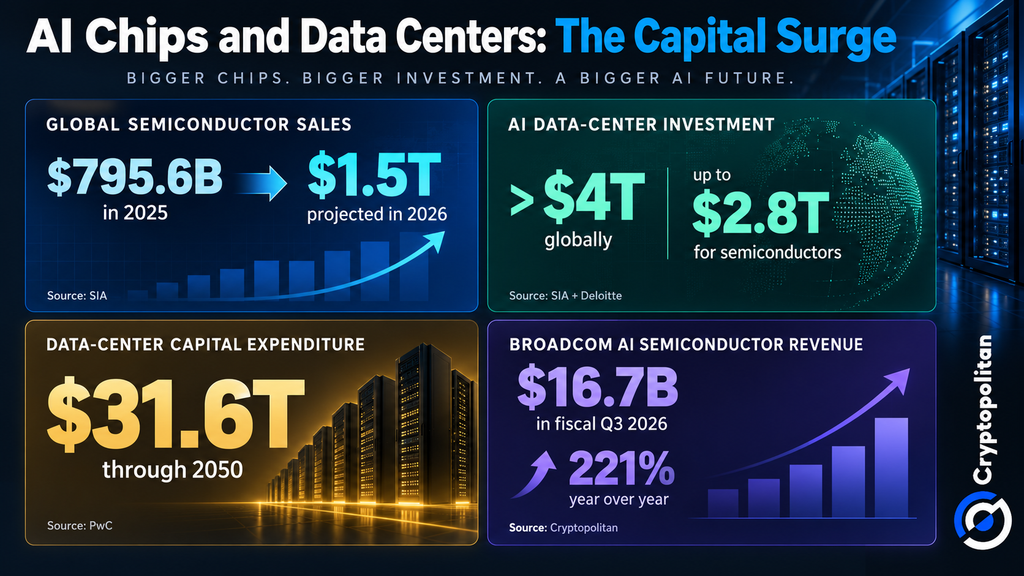
The wider market helps explain why so much capital is moving into the sector. The Semiconductor Industry Association reports that AI is driving semiconductor demand, while PwC expects data-center investment to remain a long-term cycle.
Broadcom is already seeing that demand in its results: the company reported fiscal third-quarter AI semiconductor revenue of $16.7 billion, up 221% year over year — a pace that helps explain why financiers are willing to underwrite customer buildouts of this size.
The $42 billion facility underscores that in the next phase of the AI race, designing the chips may only be half the job. Financing the infrastructure built around them could matter just as much. What happens from here will likely turn on details still to be settled: the final structure of the convertible notes, whether Broadcom adds an additional financing partner, and how the arrangement is described in Anthropic's disclosures once it becomes a public company.

