Week 36 Stocks Market Watch: Hot Payrolls and Broadcom AI Met a Higher Rate Bar
Key Takeaways
- •Broadcom posted fiscal third-quarter revenue of $29.6 billion, an 86% year-over-year increase, with non-GAAP diluted EPS of $3.32, yet its shares declined as investors focused on guidance and elevated expectations.
- •August U.S. payrolls rose 162,000, unemployment held at 4.1%, wages increased 0.3% to $37.75, and June-July revisions added 55,000 jobs, raising the odds of a firmer Fed stance and driving Friday index declines of at least 0.3%.
- •The KOSPI closed September 4 at 6,687, roughly 1.5% below its August 28 close, after a near-4% drop on September 2 tied to oil and Middle East inflation worries, while the Hang Seng closed at 25,651, modestly above its prior-week level.
- •China's official manufacturing PMI improved to 49.8 from 49.2 but remained below 50 for a second month, leaving domestic-demand transmission unfinished despite production and new orders moving above 50.
- •Week 37, the last full data week before the September 16-17 FOMC meeting, requires cooler U.S. inflation, broader Korean export participation, and firmer Chinese demand for the constructive scenario to hold.
Quick Answer
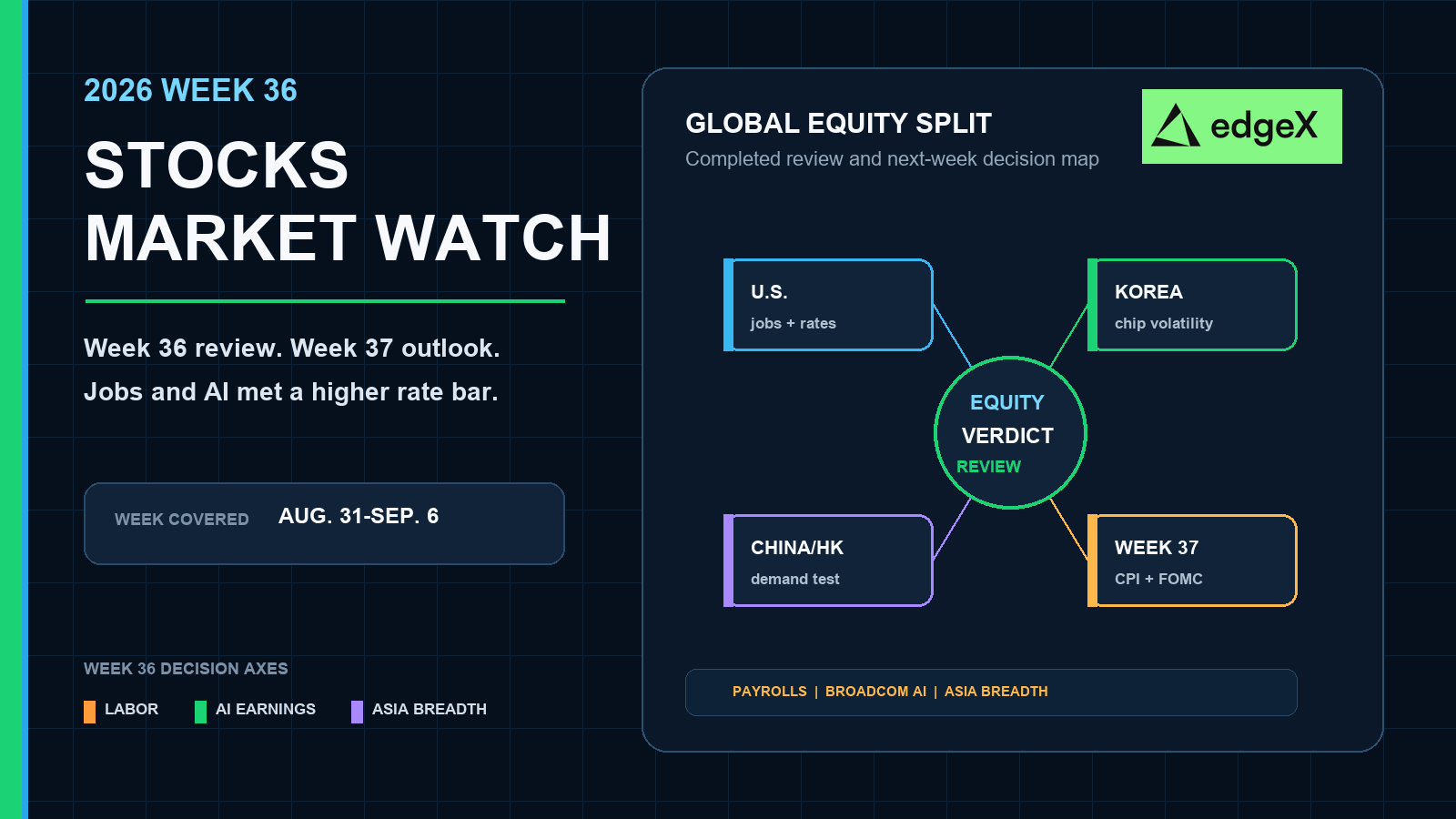
Week 36 confirmed two facts at once. AI infrastructure demand remained powerful enough for Broadcom to post an 86% revenue surge, and the U.S. labor market remained firm enough to lift near-term rate-hike odds after a 162,000 payroll gain. That combination supported selective technology earnings credibility while limiting valuation expansion. U.S. equities ended the week nearly flat to slightly lower, Korea stayed chip- and flow-sensitive after midweek oil-driven stress, Hong Kong stabilized without completing a broad China-demand recovery, and mainland equities still depended on activity evidence beyond a partial PMI bounce. Week 37 therefore starts with a higher policy bar: inflation and September FOMC pricing must cool enough for breadth to improve, while Korea and China need export and domestic-demand confirmation rather than another single-stock AI handoff.
Week 36 Put Labor and AI Earnings on the Same Tape
The completed Week 36 record mattered more than the Week 35 pre-jobs expectations that framed the calendar. Investors entered asking whether Nvidia’s demand signal would broaden through Broadcom, Korean memory, and Chinese activity. They left with a clearer labor answer and a more conditional valuation answer. Strong payrolls restored the discount-rate constraint just as another AI infrastructure report validated the earnings numerator.
Broadcom’s results reduced the chance that AI capital spending had stalled after Nvidia’s guidance step. The Bureau of Labor Statistics Employment Situation, released on the BLS schedule, reduced the chance that policy would ease simply because the labor market was already breaking. Global equities traded earnings certainty against higher real yields rather than a clean risk-on advance.
U.S. indexes absorbed AI support, then lost ground to jobs
U.S. equities spent the first half of the week balancing AI follow-through against oil and inflation worries, then spent Friday repricing the policy path. Session coverage reported major indexes finished Friday at least 0.3% lower after the payrolls surprise, with the Dow about 0.3% lower for the week and the S&P 500 nearly flat. Strong growth data compressed multiples even while technology reports remained constructive.
Food services and drinking places added 59,000 jobs, local government education added 42,000, and manufacturing rose 16,000, while information employment fell 23,000. Participation edged up to 61.6%, and people working part time for economic reasons declined by 414,000 to 4.4 million. June and July payrolls were revised higher by a combined 55,000, raising the hurdle for rate-sensitive software, small caps, and housing-linked groups.
Korea and Hong Kong diverged under the same global rate impulse
The KOSPI closed September 4 at 6,687 after a volatile week. A roughly 4% decline on September 2, linked in session coverage to oil and Middle East inflation worries, showed how quickly Korea’s chip-heavy benchmark can reverse when foreign flows, the won, and energy prices dominate. Friday’s rebound left the index about 1.5% below its August 28 close of 6,788.88.
The Hang Seng closed September 4 at 25,651, recovering from the prior week’s decline and finishing modestly above its August 28 close of 25,584.79. Technology and liquidity-sensitive names helped, but the advance remained conditional on global yields and China demand. Mainland Chinese equities received support from policy and technology interest after the PMI improvement, yet precise weekly benchmark performance remained less cleanly certified than the U.S., Korea, and Hong Kong closes used here.
Week 36 Global Equity Dashboard
| Market | Completed Week 36 evidence | What the result means |
|---|---|---|
| S&P 500 | Nearly flat for the week; Friday decline of at least 0.3% after jobs | AI support offset part of the rate shock, but valuation expansion stayed constrained |
| Nasdaq Composite | Finished lower into Friday’s rate repricing | AI earnings credibility remained, while high-duration multiples absorbed yield pressure |
| Dow Jones Industrial Average | About -0.3% for the week | Broader sector exposure did not escape the labor-driven policy scare |
| KOSPI | September 4 close 6,687, about -1.5% versus August 28 | Chip concentration and oil/flow shocks outweighed the global AI demand handoff |
| Mainland China | Directionally mixed to supported after PMI bounce; precise weekly % not certified | Sub-50 manufacturing PMI improved, but domestic-demand transmission stayed incomplete |
| Hang Seng | September 4 close 25,651, about +0.3% versus August 28 | Offshore rebound repaired part of Week 35 losses without completing a China-demand recovery |
Broadcom Extended the AI Infrastructure Case
Broadcom’s fiscal third-quarter release supplied the week’s clearest company-level AI checkpoint after Nvidia. Revenue reached $29.6 billion, up 86% from a year earlier. GAAP diluted EPS was $2.68, non-GAAP diluted EPS was $3.32, GAAP operating income was $16.0 billion, and non-GAAP operating income was $20.1 billion. The beat kept the infrastructure demand thesis alive for custom accelerators, networking, and semiconductor content in hyperscaler budgets.
The market reaction showed that a beat is not an uncomplicated re-rating. Coverage reported Broadcom shares falling despite the results as investors focused on near-term guidance and elevated expectations. AI revenue growth can validate suppliers and adjacent memory demand without lifting every AI-exposed benchmark in the same week, especially when Treasury yields rise on labor data.
Earnings certainty rose; multiple certainty did not
Broadcom reduced the probability of an immediate AI-capex air pocket, but it did not remove customer concentration, execution, export-control, or valuation risk. U.S. mega-cap technology could still absorb part of the discount-rate shock through exceptional growth. Korean memory names remained more exposed to foreign positioning and currency moves. Hong Kong technology stayed sensitive to offshore liquidity. Mainland Chinese technology still needed local orders and consumption to convert thematic interest into durable earnings revisions. Without a handoff into networking peers, equipment, memory, industrial power, and enterprise software, Week 36 stayed a week of strong AI evidence and weak global participation.
Labor Data Repriced the Discount Rate
The August Employment Situation was the week’s decisive macro event for stocks. Payrolls rose 162,000 against a much softer consensus, unemployment held at 4.1%, and wages rose 0.3% to $37.75. Combined upward revisions of 55,000 to June and July removed part of the earlier soft-labor narrative used to support near-term easing bets.
For equities, the report was neither a recession signal nor a clean disinflation signal. Demand remained firm enough to support revenues, while the policy path became less friendly to long-duration multiples. Friday’s declines and higher Treasury yields reflected increased odds of a firmer September Fed stance after the FOMC calendar window came back into focus. Rate-sensitive groups faced the first filter; AI leaders faced the second filter of whether earnings growth could still outrun the higher discount rate.
Manufacturing cooled without flipping into contraction
The ISM Manufacturing PMI registered 54.6% for August, released September 1, down from 55.6% in July but still expanding. Stronger labor and still-expanding manufacturing argued that demand was not collapsing into the September FOMC window. U.S. industrial and semiconductor suppliers could treat the level as order-supportive, while valuation still depended on yields. Korea needed export and memory shipment evidence rather than U.S. survey stability alone. Mainland China and Hong Kong remained more sensitive to local PMI, property, and consumption data.
Asia Still Needed Demand Confirmation Beyond AI Handoffs
China opened the week with a partial improvement rather than a completed expansion signal. The official manufacturing PMI rose to 49.8 from 49.2 but stayed below 50 for a second month, while non-manufacturing held at 49.0. Production and new orders moved back above 50, supporting factory stabilization, yet headline gauges left domestic-demand transmission unfinished.
That package helps explain why mainland equities could firm on policy and technology interest without a certified broad weekly rally, and why Hong Kong’s rebound remained fragile. Offshore indexes can rise on global tech liquidity even when Chinese household demand remains incomplete. Week 36 left Asia as an open confirmation problem.
Korea’s weekly path showed concentration risk in real time
A large midweek decline tied to oil and inflation worries, followed by a Friday semiconductor-led rebound to 6,687, left the KOSPI lower on the week versus August 28. Samsung Electronics and SK Hynix can dominate daily repairs, but a durable equity signal still requires broader export, equipment, and components participation plus steadier foreign flows. Nvidia and Broadcom support the long-run memory case; they do not automatically stabilize Korea’s weekly index path.
What Week 36 Changed for Global Stock Selection
AI earnings and labor strength can reinforce the real economy while still pulling equities in opposite directions through the discount rate. Broadcom raised confidence in infrastructure demand. Payrolls raised confidence in growth and raised the cost of capital. Regional selection remained a choice among U.S. earnings duration, Korean memory beta and flow risk, mainland China policy transmission, and Hong Kong offshore liquidity.
A healthy global advance would require U.S. gains beyond the largest AI names, Korean participation beyond the two chip heavyweights, and Chinese strength in consumption and earnings revisions. Week 36 did not meet that standard. It left a constructive earnings core and unfinished global breadth heading into Week 37.
Week 37 Outlook: Inflation, FOMC Pricing, and Asia Demand Must Broaden the Signal
Week 37 runs from September 7 through September 13. It tests whether Week 36’s hot labor print hardens into a durable yield shock or fades as inflation evidence arrives, and whether Asia can convert partial PMI and offshore rebounds into broader equity participation. The base case is selective volatility: AI infrastructure remains supportive, while firm labor keeps valuation expansion constrained until inflation and FOMC communication clarify the path.
The U.S. calendar centers on the inflation sequence and market pricing into the September FOMC. After a 162,000 payroll gain, sticky goods or services inflation would keep front-end yields elevated and favor quality earnings leaders over small caps and long-duration software. Cooler inflation with stable growth expectations would give breadth a second chance. Korea’s exports, semiconductor equipment, and foreign-flow evidence remain the local test of whether Broadcom and Nvidia demand is reaching memory shipments. Chinese CPI, PPI, and related activity readings test whether the sub-50 PMI bounce is broadening into household and investment demand that can support the CSI 300 and stabilize the Hang Seng.
Investors should treat the week as a sequence. Inflation sets the rate backdrop, FOMC path pricing determines whether mega-cap multiples can re-expand, and Asia data decide whether the AI handoff becomes a regional equity signal. The constructive case is cooler inflation, contained real yields, steadier Korean flows, and firmer Chinese demand. The downside case is another yield spike, weak chip follow-through, soft Korean exports, and disappointing Chinese activity. Confirmation requires better advance-decline breadth, stable credit spreads, a steadier won, and gains beyond the largest technology weights.
U.S. inflation will decide whether jobs become a multiple problem
A cooler CPI and PPI sequence would be the most constructive outcome after strong payrolls. It would argue that labor resilience need not force a full reacceleration in consumer prices, giving rate-sensitive groups room to participate again. Firm inflation alongside strong jobs would keep the September FOMC window hawkish and return leadership to companies with the clearest earnings duration. One soft print is not permission to ignore the labor baseline Week 36 already raised.
Korea needs export breadth and China needs demand transmission
Korean equities need evidence that AI demand is reaching memory shipments, equipment, components, and exporters beyond a two-name rebound. A KOSPI bounce led only by Samsung and SK Hynix would repair the index without resolving concentration. Won stability and foreign inflows would make the signal more durable after the September 2 oil shock. Mainland China and Hong Kong need activity and price data that support revenue expectations rather than only liquidity. Improving consumption, investment, or factory-gate conditions would help onshore benchmarks and could sustain offshore confidence in the Hang Seng.
Week 37 Decision Map
| Week 37 setup | U.S. stocks | South Korean stocks | Mainland China and Hong Kong |
|---|---|---|---|
| Cooler inflation, stable yields, firm AI follow-through | Breadth can expand beyond mega-cap technology | Memory and equipment shares gain with better foreign flows | Lower global rate pressure helps Hong Kong; mainland still needs local demand proof |
| Sticky inflation and rising yields after strong jobs | Earnings leaders outperform while long-duration and small-cap multiples compress | Chip leaders may hold up, but won and flow pressure limit breadth | Hong Kong technology faces valuation pressure; mainland policy trades may diverge |
| Soft inflation with weaker growth signals | Bonds may rally, but earnings concerns favor quality and defensives | Exporters and cyclicals face demand questions | Weak external demand adds pressure unless domestic indicators improve |
| Better Korean exports and firmer China demand readings | U.S. industrial and semiconductor suppliers gain confirmation | Leadership broadens beyond the two largest chipmakers | CSI 300 and Hang Seng receive stronger earnings and demand support |
The constructive Week 37 scenario requires cooler U.S. inflation without an earnings break, broader Korean semiconductor participation, and firmer Chinese demand. Failure across those dimensions would turn Week 36’s AI confirmation into a short-lived bounce under a higher policy bar. Closing prices, breadth, currencies, and yields will show whether the initial reaction held.
Trade Stocks Without the TradFi Gatekeeping
The stock market moves fast. Your trading infrastructure should too.
As RWA markets mature and tokenized stocks become a serious alternative to traditional access points, more traders are asking why a centralized platform should control their assets, identity, and trading costs.
edgeX Exchange offers a decentralized perpetual-futures venue where eligible users can trade stock-linked markets while retaining control of their assets. The platform combines self-custody, an order-book trading experience, USDC settlement, and mobile access.
- Self-custody: users retain control of their private keys.
- Order-book execution: the platform is designed for high-speed trading and deep liquidity.
- No traditional brokerage onboarding: access does not depend on a conventional securities account.
- USDC settlement: positions use a familiar dollar-linked settlement asset.
- Mobile access: edgeX is available on iOS and Android.
Stock-linked perpetuals carry leverage, liquidity, smart-contract, oracle, and market risks and do not represent ownership of the underlying shares. Availability may vary by jurisdiction. Explore markets on edgeX.
Frequently Asked Questions
What defined the stock market in Week 36?
Hot August payrolls and Broadcom’s AI-driven revenue beat defined the week. Labor strength raised rate-hike odds, while Broadcom extended the infrastructure demand case after Nvidia. U.S. indexes ended nearly flat to slightly lower, Korea finished lower after midweek stress, and Hong Kong recovered modestly.
How did U.S. stocks perform in Week 36?
Major indexes fell at least 0.3% on Friday after the jobs report. The Dow was about 0.3% lower for the week, and the S&P 500 ended nearly flat as AI support collided with a firmer policy path.
Why did the KOSPI lag despite Broadcom’s AI confirmation?
Broadcom supported the long-run memory and networking demand case, but Korea remained exposed to concentrated heavyweight performance, foreign flows, oil shocks, and currency conditions. The KOSPI closed September 4 about 1.5% below its August 28 level after a sharp September 2 decline.
What happened in Chinese and Hong Kong equities?
China’s manufacturing PMI improved to 49.8 but stayed below 50, leaving domestic-demand confirmation incomplete. The Hang Seng closed September 4 at 25,651, modestly above its August 28 close, as offshore technology and liquidity conditions improved without completing a broad China recovery.
What is the base case for stocks in Week 37?
The base case is selective volatility. AI earnings remain supportive, but U.S. inflation, FOMC path pricing, Korean exports, and Chinese demand must broaden the signal before a synchronized global rally becomes credible.
What would invalidate the constructive Week 37 outlook?
A combination of sticky inflation, rising yields, weak semiconductor follow-through, soft Korean exports, and disappointing Chinese activity would pressure long-duration shares and expose the unfinished global breadth problem left by Week 36.
