Brent Crude Nears $100 After Houthi Attacks on Saudi Tankers in Red Sea
Key Takeaways
- •Houthi attacks on two Saudi tankers marked the first direct Red Sea tanker strikes in the current conflict.
- •Bab el-Mandeb handled about 5.4 million barrels of oil per day in the first quarter, according to the US Energy Information Administration.
- •Brent has gained more than 10% this week after rising 17.35% the previous week.
- •The Caspian Pipeline Consortium halted intake from Kazakhstan after drone attacks near its Black Sea terminal.
- •A sustained move above $100.64 could point Brent toward $119.50, while a drop below $92 would weaken the bullish technical outlook.
Brent crude oil climbed to a six-week high near $96 on Thursday after Iran-backed Houthi forces struck two Saudi tankers in the Red Sea, adding another potential threat to global oil supply beyond the Strait of Hormuz. With roughly one-fifth of global oil consumption already passing through Hormuz each day, the emergence of a simultaneous disruption risk at the Red Sea's Bab el-Mandeb chokepoint puts two of the world's most critical maritime energy corridors under pressure at once—a scenario that has no recent precedent.
The benchmark has risen more than 10% this week, following a 17.35% jump last week. Technical charts show Brent pressing toward the $100 level, where a key Fibonacci retraction area aligns with a major psychological resistance point.
🇸🇦 Saudi Aramco is rerouting its oil to dodge the Houthis, offering cargoes from Egypt's Mediterranean coast instead of sailing past Yemen… -Aramco is putting extra crude cargoes on offer at Sidi Kerir, its terminal on Egypt's Mediterranean shore, so buyers never have to pass… pic.twitter.com/z1bAbWKPYo — Mario Nawfal (@MarioNawfal) July 23, 2026
Red Sea Attacks Add a Second Supply Risk
Brent rose 1.8% to $95.70 on Thursday, marking its fifth straight daily advance, according to Trading Economics data. The oil benchmark has gained almost 30% over the past month and 38% year over year.
The move accelerated after Houthi militants struck two Saudi tankers with missiles and drones on Wednesday. The incidents were the first direct tanker attacks in the Red Sea during the current conflict. The group also announced a maritime embargo on Saudi-linked shipping, while three crude carriers headed for Asia reversed course. Houthi forces have been targeting commercial vessels in the Red Sea corridor since late 2023, but the escalation to direct strikes on crude tankers marks a notable widening of the threat to energy flows specifically.
The Red Sea route is significant for global energy trade. Bab el-Mandeb handled about 5.4 million barrels of oil per day in the first quarter, according to US Energy Information Administration figures. If the passage were blocked, vessels would be forced to sail around southern Africa, increasing freight and insurance costs. The strait also serves as the southern gateway to the Suez Canal, meaning any sustained disruption cascades into one of the busiest global trade arteries for everything from liquefied natural gas to container goods.
Last night, the Houthis struck a Saudi oil tanker in the Red Sea. This was the first Houthi attack since they announced their new naval blockade. THE HOUTHIS CONTROL THE BAB AL-MANDAB STRAIT. pic.twitter.com/EteNMiXSQR — Steve Hanke (@steve_hanke) July 23, 2026
At the same time, US forces struck Iranian targets for a 12th consecutive day. President Donald Trump warned that Washington would attack Iranian infrastructure if Tehran targeted ships in the Strait of Hormuz.
Iran threatened retaliation against US-linked energy assets, while both sides played down the possibility of a ceasefire.
Supply concerns also extended beyond the Middle East. The Caspian Pipeline Consortium stopped intake from Kazakhstan after drone attacks near its Black Sea terminal. The CPC pipeline normally carries over 1% of global oil supply from Central Asia to global markets, making the disruption part of a broader pattern of conflict-driven outages touching multiple regions.
The main counterpoint came from the EIA, which reported an unexpected 1.4 million-barrel increase in US crude inventories.
Weekly Chart Shows Brent Breaking Above $92
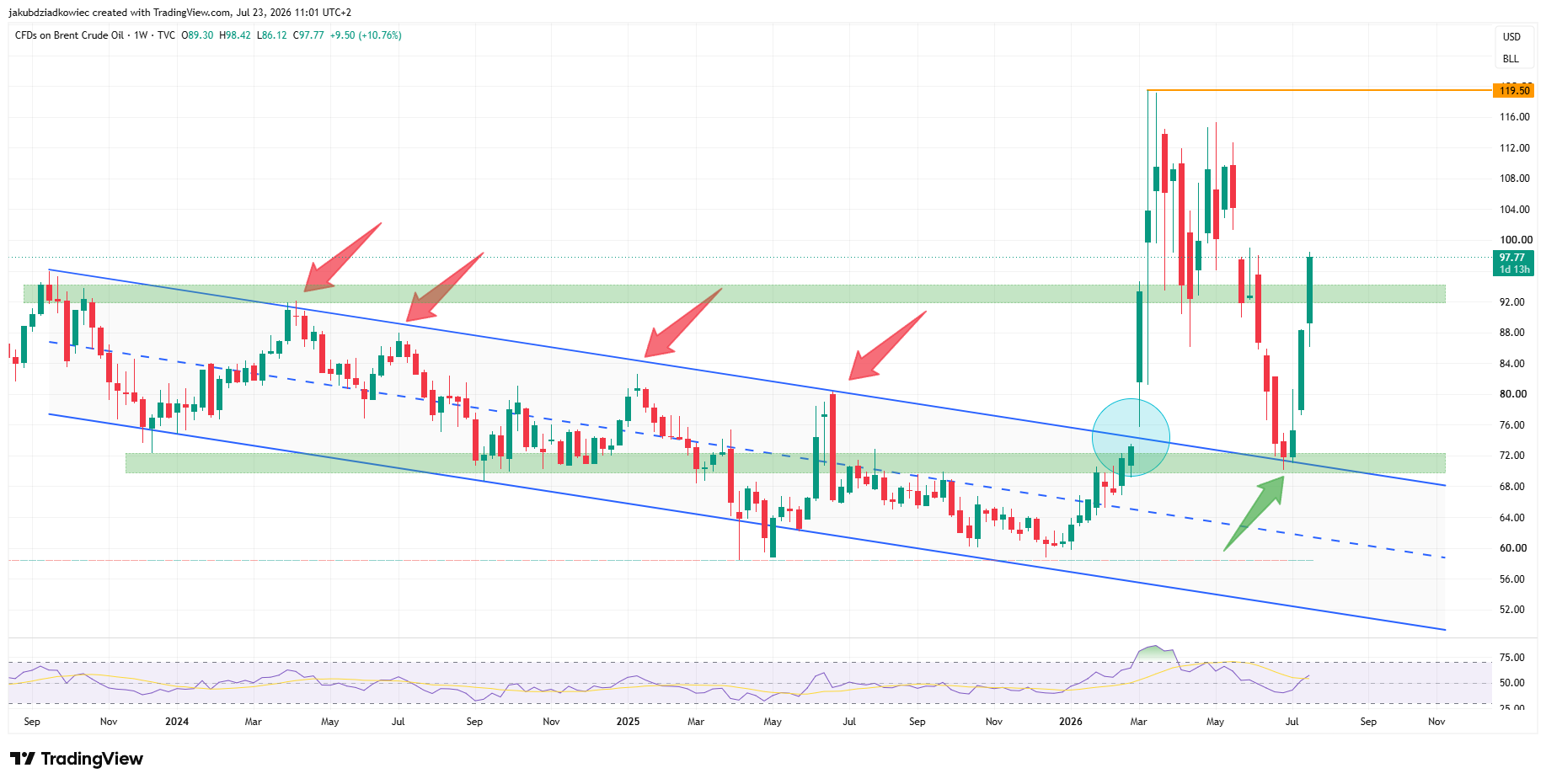
The weekly chart points to a strong advance. Brent has gained 10.76% so far this week after rising 17.35% in the previous week. More importantly, the price moved above the $92 area, a level that had rejected several advances since 2023.
Earlier this month, Brent corrected sharply from war-driven highs and found support at $72. That horizontal area aligned with the upper boundary of a descending parallel channel. The same channel line capped prices through much of 2024 and 2025, meaning former resistance is now acting as support.
The weekly Relative Strength Index, or RSI, is turning higher but remains in neutral territory just above 50. That indicates momentum has not yet reached overbought conditions. As long as Brent stays above $92, that area is likely to function as new support in the current technical structure.
Brent Crude Outlook Hinges on the $100 Test
The daily chart presents a similar setup. Brent rebounded sharply from $70.14 and quickly recovered the 0.382 Fibonacci retracement at $89. It then moved above the $92 zone and the 0.5 Fibonacci level at $94.82.
The next major test is the 0.618 Fibonacci retracement at $100.64. That level overlaps with a previous support and resistance area, as well as the psychological $100 mark. Historically, such technical confluences can produce strong reactions when first approached.
A daily close above $100.64 could clear a path toward the swing high at $119.50, representing a move of roughly 19% from the breakout level. On the downside, $94.82 is the first support level, followed by the $92 zone. A move back below $92 would invalidate the bullish technical outlook.
The daily RSI has just entered bullish territory and continues to rise, with no bearish divergence yet visible. However, the fundamental driver remains highly dependent on geopolitical developments.
A broader blockade could send Brent above $100, increasing inflationary pressure and weighing on crypto markets. Oil prices feed directly into transportation, manufacturing, and petrochemical costs, and sustained crude above $100 has historically complicated central bank efforts to manage inflation. A durable truce, by contrast, could unwind the war premium.
For now, Brent is positioned between two key scenarios: a break above the $100.64 barrier that targets $119.50, or a rejection at the Fibonacci resistance area followed by a retest of $92. What bears watching is whether the dual chokepoint risk in the Red Sea and Strait of Hormuz intensifies or eases, and whether any additional supply disruptions surface at other transit points that are already operating under strain.

