Brazil’s Tokenized Cattle Pilot Highlights RWA Use Case for Finance Access
Key Takeaways
- •A small herd of 10 cows in Brazil was represented through digital tokens instead of traditional paper-based ownership records.
- •The first tokenized cattle operation moved roughly R$100,000 on the B3 exchange, according to CNN Brasil.
- •Cattle are considered suitable for tokenization because individual animals can be identified, tracked and supported by monitoring data.
- •Fractional ownership could allow smaller investors to gain exposure to agricultural assets that would otherwise require larger purchases.
- •The pilot remains limited in scale and does not show whether tokenized livestock can address the broader $8 trillion financing shortfall.
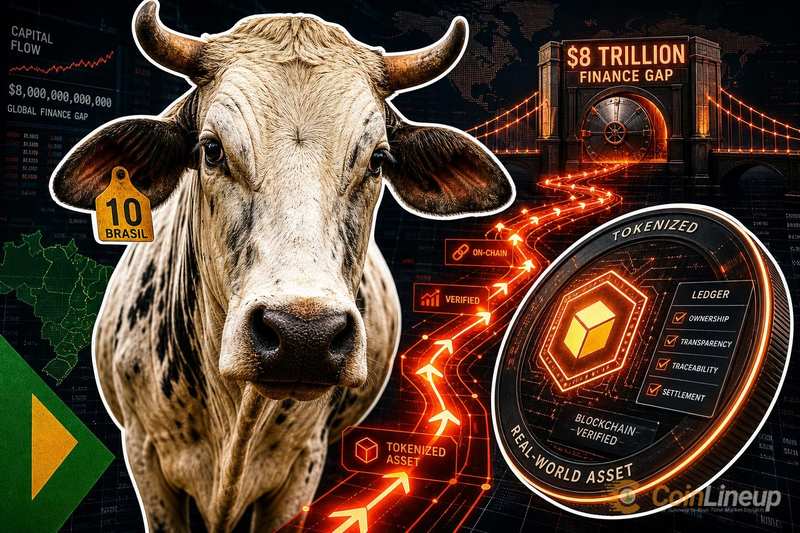
A pilot that brought 10 cows in Brazil on-chain has drawn attention to how tokenization of real-world assets could be used to address a global financing shortfall estimated at $8 trillion. The project turns livestock into a practical example of blockchain infrastructure being applied beyond speculative trading.
The case involves a small Brazilian herd whose ownership was represented through digital tokens rather than conventional paper-based records. In the first operation, tokenized cows moved roughly R$100,000 on the B3 exchange, according to CNN Brasil.
Cattle are seen as a suitable asset for this type of experiment because they are productive, identifiable and trackable. Herd monitoring platforms such as Cowmed already collect data on individual animals in Brazil. Those records are the type of verifiable information that tokenized ownership models need in order to connect a physical asset with a digital claim.
The broader context is the $8 trillion global finance gap referenced in the original framing of the project. That figure refers to the estimated shortfall in capital reaching underserved borrowers and producers. In this case, the cows act as a proof of concept: if a live animal can be fractionally owned and traded, similar structures may be applied to other assets that are difficult to finance through traditional channels.
The proposed benefit of tokenization is improved access to capital. Fractional ownership allows multiple smaller investors to hold exposure to an asset that would otherwise require purchasing an entire herd. A regulated market venue such as B3 also offers a potential route to liquidity that private livestock transactions typically do not provide, as illustrated by the first Brazilian operation.
For agricultural producers, the practical question is not only whether an asset can be tokenized, but whether the link between the animal, the data record and the ownership claim can remain reliable over time. The cattle example highlights why real-world asset projects depend on verifiable off-chain information as much as on blockchain-based settlement.
At the same time, the available evidence does not show whether the model can scale to anything close to the headline financing gap. The Brazil case demonstrates the mechanics of tokenized livestock at a limited scale, not the size of the market it could eventually serve.
The example fits into the wider crypto sector’s focus on real-world assets, or RWA, where physical value is connected to blockchain-based financial infrastructure. It sits alongside other efforts to move crypto rails closer to everyday finance, including Samsung Wallet adding native stablecoin support for payments.
For emerging markets, tokenized collateral could broaden the investor base available to agricultural producers who may sit outside the reach of conventional banking. That framing presents crypto as utility infrastructure rather than only a trading instrument, a distinction also cited in policy discussions, including initiatives such as the Bitcoin Policy Institute’s freedom tech work.
The case also comes as regulators continue monitoring how crypto-linked networks move across financial rails. Brazil’s tokenized cattle pilot remains modest in size, but it provides a concrete example of how blockchain-based ownership claims can be linked to physical agricultural assets.

