Bonghwa Apple Billboard Lights Up Times Square With 'We Don't Advertise' Message
Key Takeaways
- •A Korean-language advertisement for Bonghwa apples appeared on a Times Square digital billboard with the ironic message "Bonghwa apples are delicious, but we don't advertise."
- •The campaign was conceived and personally funded by Kim Su-sung, a 27-year-old official at the Bonghwa Agricultural Technology Center, who paid about $230 out of pocket.
- •The advertisement was intended to generate attention in South Korea and raise awareness of the local specialty, not to directly target US consumers.
- •The county's Instagram post about the billboard received more than 7,000 likes, and a video of it drew over 4,000, with online reactions overwhelmingly positive.
- •Brief Times Square screen appearances booked through online platforms cost far less than the thousands of dollars per day charged for long-running prime billboard placements.
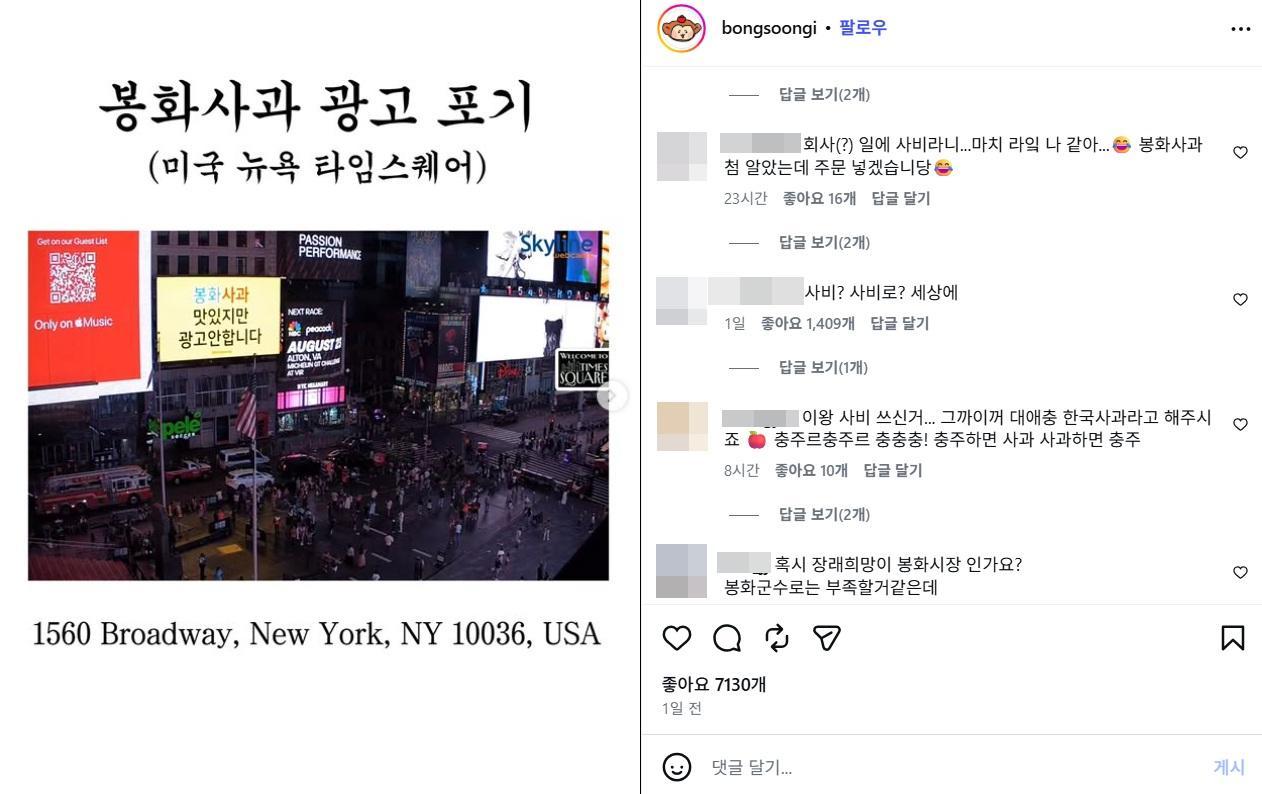
BONGHWA, North Gyeongsang Province — A Korean-language advertisement for apples from Bonghwa, a county in North Gyeongsang Province, has appeared on a digital billboard in the heart of New York City's Times Square, drawing attention for its unconventional message: "Bonghwa apples are delicious, but we don't advertise."
Cost-effective promotion sets example for other local governments
The billboard promotes Bonghwa apples, a local specialty of South Korea's southeastern region. Bonghwa is a rural, mountainous county known for its highland apple orchards. Rather than making a conventional sales pitch, it declares, "Bonghwa apples are delicious, but we don't advertise," creating an ironic twist — a self-negating formula sometimes described in advertising as "anti-advertising," which turns audiences' skepticism of marketing into the pitch itself.
The campaign came to light on Thursday, when photos documenting the advertisement were posted on the Instagram account of "Bongsungi," Bonghwa County's official promotional character. In the images, the word "Bonghwa" appears in blue and "apple" in red, with a design reminiscent of the Korean national flag. An image of a Bonghwa apple also appears in the advertisement.
According to the Instagram post, the idea originated with Kim Su-sung, a 27-year-old official working in the Distribution and Specialty Crops Division of the Bonghwa Agricultural Technology Center. He reportedly paid about $230 out of his own pocket for the advertisement. That figure is a fraction of what prime Times Square placements typically cost — long-running spots on the district's largest billboards are priced in the thousands of dollars per day — but brief appearances on its screens can be booked through online platforms for sums comparable to Kim's budget, which is how small-budget campaigns occasionally reach one of the world's most expensive advertising districts.
Kim said the campaign was not intended to directly target consumers in the United States. Instead, the goal was to put Bonghwa apples on a billboard in the middle of Times Square, generate attention in Korea and ultimately raise awareness of the local specialty.
"If we don't go this far, nobody will recognize Bonghwa apples," Kim wrote on Instagram, explaining the motivation behind the unusual campaign.
The publicity appears to have paid off. As of 4:30 p.m. on Friday, the Instagram post announcing the Times Square advertisement had received more than 7,000 likes, while a video showing the billboard in Times Square had drawn more than 4,000 likes.
Online reactions were overwhelmingly positive, with commenters writing, "With this much effort, I have to try Bonghwa apples," "Promote this official immediately" and "Bonghwa is going to become famous because of this."
The campaign has since become an unexpected example of how a small local government can use a simple, attention-grabbing idea to generate nationwide publicity at a relatively low cost. It also fits a broader pattern in South Korea, where local governments and their officials increasingly front their own playful promotional videos and social media posts to help regional specialty crops stand out in a crowded domestic market. Whether the online buzz converts into lasting demand for Bonghwa apples, rather than a passing viral moment, remains to be seen.
This article is based on a report by the Hankook Ilbo, the sister publication of The Korea Times, translated by a generative AI system and edited by The Korea Times. Source: The Korea Times

