Bolton says Trump could consider Pyongyang for Kim summit, warns of high risks
Key Takeaways
- •Bolton said Trump could consider Pyongyang as the venue for a new meeting with Kim Jong-un.
- •He warned that renewed Trump-Kim summitry carries very high risk because past meetings involved little preparation.
- •Bolton said Trump may be seeking publicity and distraction from domestic and international problems.
- •Trump recently ordered a reduction of the Ulchi Freedom Shield exercise, citing his relationship with Kim and calling the drills costly and hostile.
- •Bolton said the reduced exercise has raised concerns about weakening deterrence against North Korea's nuclear and missile threats.
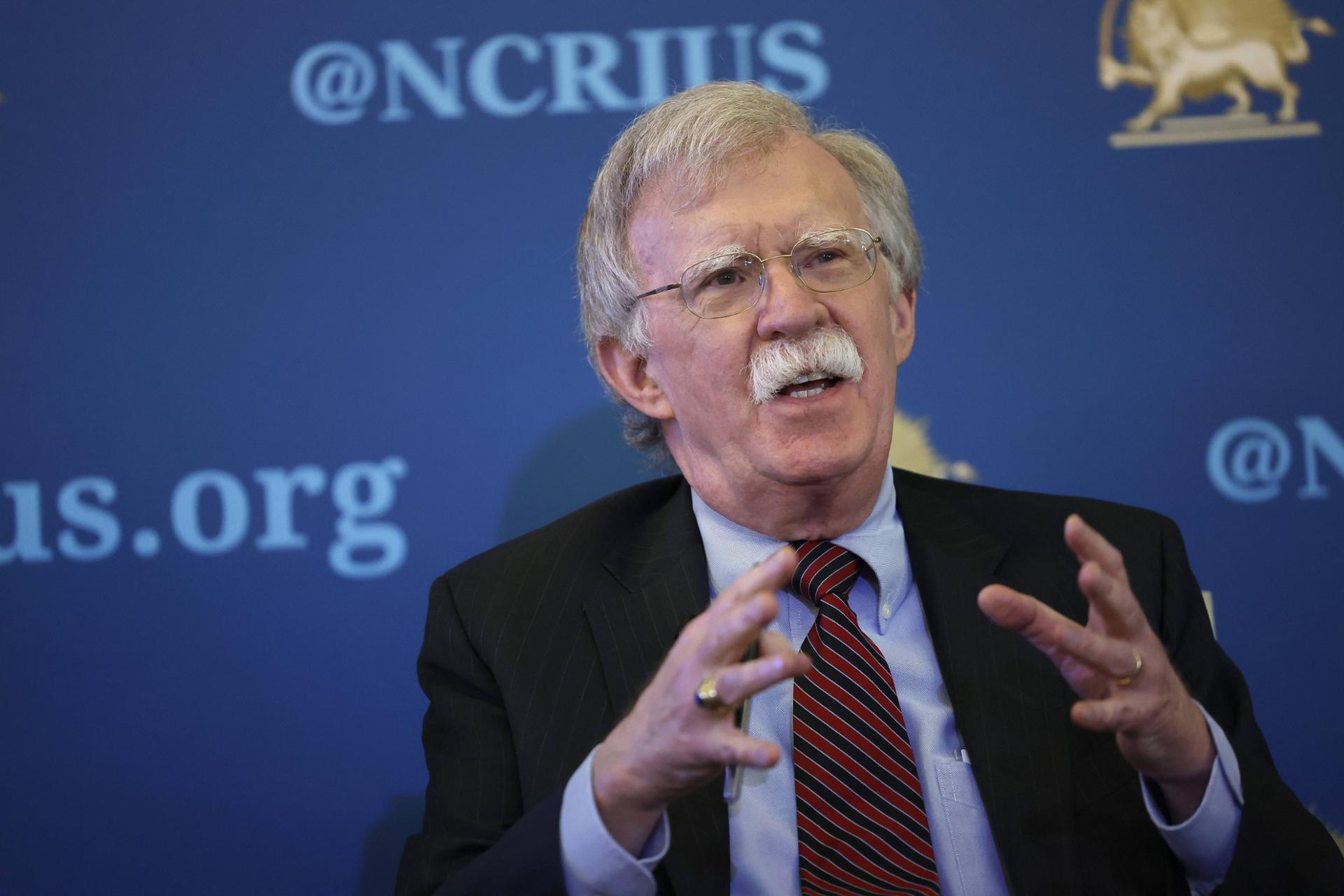
John Bolton, former U.S. national security adviser / AFP-Yonhap
WASHINGTON — Former U.S. National Security Adviser John Bolton on Tuesday said there is a possibility that President Donald Trump could meet North Korean leader Kim Jong-un in Pyongyang for a new summit, while warning that the risks of renewed summitry are "very high."
Bolton, who served as a top security aide to Trump from 2018 to 2019, made the remarks during an online forum as Trump has said he wants to meet Kim later this year. Trump held three meetings with Kim during his first term: the first in Singapore in June 2018, the second in Hanoi in February 2019 and the third at the inter-Korean border village of Panmunjom in June 2019.
"I think Trump would look at Pyongyang because ... he's had the first meeting with the North Korean leader (in Singapore). So doing it again breaks no new ground. It's not a big PR stunt," Bolton said during the forum hosted by the Institute for Corean-American Studies (ICAS).
"He's been to the DMZ and walked in North Korea, so he can't do that again. So what else is there really except to go to Pyongyang?" he added, referring to the Panmunjom meeting inside the Demilitarized Zone, where the two leaders briefly crossed the Military Demarcation Line separating the two Koreas.
Bolton said Trump appears to want a meeting with Kim because he wants "pictures" and "distraction" from difficult issues at home and abroad.
"(Trump) wants something other than worrying about the war in the Middle East or prices in the United States, or the November election," he said, referring to the U.S. midterm elections in which control of Congress is at stake.
Trump is also looking for the "biggest welcome any North Korean leader has given a foreign leader," Bolton said.
Bolton warned of the "very high" risk of another Trump-Kim meeting, recalling that there was "zero planning" when Trump abruptly said he would suspend joint military drills with South Korea soon after the Singapore summit in 2018. The remark comes as Washington and Seoul continue to manage deterrence on the Korean Peninsula alongside periodic adjustments to their combined exercises, which Pyongyang has long condemned.
"Kim complained about the annual field exercise. Trump said, 'You know, I agree with you. It's very provocative. It costs too much money. It's very dangerous. I'm just going to cancel it this year,'" Bolton said, describing the Singapore summit, where he, then Secretary of State Mike Pompeo and White House Chief of Staff John Kelly participated.
"Pompeo and Kelly and I were just sitting there with our mouths closed, hoping that our jaws haven't dropped to the table in front of us because there was zero planning for that ... Just a few weeks ago, there was zero planning for it as well. So you put Trump across the table from Kim. Who knows what he'll say?"
Last month, Trump ordered the scaling back of a major South Korea-U.S. exercise, called Ulchi Freedom Shield, citing his "very good" relationship with Kim and arguing that the allies' drills are "not only costly," but also send a "totally inappropriate and hostile" signal to the North.
The reduction of the exercise fueled concerns that it could weaken the allies' deterrence against growing North Korean nuclear and missile threats.
Bolton also said Trump had asked Kim during the Singapore meeting to board his presidential aircraft and fly to Pyongyang on the way back to Washington.
"(Trump) said to Kim, 'Well, look, I'm flying back to Washington. Why don't you ride on Air Force One with me, and we'll stop in Pyongyang?' After the Secret Service picked themselves up off the floor, we talked him out of it. And Kim didn't want to do it either, fortunately," he said.
"But the purpose of a trip to Pyongyang is the publicity. That's the sum and substance of it."
Asked what Trump could gain from a meeting with Kim, Bolton said he was skeptical.
He also called it "dangerous" for Trump to view international relations "through the prism of the relations of heads of state," and said he was not sure whether anyone is advising Trump on North Korea.
"If he has a good relationship with Kim Jong-un, then U.S.-North Korea relations are good. He doesn't need the State Department, the Defense Department, the Treasury Department or anybody else. It's just the two buddies talking to one another," he said.
"I think that's dangerous. I think it's naive, and particularly dealing with governments that do have the capacity to think at longer range. I am nervous about a meeting at the summit, with Trump on one side and almost any of these authoritarian leaders on the other."
Asked how South Korea can ensure it would not be sidelined in Trump's diplomacy toward Pyongyang, Bolton said it is "not necessarily a bad thing" not to push for a meeting with Trump.
"Be careful what you wish for and what he might say and do ... That's why I think the risks are high here. There are so many uncertainties that what in some circumstances at least arguably might be very sensible things to do in a Trump world don't necessarily lead to sensible consequences," he said.
"There's no doubt of the urgency of matters on the (Korean) peninsula and in East Asia generally, but that doesn't necessarily mean the answer is to gin up the president of the United States to think about what he would do about it, because there's no telling what response you might get."
