BNB Chain's Proposed Network Could Make PancakeSwap Swaps 27% More Expensive
Key Takeaways
- •BNB Chain published a layer-1 litepaper on Nov. 26 for a proposed network developed separately from BNB Smart Chain that continues using BNB as its gas token, with a public testnet in preparation.
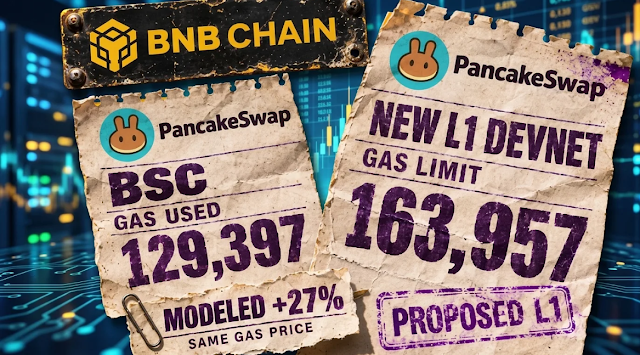
- •Under the proposed devnet rules, transactions pay their full declared gas limit even when consuming less, so a modeled PancakeSwap v3 swap with a 163,957 gas limit would cost 0.00000819785 BNB, about 27% more than the 0.00000646985 BNB observed on BSC.
- •The fee gap varies with the declared gas limit, from roughly 16% higher at 150,000 gas to about 55% higher at 200,000 gas, and included transactions that revert or run out of gas also pay the full-limit charge.
- •The design introduces protected lanes reserving block capacity for governance-approved contract addresses and preconfirmation signals streamed in roughly 20 milliseconds, though such placement indications are not equivalent to final execution.
- •Market makers could potentially offset the unused-gas cost by avoiding stale quotes using early placement signals, while BNB Smart Chain recorded $484.13 million in 24-hour decentralized exchange volume in DefiLlama's Nov. 27 snapshot.
BNB Chain has outlined a proposed network design that, under its new fee model, could make an identical PancakeSwap swap cost roughly 27% more than it does on BNB Smart Chain today. The design was detailed in a new layer-1 litepaper published by BNB Chain on Nov. 26.
The proposed network is being developed separately from BNB Smart Chain (BSC), will continue to use BNB as its gas token, and has a public testnet in preparation. Its model takes a different approach to transaction ordering and block capacity, introducing reserved capacity for eligible transactions along with preconfirmation signals intended to give applications an early indication of where a transaction may be placed.
How the New BNB Chain Fee Model Works
On BNB Smart Chain, an ordinary transaction's network fee is based on the gas it actually consumes. Unused gas within a declared limit is refunded under this accounting, a convention standard across EVM-compatible chains. A gas limit, by contrast, represents the maximum amount of computing work the transaction is permitted to use.
Under the proposed devnet rules, transactions are ordered before execution, and their declared gas limits are used to allocate block space. An ordinary transaction with a valid sequence number and sufficient funds when executed pays for its full gas limit, even if it uses less gas than the amount reserved.
A PancakeSwap v3 router swap illustrates the potential difference. On June 26, a successful transaction on BSC used 129,397 gas at a price of 0.05 gwei per unit and paid 0.00000646985 BNB.
Applying the proposed devnet rule at the same gas price, with a gas limit of 163,957, would produce a fee of 0.00000819785 BNB. The 34,560 units of unused capacity would account for an additional 0.000001728 BNB, making the modeled fee about 27% higher than the observed charge.
The size of the gap would vary with the declared gas limit. At 150,000 gas, the modeled fee would be 0.0000075 BNB, about 16% above the observed BSC fee. With a 200,000-gas limit, it would reach 0.00001 BNB, roughly 55% higher.
Reducing a router's declared gas limit could lower the charge when a transaction completes within that limit. However, setting the limit too low could cause the transaction to run out of gas if the route requires more computing work than anticipated. In effect, the headroom a router includes to keep a route from failing becomes a recurring cost rather than free insurance.
The devnet rules also apply the full-limit charge to included transactions that revert or run out of gas. Invalid transaction sequence numbers incur no gas charge, while insufficient funds can restrict the amount the network collects.
Protected Lanes and Transaction Preconfirmations
The proposed network also introduces protected lanes, which reserve part of block capacity for transactions sent to contract addresses approved through governance. Because eligibility runs through governance approval, which applications can draw on reserved capacity would be settled by vote rather than open competition, a mechanism BSC does not currently offer. A swap sent to an unregistered router cannot use the reserved capacity of a contract that the router calls.
Each transaction's declared gas limit counts toward its lane's quota. A larger gas buffer therefore consumes more of the capacity available to other eligible transactions, which must still compete for space within the same lane.
BNB Chain's devnet documentation describes a preconfirmation process in which a block producer streams a signed update indicating a transaction's intended position. The documented timing is roughly 20 milliseconds.
That placement signal is not the same as final execution. A transaction's result becomes final after execution is committed and the block containing that commitment has finalized. Applications settling a trade must receive a successful transaction receipt and verify that its block is on the canonical chain and at or below the execution-finalized height.
When the Additional Fee Could Be Worth Paying
The early placement signal could be useful to market makers managing quotes. For example, a market maker might delay updating a quote after receiving provisional placement information about a swap likely to change its reference price.
If the signal helps the market maker avoid costly stale quotes often enough, the resulting savings could offset the recurring cost of unused gas. If the signal is withdrawn, however, the market maker must reassess its position. Applications that need the actual swap result before taking another action still have to wait for execution. For swaps not connected to such timing-sensitive strategies, the placement signal provides no direct benefit, leaving the full-limit charge as the model's most visible effect.
Volume Snapshot and Public Testing
BNB Smart Chain recorded $484.13 million in 24-hour decentralized exchange volume in DefiLlama's Nov. 27 snapshot. Whether activity migrates to the proposed network will depend on whether its model makes economic sense for traders at actual gas prices.
Public testing is expected to provide evidence about lane availability, the frequency of withdrawn placement signals, and the amount of spare gas required by different transaction routes. Until that evidence exists, the fee comparisons described here remain modeled figures derived from devnet rules, not charges observed on a live network.
This article is based on reporting published by Hokanews, drawing on the original CryptoSlate article written by crypto journalist Ethan Collins, who covers market movements, protocol updates, regulatory changes, and emerging trends in digital assets.

