BMW’s Mark Berger Discusses Neue Klasse, the New iX3, and EV-Only Platforms
Key Takeaways
- •The new BMW iX3 is the first production model based on BMW’s Neue Klasse architecture.
- •BMW says Neue Klasse technology will be applied to 40 new models and model updates by 2027.
- •The iX3 50 xDrive M Sport produces 469hp and 645Nm from two electric motors and reaches 100kph in 4.9 seconds.
- •Mark Berger said a dedicated EV platform helps BMW reduce weight, cost, production complexity, and packaging compromises.
- •BMW is maintaining a flexible strategy by investing in EVs while continuing petrol and diesel models in markets where demand remains.
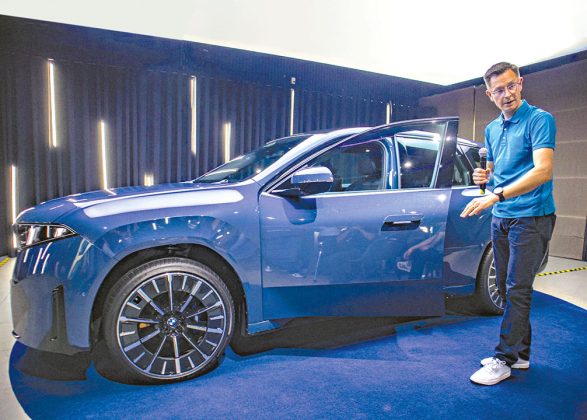
Interview by Kap Maceda Aguila
As mobility electrification continues to accelerate in the Philippines, particularly as the US-Iran war has driven spikes in fuel prices, vehicle shoppers are being presented with a growing range of electrified choices from both familiar and newer brands.
Around 40 kilometers from Bangkok, the Pathum Thani Speedway sits in the old town from which it takes its name. The venue hosted a Masterclass Experience for the all-new BMW iX3, also identified internally by the code NA5.
The BMW iX3 is the fully electric version of the X3, one of the more compact models in the Munich-based brand’s SAV, or sports activity vehicle, lineup. The second-generation iX3 is particularly significant because it introduces what BMW calls its Neue Klasse architecture, described by the company as the “dawn of a new era of individual mobility for the BMW Group.” BMW defines the Neue Klasse approach through electrification, digitalization, circularity, a new design language, and next-level driving pleasure. The company says Neue Klasse technology will be introduced across a total of 40 new models and model updates until 2027.
That makes the iX3 more than a single-model launch for BMW. For markets where EV acceptance is still shaped by charging access, purchase cost, and confidence in long-distance usability, the Neue Klasse program is also a test of how far a legacy premium brand can push dedicated electric engineering while still keeping combustion-powered models in its global portfolio.
Calling the new iX3 a revolution rather than a gradual evolution would not be an overstatement. The model receives new BMW eDrive technology, a claimed range of up to 805 kilometers, and a maximum charging rate of 400kW, allowing longer trips while reducing charging time. It also features new electronics and software built around four “superbrain” high-performance computers.
The new iX3 measures 4.782 meters in length, 1.895 meters in width, and 1.635 meters in height, making it longer and wider than the vehicle it replaces while standing lower. Its 2.897-meter wheelbase is 33 millimeters longer than that of the outgoing model, improving cabin space. Cargo capacity starts at 520 liters with the rear seatbacks in place and expands to 1,750 liters when they are folded. The previous model offered 510 liters and 1,560 liters, respectively. The new vehicle also provides an additional 58 liters of storage in the frunk, or front trunk.
The front fascia may be polarizing, but BMW has framed the design as a tribute to its past, particularly the Neue Klasse cars of the 1960s and 1970s. The company is pursuing a reductionist design direction while adding a modern digital interface through the Panoramic iDrive, a floating instrument display based on the new BMW Operating System X and extending across the lower windshield. BMW also applies what it calls a “Shy Tech” approach, visible in elements such as the multifunction steering wheel, to “reduce visual complexity and create a cleaner, more intuitive cabin environment.”
The BMW iX3 50 xDrive M Sport driven for this program is equipped with two electric motors producing 345kW, or 469hp, and 645Nm of torque. It accelerates from a standstill to 100kph in 4.9 seconds and has a top speed of 210kph.
Below are excerpts from an exclusive interview with BMW Group Product Manager for Neue Klasse Mark Berger, who discussed the iX3, the Neue Klasse architecture, and the German automaker’s broader product direction.
VELOCITY: The previous X line generation used shared platforms across powertrains. I think it was a good decision for reasons including a consistent appearance across the lineup. Why change the formula if it was clearly working? How did BMW decide to break that mold with Neue Klasse?
MARK BERGER: When you build an EV-purpose platform, you can remove excess weight and excess cost. When you have to combine different drivetrains in one chassis, on one platform, you have some losses in efficiency because production becomes much more complex. The construction of the car also becomes more complex because you need to provide for an electric drivetrain while at the same time accounting for a hot exhaust system when there is an internal combustion engine. In an electric car, you do not need to worry about how exhaust gases flow, and you do not need the floor tunnel.
If we wanted to combine everything, it would always be a compromise. With the competitors we are facing now, it is not like in the past with these combined platforms. Especially in this segment, and where the iX3 is now positioned, we face the toughest competitors, and they are EV-only.
To achieve the range, efficiency, target weight, and interior roominess, we need to compete in this very competitive environment. We had to make the choice. We also needed to go EV-only and create a brand-new platform because otherwise we would not be competitive. If I am honest, our competitors include the Tesla Model Y, which is an EV, and the Volvo EX60 on a completely new platform, also EV-only.
We now have a lot of Chinese EV-only brands as well, and we have seen the constraints we had in previous generations. There was always a tradeoff, so we made the decision: we want to be successful and go EV.
VELOCITY: In other words, it allows BMW to tailor the product more precisely because it is no longer constrained by having to share a platform?
MARK BERGER: Yes, exactly.
VELOCITY: One advantage of a shared platform in the previous generation was that BMW could produce different models from one production line. But are you also saying that, in the final analysis, an EV-only approach also makes sense for BMW from a cost perspective?
MARK BERGER: Exactly, yes. For example, the new plant we built in Hungary is for EVs only. We can build the iX3 as a big-volume model. It allows us to completely fill the plant, and we do not have to provide additional steps down the line where a gearbox needs to be fitted or where an engine goes into the chassis. We were able to completely redesign the production process to make it very lean for electric cars. It is not easy if you want to combine different drivetrains in one line.
For example, as I also mentioned in my presentation, if you have a petrol car, you need a large oil-filling station and a fuel station where you fill the vehicle with petrol. Instead, we have now installed chargers so that every car rolling off the line is charged to a certain percentage for transport, and that is it. Otherwise, we would still need various stations in the production process.
We can maximize output and minimize cost because we already have many factories building petrol and diesel cars. We are still doing quite well there, so the decision was to build an additional plant but make it EV-only because that is where we believe a lot of growth will come from, or where a lot of volume will shift toward electric.
VELOCITY: Many brands have stepped back from initial commitments to place a hard stop on internal combustion engines. Market forces around the world have required hybrids and have made it difficult to let go of ICE right now. But based on your earlier point, BMW also sees enough demand for fully electric vehicles to make it in the company’s interest to commit through Neue Klasse.
MARK BERGER: That is the thing. In the past, our previous board member Mr. Oliver Zipse never said we would commit to ending petrol cars at a certain point and then only build electric. We also never said we would not invest fully in electric, because we do believe electric is the future — maybe not at the time that journalists, investors, or even governments were anticipating. People had said that by 2030 or 2035 in Europe, there would be no more petrol. I think they are even reviewing that. We will be ready if legislation changes.
Since we are a global brand, we know and see that in certain parts of the world electromobility is moving more slowly, and people, for various reasons, are still holding on more to petrol cars. In certain parts such as Europe, we will definitely shift to electric sooner or later.
That is also why we built the plant in Europe, because for now that is where we see the fastest shift for this kind of car. For the petrol X3, we build in South Africa and America, and in America, with the new government, the shift toward EVs is a bit halted, at least for the moment. That is how we continuously analyze where the market is heading and how it is developing. Our strategy is to be flexible.
But as I said, if we do electric, we commit fully and try to build benchmark cars and be very strong in the segment. It is the same with the petrol X3. It is very nice and very competitive in its own right as well.
Berger’s comments point to the balance BMW is trying to maintain: using dedicated EV platforms where the company believes they are necessary for efficiency and packaging, while continuing to serve regions and customers that still depend on petrol and diesel vehicles. For buyers, that distinction matters because the vehicle’s architecture affects not only performance figures, but also cabin packaging, charging capability, production complexity, and the way future software and electronic systems are integrated.
VELOCITY: You said the iX3 is almost jumping generations because its appearance is very revolutionary. But there must have been a risk in that, because some people have said they are not too keen on the look. I will not name any brands, but I am sure you know one that went all-in on electric with a completely different look, and the market did not like it. What studies or research did BMW conduct to help ensure that Neue Klasse would work?
MARK BERGER: We had various steps. At a very early stage, we used global connections to influencers and trendsetters and discussed with them what they would like. Then we also took our early models to secret locations and showed them not only to BMW customers, but also to competitor customers and people who do not buy the BMW brand. We had them evaluate the design at an early stage. It was a very comprehensive clinic, and they came back with what they saw.
In this car, I must say, the interior received the highest score ever on any BMW, and that really gave us the feeling that we were heading in the right direction. I think most of us were still very nervous before we launched it, but the relief came when we showed the car last year at the IAA (Internationale Automobil-Ausstellung) Mobility in Munich. The positive feedback was overwhelming. It was really a good step, and people said they really liked the new language. “Mark, I really like the smaller kidney. I really like it. And finally, you know, I had it on my E36, or I had it on my old 3 Series, and I didn’t like the (last one), but this one I really like.” So we do our studies, but then we still have to trust the design team.

