Chainlink, Cardano and Other Blockchain Groups Urge SEC to Classify Digital Commodities as Non-Securities
Key Takeaways
- •Six blockchain organizations, including Chainlink Labs and the Cardano Foundation, jointly urged the SEC to formally classify digital commodities as non-securities in a letter dated Oct. 20.
- •The signatories want the commodity classification written directly into the proposed Regulation Crypto Assets framework, arguing that interpretive guidance alone leaves market participants facing legal uncertainty.
- •The letter also seeks greater clarity on how securities laws apply to secondary-market digital asset transactions and to staking and other decentralized network activities.
- •The SEC's proposed crypto framework, introduced in August, received roughly 140 public comments during its 60-day consultation before the submission window closed Tuesday.
- •Whether the requested digital commodity classification appears in the final regulatory text remains undecided, as the SEC weighs the consultation record to determine the framework's shape.
Chainlink, Cardano and Other Blockchain Groups Urge SEC to Classify Digital Commodities as Non-Securities
Six major blockchain organizations, including Chainlink Labs and the Cardano Foundation, have urged the United States Securities and Exchange Commission (SEC) to formally classify digital commodities as non-securities, filing the request as the agency's public consultation on proposed crypto regulations came to a close on Tuesday.
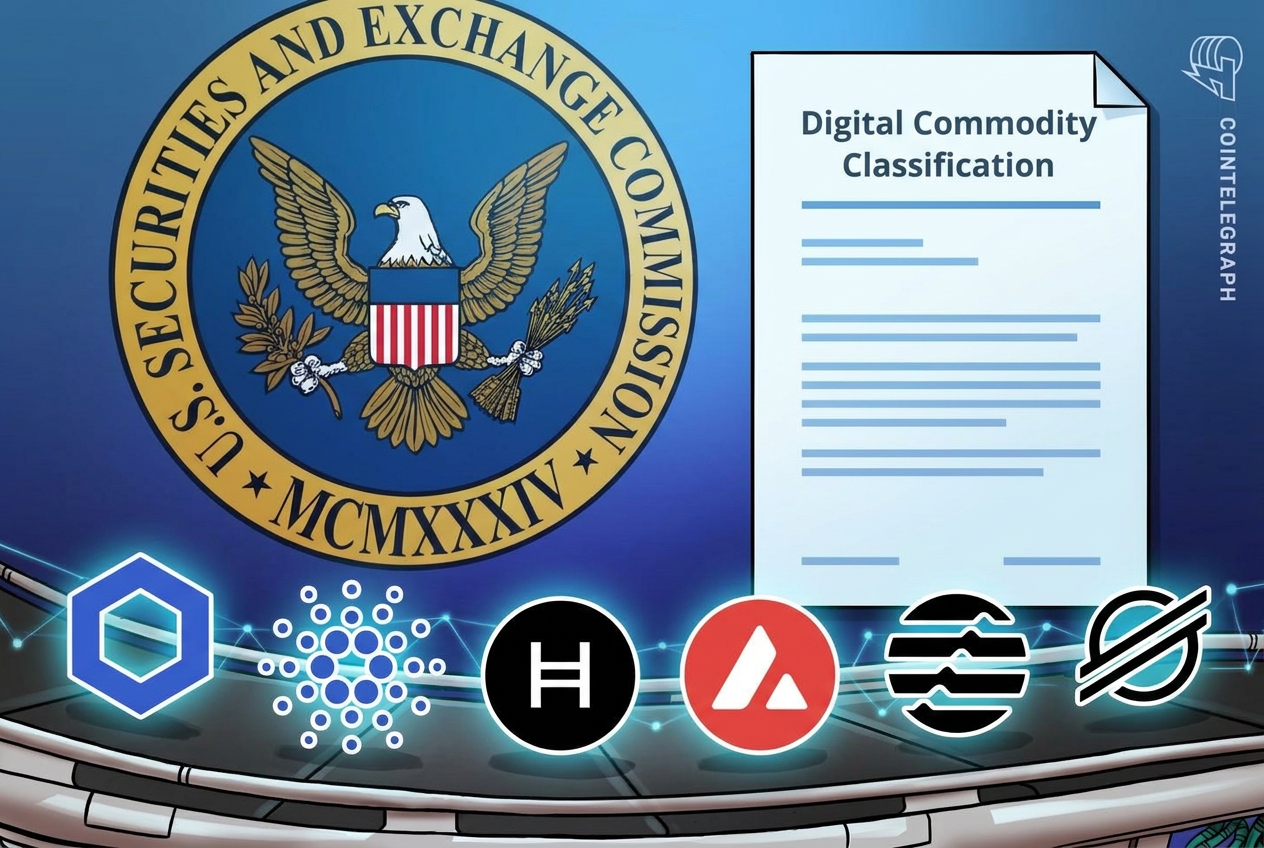
In a joint letter dated Oct. 20, Chainlink Labs, the Cardano Foundation, Hedera, Aptos Labs, Ava Labs and the Stellar Development Foundation — the organizations associated with the Chainlink, Cardano, Hedera, Aptos, Avalanche and Stellar blockchain networks — called on the SEC to incorporate its digital commodity classification directly into the proposed Regulation Crypto Assets framework. The signatories argued that interpretive guidance alone leaves market participants facing uncertainty.
The groups contended that the SEC's existing interpretation already recognizes digital commodities as a distinct category, but that the proposed rules fail to explicitly reflect that distinction. Codifying the classification in the regulatory text, rather than relying on interpretive guidance, would provide developers and other market participants with a clearer understanding of which securities regulations apply to their activities, according to the letter.
In the US regulatory system, whether an asset is treated as a security or a commodity determines which rules and oversight mechanisms. Securities fall under the SEC's registration and disclosure regime, while commodities are subject to a separate oversight framework — a distinction that has been contested for digital assets in recent years and carries direct consequences for how projects can issue, list and trade tokens.
Source: Taylor Barr
Beyond the commodity classification, the letter seeks greater clarity on how securities laws apply to secondary-market transactions involving digital assets, as well as the treatment of staking and other activities associated with decentralized blockchain networks.
The SEC's proposed crypto framework was introduced in August and drew roughly 140 public comments over the 60-day consultation period. Industry participants and legal scholars offered competing views on the proposals, which include exemptions for certain crypto offerings and a conditional safe harbor for specific tokens. The letter was submitted as the window for public input closed. With the consultation now over, the submissions — including the joint letter — form part of the record the SEC will weigh as it determines the final shape of the framework, leaving open whether the requested digital commodity classification appears in the finished regulatory text.
This article was reported by Cointelegraph.

