Bloccpay Uses Stablecoins to Simplify Cross-Border Payroll for African Remote Workers
Key Takeaways
- •Bloccpay, founded by Jennifer Echenim and Ajoke Asunmonu, combines stablecoin settlement speed with itemised digital pay slips that banks, landlords, and immigration authorities can accept as proof of income.
- •The platform was inspired by Echenim's experience in the UAE, where banks rejected raw crypto wallet ledger histories while verifiable fiat intermediaries were slow and offered poor exchange rates.
- •Employers must complete automated Know Your Business and Know Your Customer verification before onboarding workers, who can be paid through bank accounts or digital wallets on the worker's preferred blockchain network.
- •Bloccpay's revenue model consists of a $15 monthly fee per contractor for payroll processing, a 1% invoicing fee, and a 1% withdrawal fee structured to encourage users to retain funds on the platform.
- •The company competes with established crypto-payroll players including Request Finance, Bitwage, and Rise Works, and plans to use verified income histories to offer embedded services such as health insurance and travel booking.
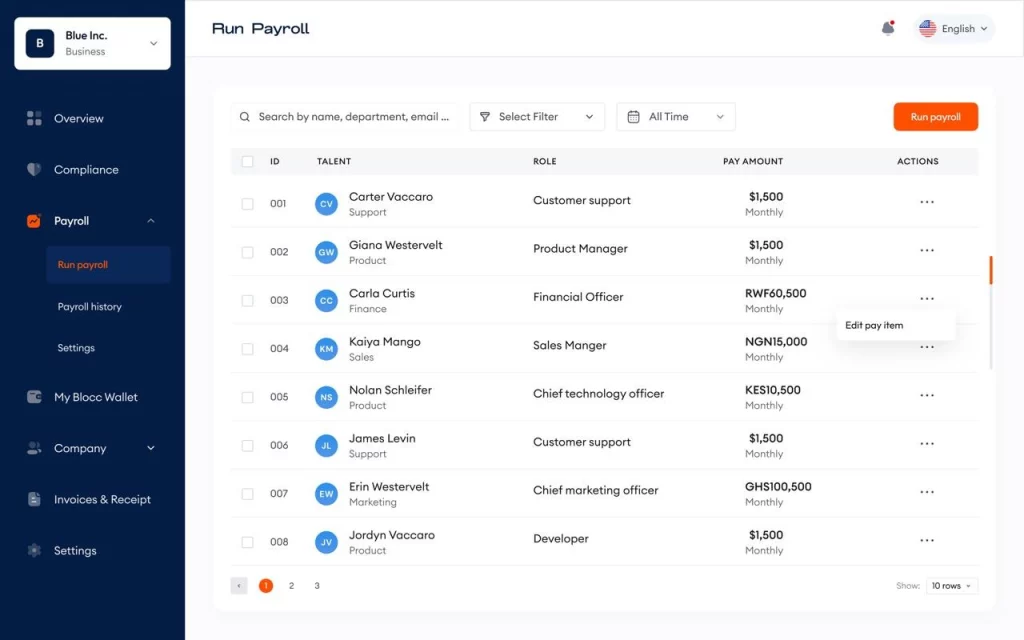
Bloccpay, a chain-agnostic payroll platform founded by Jennifer Echenim and Ajoke Asunmonu, is pairing stablecoin settlements—digital tokens pegged to fiat currencies such as the US dollar, widely used to move value across borders—with bank-grade digital pay slips to close a persistent gap in cross-border remote work: turning instant crypto payouts into income records that banks, landlords, and immigration authorities will actually accept.
The company's approach is detailed in a feature published by TechCabal on October 8 and reported by Opeyemi Kareem (original article).
Anyone who has relocated internationally knows the exact moment their finances become a bureaucratic hurdle. Opening a local bank account, securing a lease, or applying for a visa requires a clear, verifiable audit trail demonstrating the source and legitimacy of income. For remote workers in Africa earning from international clients, establishing that paper trail is notoriously difficult. Payouts often arrive through third-party intermediaries, remittance platforms, or informal channels, leaving workers with opaque transaction histories that fail to satisfy traditional banking compliance.
Echenim encountered this friction firsthand after relocating from Nigeria to the United Arab Emirates (UAE) while working remotely for international firms. One payment platform provided verifiable proof of earnings but suffered from sluggish processing times and uncompetitive foreign-exchange conversion rates. A cryptocurrency exchange, by contrast, offered instant settlement but produced raw wallet ledger histories that UAE commercial banks flatly rejected as proof of income.
To access her earnings, Echenim was forced to construct an arduous monthly workaround. She transferred funds to a friend with a US dollar account in the UAE, converted the fiat into stablecoins, routed the digital assets to her crypto wallet, and executed peer-to-peer (P2P) trades to deposit local currency into her UAE bank account.
“I was doing this convoluted dance every month—moving money through friends, converting stablecoins, and navigating P2P channels just to access my salary,” Echenim recalls.
The episode captures the trade-off that has defined cross-border earning for remote workers: the fastest rails produced the weakest documentation, while the most document-friendly services were the slowest and least economical to use. It is precisely that gap—speed without paperwork, or paperwork without speed—that crypto-payroll platforms such as Bloccpay are built to close.
Drawing on her background as a software engineer building in blockchain, Echenim teamed up with Asunmonu to map the end-to-end payment lifecycle for global contractors, from corporate dispatch to final withdrawal. They systematically pinpointed where value was lost to high fees, delayed settlement, and compliance gaps. That exercise produced Bloccpay, a stablecoin-powered payroll and invoicing infrastructure designed for cross-border talent. Conceived in 2022, the platform underwent private beta testing in 2023.
How Bloccpay works
An estimated 20,000 Nigerians work for domestic and international outsourcing firms, part of a broader shift across Africa toward remote global employment. Yet as exportable digital talent expands, payroll infrastructure has struggled to keep pace.
“Legacy payroll systems were built on the assumption that employers and employees operate within the same legal jurisdiction,” Echenim explains. “Banking rules, tax compliance, and documentation frameworks were all designed around that premise. Remote work completely shattered those assumptions.”
To use Bloccpay, employers complete automated Know Your Business (KYB) and Know Your Customer (KYC) verification by submitting corporate registration records and administrator identification. Once approved, companies can onboard full-time staff or independent contractors and pay them via bank accounts or digital wallets. Employers configure automated payroll schedules—weekly or monthly—and fund payouts using either fiat or cryptocurrency.
The platform operates on a chain-agnostic architecture, enabling workers to receive funds on their preferred blockchain network without forcing employers to manage multi-chain liquidity.
Crucially for compliance, Bloccpay generates itemised digital pay slips for payroll cycles and official receipts for invoices. Contractors can also issue custom invoices complete with contract attachments, proof-of-work documentation, and Value Added Tax (VAT) calculations, creating an undeniable paper trail for traditional banks. The design directly targets the two failures Echenim experienced abroad: stablecoin rails supply the settlement speed her fiat intermediary lacked, while itemised documentation provides the legitimacy that raw wallet ledger histories could not.
Business model and competitive landscape
Bloccpay's revenue model relies on a $15 monthly fee per contractor for payroll processing, alongside a 1% fee on invoicing and a 1% withdrawal fee when users transfer funds out of the ecosystem. The withdrawal charge is deliberately structured to encourage talent to retain capital within the platform.
“Our vision is to build a unified financial hub where workers manage and spend their earnings seamlessly, rather than juggling multiple payment apps,” Echenim notes.
Bloccpay competes with global crypto-payroll platforms including Request Finance, Bitwage, and Rise Works. The presence of several established players signals that crypto-payroll has matured into a competitive category, one in which Bloccpay's founders are counting on regional depth in African banking corridors and its chain-agnostic design to stand out.
“We cater seamlessly to both crypto-native users and non-crypto talent,” Asunmonu adds.
Longer term, Bloccpay plans to leverage verified income histories to unlock embedded financial services, including health insurance, gym memberships, travel booking, and utility payments. For now, the team remains focused on expanding processing volumes and strengthening cross-border off-ramp liquidity across emerging markets. The milestones to watch are the ones the team itself has set: growing processing volumes, deeper off-ramp liquidity in emerging markets, and, further out, the rollout of embedded services built on verified income histories—each a concrete measure of progress toward the unified financial hub the founders describe.

