Blast to Shut Down Ethereum Layer 2 as Costs Outrun Revenue
Key Takeaways
- •Blast is shutting down its Ethereum Layer 2 network and returning users to mainnet because the cost of operating the network has grown larger than the income it produces.
- •Blast drew more than $2 billion in deposits from nearly 200,000 early users before its February 2024 mainnet launch, but its DeFi TVL has since fallen to around $32 million.
- •DeFiLlama data showed roughly $755,500 in annualized fees on the chain against only about $22,700 in annualized revenue accruing to the network itself.
- •The BLAST token fell 17% on the announcement to about a $23 million market value, and Upbit and Bithumb designated the asset as a trading-caution item.
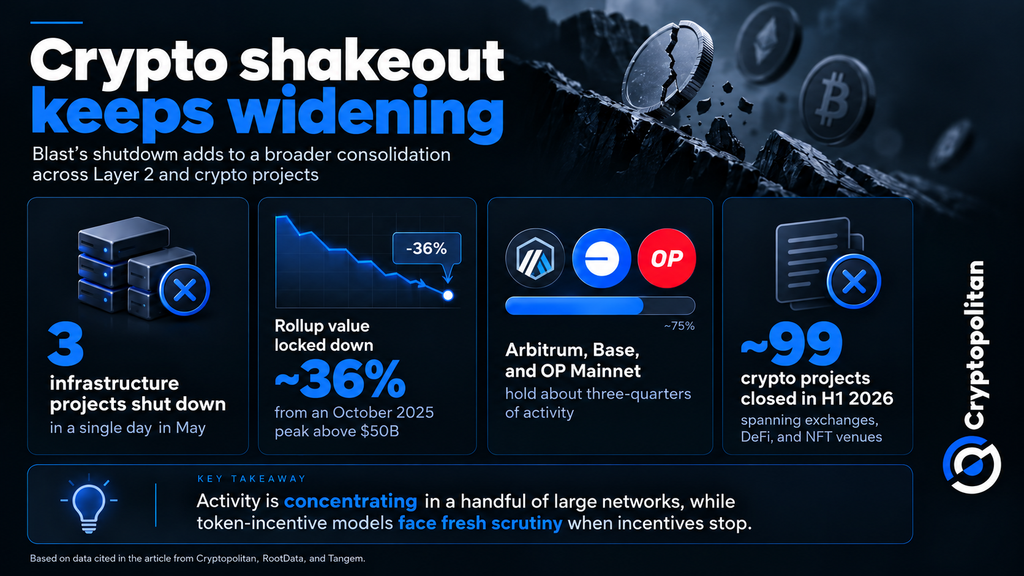
- •The shutdown reflects a wider Layer 2 shakeout in which rollup value locked has dropped roughly 36% from its October 2025 peak above $50 billion, with Arbitrum One, Base, and OP Mainnet holding nearly 75% of all activity.
Blast announced on Friday that it will shut down its Ethereum Layer 2 network and return users to Ethereum mainnet, saying that keeping the network running now costs more than it earns. The team shared the decision in an announcement on X.
The move sharpens a question hanging over smaller rollups in an already crowded Layer 2 market: can they generate enough genuine activity to justify their own operation? Blast said its numbers no longer looked promising and that the overhead of running the network had grown larger than the income it derived from the L2. Layer 2s are secondary networks that execute transactions off Ethereum mainnet and settle results back to it, a design meant to cut fees and raise throughput, with the networks themselves responsible for generating enough activity to cover their own operations.
From $2 billion in deposits to $32 million
Blast debuted in November 2023 after securing a $20 million funding round led by Paradigm and Standard Crypto. Ahead of its mainnet launch in February 2024, the project had drawn more than $2 billion in deposits from nearly 200,000 early users, attracted by native yield on ETH and stablecoins.
Those figures have since fallen sharply. DeFiLlama currently reports Blast's DeFi TVL at around $32 million, while L2BEAT lists roughly $38 million secured on the platform and notes that its fraud-proof system — the mechanism that lets users challenge invalid transactions — remains under development.
The BLAST token also fell 17% on Friday, cutting its market value to about $23 million, according to The Block.
When annualized fees reach $755,500 and revenue just $22,700
The imbalance is visible in Blast's economics. DeFiLlama recently showed roughly $755,500 in annualized fees — what users pay to transact on the chain — against only about $22,700 in annualized chain revenue, the portion that accrues to the network itself. That gap is the real problem: bringing money onto a network is one thing, but sustaining enough constant transactions to justify keeping that network running is quite another.
Cheaper blobs did not fix the math
Blast operated during a period in which Ethereum had already cut one of the key costs rollups face. Through blobs introduced under EIP-4844, which went live with Ethereum's March 2024 Dencun upgrade, Ethereum enabled Layer 2s to transmit data at far lower cost than traditional calldata. Under Ethereum's Danksharding plan, blob data is temporary and is deleted from nodes after about 18 days.
Blast's shutdown shows that reducing a major operating cost can help, but a network still needs enough activity and revenue to sustain itself.
A shakeout that keeps widening
Blast is part of a broader contraction. Ethereum's scaling roadmap has long placed rollups at the center of its plans, a premise that drew dozens of teams to launch their own networks. As previously reported by Cryptopolitan, three blockchain projects suspended operations on the same day in May. Rollup value locked, which peaked above $50 billion in October 2025, has dropped by roughly 36% since then, while Arbitrum One, Base, and OP Mainnet are estimated to hold almost 75% of all activity, leaving smaller operators to compete for what remains.
The weakness is not limited to Layer 2s. A recent count by RootData, cited by Tangem, found that more than 99 blockchain projects closed in the first six months of 2026.
Exchanges move before the lights go out
Upbit and Bithumb moved quickly after the announcement, designating BLAST a trading-caution asset, a label the exchanges use to flag elevated risk to users. Bithumb's notice cited concerns about sustainability and the end of mainnet operations, and Upbit posted its own notice.
Blast will first withdraw its Lido holdings, a process expected to take about a week. Users can withdraw through Blast's interface until October 26, after which they will need to use its Ethereum bridge contracts directly.
With only about $32 million left in DeFi TVL, the shutdown is unlikely to threaten the wider market. Its bigger message is about Layer 2 economics: cheaper infrastructure only goes so far when users, activity, and revenue do not follow.

