BlackRock Cuts Minimum In-Kind Transfer of Self-Custodied Bitcoin Into IBIT to $1 Million
Key Takeaways
- •BlackRock lowered the minimum amount of self-custodied Bitcoin eligible for direct in-kind transfer into IBIT to $1 million, a reduction from a much higher previous threshold.
- •In-kind transfers allow eligible holders to exchange actual Bitcoin for IBIT shares without selling on the open market, a pathway the SEC approved for crypto exchange-traded products, including IBIT, in July 2025 after spot Bitcoin ETFs launched in January 2024 were cash-only.
- •The lower threshold mainly benefits wealthy individuals, family offices, and financial advisers holding large Bitcoin positions, and does not apply to typical retail holders with small amounts of Bitcoin.
- •Bitcoin converted into IBIT moves from private wallets into the trust, whose bitcoin is custodied by Coinbase Custody Trust Company according to the fund's filings.
- •The reduced minimum is an access signal rather than evidence of a demand surge, and whether it translates into measurable inflows will depend on future flow data and possible responses from other ETF issuers.
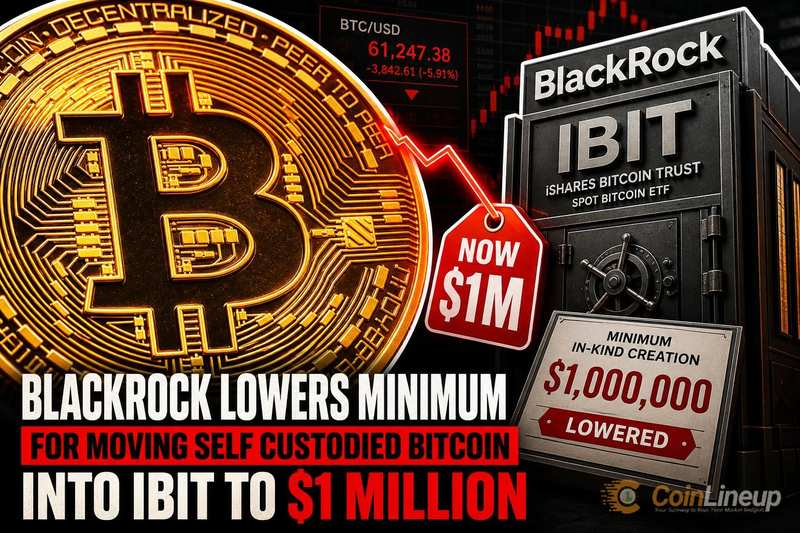
BlackRock has lowered the minimum amount of self-custodied Bitcoin that large holders can move directly into its iShares Bitcoin Trust (IBIT) to $1 million. The change makes it easier for people who store their own Bitcoin to convert those coins into shares of the largest spot Bitcoin exchange-traded fund, without first selling on the open market.
What BlackRock Changed for Self-Custodied Bitcoin Transfers Into IBIT
Self-custodied Bitcoin means coins a person holds themselves, in their own wallet, rather than on an exchange or with a broker. Under an "in-kind" transfer, an eligible holder hands over actual Bitcoin and receives IBIT shares in return, instead of cashing out. The mechanism lets holders move real coins into the fund directly rather than selling them for cash and repurchasing exposure through the market.
BlackRock set the new floor for that pathway at $1 million, a reduction from a much higher prior threshold, according to reporting from CryptoSlate. The route itself is a recent regulatory development: the US spot Bitcoin ETFs that launched in January 2024 were required to create and redeem shares in cash, and the SEC cleared in-kind creations and redemptions for crypto exchange-traded products — IBIT among them — in July 2025. In-kind creation and redemption has long been the standard mechanism for traditional equity ETFs, so that approval brought Bitcoin funds closer to how mainstream funds operate. The mechanics of the fund and its share-creation process are described on BlackRock's official iShares Bitcoin Trust product page. The exact prior minimum and the operational steps are set out in BlackRock's regulatory paperwork, including a post-effective amendment filed with the SEC; readers should treat the finer details as subject to that filing.
Who Benefits Most From the Lower IBIT Entry Threshold
A $1 million floor is lower than before, but it is still far above a typical retail account. The previous, higher threshold had confined the direct-transfer route to an even narrower group of eligible holders. The change matters mainly to wealthy individuals, family offices, and financial advisers managing large Bitcoin positions — people who already own significant Bitcoin directly and want regulated ETF exposure instead. The lower bar gives them a smoother route to swap coins for fund shares, rather than selling on an exchange and buying IBIT separately.
For someone holding a small amount of Bitcoin on an app like Coinbase, this specific pathway does not apply. It is a bridge between direct ownership and ETF exposure, built for allocation-sized transfers, not everyday buyers.
Why the Change Matters for Bitcoin ETF Adoption
IBIT is the destination here, and BlackRock's fund has been a magnet for new money. IBIT recently drew fresh inflows even as a rival Bitcoin ETF shut down, underscoring its dominant position among these products.
Lowering an onboarding threshold can signal an effort to attract a wider pool of eligible capital. It reduces friction for holders weighing the trade-offs between self-custody, convenience, and regulated exposure. The choice between holding your own keys and holding an ETF is a real one for many investors, sharpened by Bitcoin's long-standing "not your keys, not your coins" ethos — converting to IBIT moves coins from private wallets to the trust, whose bitcoin is held by Coinbase Custody Trust Company as custodian, according to the fund's filings. The decision also interacts with issues such as taxes and how governments treat unrealized Bitcoin gains. Broader Bitcoin demand also tracks macro forces such as the US dollar, liquidity, and Fed policy.
Still, a lower minimum is an access signal, not proof of a demand surge. Without verified follow-on flow data, it would be a stretch to claim this single change will move Bitcoin's price, and whether it translates into measurable inflows remains to be seen in the flow data. The concrete follow-on markers are whether other spot Bitcoin ETF issuers adjust their own in-kind terms and how the minimum is described in BlackRock's future SEC filings.
For holders of self-custodied Bitcoin measured in seven-figure amounts, the adjustment offers a more direct, tax- and custody-conscious route to convert coins into IBIT shares. For those with modest stakes, the development mainly indicates how large capital is accessing regulated Bitcoin exposure.
