BlackRock's IBIT Moved $1.25 Billion in Bitcoin: What the Data Actually Shows
Key Takeaways
- •CryptoQuant's Amr Taha estimates $1.248 billion in bitcoin left wallets attributed to BlackRock's iShares Bitcoin Trust from Nov. 23 to Nov. 25, about $234 million more than the $1.014 billion in IBIT fund outflows Farside Investors recorded for the same dates.
- •The discrepancy matches the footprint of a one-day settlement lag, under which coins reach the chain after the session in which a redemption is booked, and the two series align closely on that basis.
- •IBIT may settle redemptions in cash, selling bitcoin through Coinbase Prime, or in kind, an option the SEC approved on July 29, 2025, and in-kind deliveries accounted for roughly 76% of the $2.67 billion paid for redeemed shares in the quarter ended Sept. 30.
- •A decline of 5.2 million IBIT shares outstanding equals 130 redemption baskets, or roughly 2,942 BTC worth about $176 million, within $1 million of the $175.3 million Farside logged for Tuesday's session.
- •Transfers into Coinbase Prime cannot show whether the trust actually sold bitcoin, since the venue serves both settlement routes, and the cash-versus-bitcoin split for recent redemptions will first become determinable through IBIT's 2026 annual report on Form 10-K.
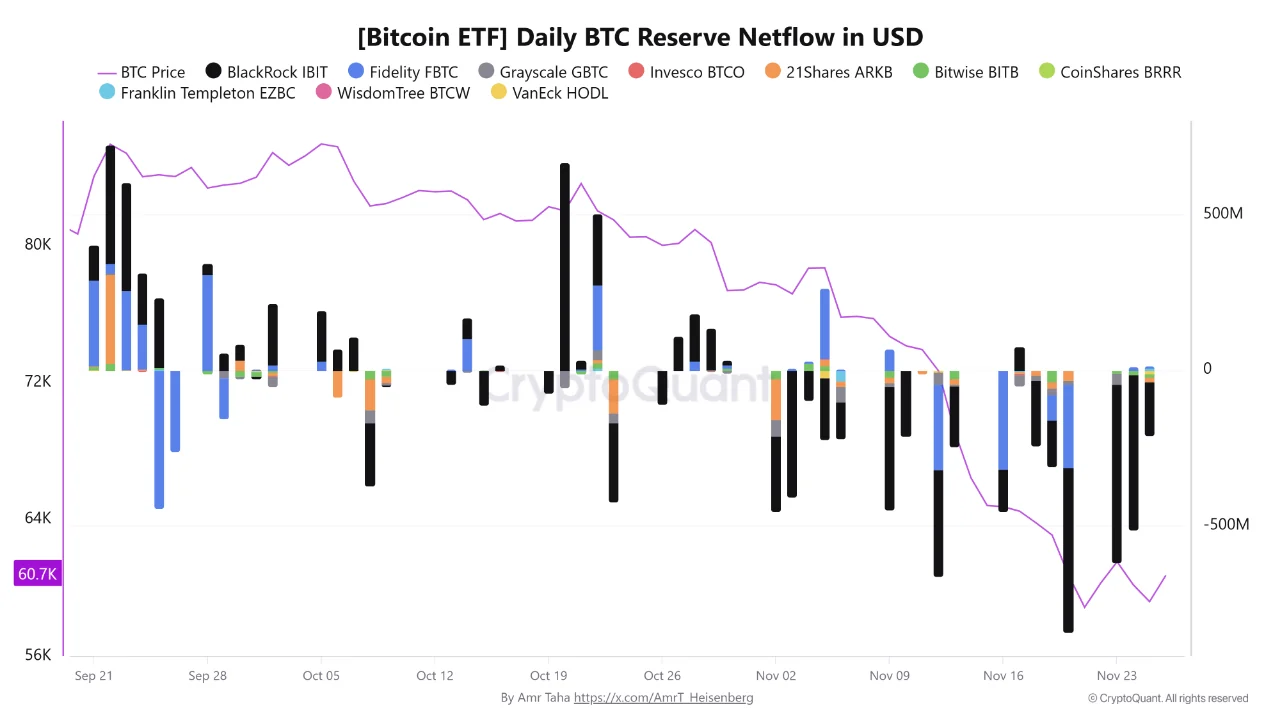
Amr Taha, a verified author at CryptoQuant, estimates that $1.248 billion left reserves he attributes to BlackRock's iShares Bitcoin Trust (IBIT) between Nov. 23 and Nov. 25. Farside Investors recorded $1.014 billion in net fund outflows from IBIT over the same three dates. The two series tracked each other closely until Nov. 25, when they split: the wallet-based estimate dropped by about two-thirds, while IBIT's fund outflow nearly doubled.
Reconciling the two numbers is more than a data exercise. A fund outflow and a movement of bitcoin are separate events, and pairing them — with a one-day offset — reveals which settlement route the trust has been using. The distinction reaches beyond this one fund: daily ETF flow tallies are among the most widely cited gauges of institutional bitcoin demand.
How Bitcoin Actually Leaves an ETF
Trading IBIT shares on an exchange leaves the trust's holdings untouched: whatever one investor sells, another buys. Coins physically exit custody only through the redemption mechanism, in which an authorized participant — usually a large broker-dealer — returns a block of shares to the trust. That creation-and-redemption mechanism is the standard plumbing of exchange-traded funds across asset classes. IBIT's quarterly filing permits two ways to settle that exchange.
Under a cash redemption, the trust sells the corresponding bitcoin through Coinbase Prime or another eligible trading counterparty and pays the authorized participant in dollars. Under an in-kind redemption, the trust delivers the bitcoin itself and sells nothing, leaving the authorized participant free to dispose of the coins afterward.
The SEC approved in-kind creations and redemptions for the trust on July 29, 2025 — an option the trust did not have before that date — and that route dominated the most recently reported quarter. For the three months ended Sept. 30, IBIT paid out $2.67 billion for redeemed shares, $2.04 billion of it — about 76% — delivered in bitcoin. A redemption, in other words, says little on its own about whether the trust actually sold anything.
The Same Redemptions, Recorded a Day Apart
Taha's series tracks on-chain transfers out of wallets he links to IBIT, while Farside books the fund's net creations and redemptions for each trading session. Because orders are placed during a session and settled after it closes, coins leaving custody should hit the chain later than the day Farside records the outflow. Aligned on that basis, the two data sets match closely.
(Sources: Farside Investors for fund flows; Amr Taha's CryptoQuant notes of Nov. 21 and Nov. 26 for wallet estimates. The gap shows the wallet figure relative to the fund figure.)
Two figures in the series stand alone. Monday's $573 million wallet outflow would line up with Friday, Nov. 20 — a session in which U.S. spot Bitcoin ETFs lost $669.2 million as a group, by Farside's count. Yet Taha's Nov. 23 note had already reported that day's transfers at about $572 million when it went out at 15:43 UTC, hours before Monday's U.S. session closed, so those coins cannot have been settling Monday's redemptions. At the other end, Wednesday's $329.7 million fund outflow would only reach the chain after Taha's window had shut.
Three matching pairs do not settle the question. The wallet attribution is Taha's own, the dollar value of any on-chain transfer hinges on the price used to convert it, and the Nov. 19–20 pairing is visibly looser than the other two. The pattern nonetheless builds in its own test: if CryptoQuant's IBIT reserve data shows an outflow near $330 million on Nov. 26 — or on the next business day, since U.S. markets close for Thanksgiving that day — the one-day reading would extend to a fourth session. A number far off that mark would undercut it.
iShares' Share Count Lands on the Same Tuesday
The issuer's records supply a third cross-check. The iShares holdings file dated Nov. 24 lists 1,329,760,000 IBIT shares outstanding, while the fund page shows 1,324,560,000 as of Nov. 25 — a decline of 5.2 million. Because IBIT redeems in baskets of 40,000 shares, that change equals 130 baskets. At the Nov. 25 basket size of 22.63 BTC, it amounts to roughly 2,942 BTC.
The IBIT fact sheet clarifies which session the drop belongs to: shares outstanding "reflect the positions as of the prior day." The Nov. 25 count therefore captures Tuesday's redemptions. Priced at Bitcoin's Nov. 24 close of about $59,744, per CryptoQuant price data, 2,942 BTC works out to roughly $176 million — within $1 million of the $175.3 million Farside logged for IBIT that day.
Why the Two $1.25 Billion Totals Are Not the Same Thing
Taha's three-day figure of $1.248 billion sits almost exactly on Farside's $1.254 billion for every tracked U.S. spot Bitcoin ETF over the same dates. The near-match is a coincidence of scope: one number covers wallets linked to a single fund, the other the entire group, of which IBIT makes up about 81%. IBIT also drove most of the group's outflows in early November, as Coindoo's breakdown of Nov. 2–6 showed.
Measured against IBIT alone on the same calendar dates, Taha's wallet total runs about $234 million higher. That is precisely the imprint a one-day lag would leave: the window absorbs Friday's settlement on Monday while missing Wednesday's redemptions entirely.
What the Coinbase Prime Transfers Cannot Show
Taha's latest note adds a second on-chain reading. The seven-day average of Bitcoin inflows into Coinbase Prime from wallets CryptoQuant classifies as mid-sized investors reached 10,400 BTC on Nov. 25 — the highest since November 2025 and about 2.8% below the earlier peak near 10,700 BTC. Taha suggested IBIT transfers may have contributed, though the note does not identify which transfers fed that cohort.
Coinbase Prime is the venue IBIT's filing designates for cash-redemption sales, but it is also an institutional custody and trading platform, so bitcoin delivered in kind could end up there too. A transfer to it fits either route. Taha acknowledged as much in his Nov. 23 note, writing that such transfers "do not independently establish that the entire amount was sold."
The price question therefore remains open. On Nov. 23, Bitcoin climbed about 5.4% early and then gave back the entire gain during U.S. trading hours — a session Coindoo covered in detail. Whether IBIT's redemptions added spot selling to that reversal depends on the cash share, which no daily source discloses.
The first filing capable of narrowing it is IBIT's 2026 annual report on Form 10-K. Set against the nine-month totals in the September quarterly filing, its full-year in-kind figure would yield the cash-versus-bitcoin split for October through December — though not for individual days.

