BlackRock's IBIT Captures $479M as Bitcoin ETFs Extend Five-Day Inflow Streak
Key Takeaways
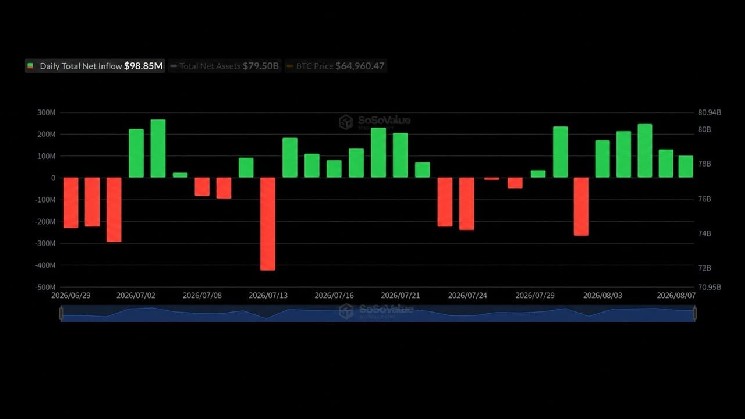
- •U.S. spot bitcoin ETFs recorded five consecutive days of net inflows through August 7, bringing weekly totals above $750 million.
- •BlackRock's IBIT captured approximately 76% of bitcoin ETF inflows over the first three days, pulling in $479 million of $626 million.
- •Ether ETFs logged their fourth straight day of positive flows, with BlackRock's ETHA responsible for roughly 83% of $60.86 million in combined inflows on August 5.
- •Grayscale's GBTC has accumulated $27.47 billion in outflows since its ETF conversion in early 2024, continuing to weigh on aggregate net flows.
- •Renewed demand appears linked to potential federal crypto market-structure legislation and expectations of interest-rate cuts following weak U.S. employment data.
BlackRock's IBIT Captures $479M as Bitcoin ETFs Extend Five-Day Inflow Streak
U.S. spot bitcoin ETFs recorded their fifth consecutive trading day of net inflows, while Ether ETF counterparts logged their fourth straight day of positive flows. Weekly bitcoin ETF inflows have now surpassed $750 million — a pace that would have seemed unlikely just a month ago. The figures are closely tracked across digital-asset markets as a real-time barometer of institutional positioning, since ETF issuers must publish daily creation and redemption data unlike most other crypto investment vehicles.
Bitcoin ETF Streak Builds Momentum
The current inflow streak began on Monday, August 3, and continued through Friday without a single session of net outflows. This marks a sharp departure from the choppy, stop-start pattern that characterized bitcoin ETF flows for much of the year. Solana and XRP ETF products, by contrast, registered effectively zero net change on August 7.
BlackRock's IBIT accounted for the lion's share of bitcoin ETF inflows. Over the Monday-through-Wednesday window that launched the current run, IBIT alone pulled in $479 million of the $626 million in total bitcoin ETF inflows — approximately 76% of all incoming capital. Fidelity's FBTC contributed $19.6 million over the same three-day period, ARK 21Shares' ARKB added $9.2 million, and Bitwise's BITB brought in $8.7 million.
Grayscale's legacy GBTC product, meanwhile, has now bled a cumulative $27.47 billion in outflows since its ETF conversion in early 2024. Those persistent GBTC redemptions have been a defining drag on aggregate spot bitcoin ETF net flows since the segment's January 2024 launch, even as newer low-fee competitors like IBIT and FBTC have consistently attracted capital.
Ether ETFs Mirror the Pattern
Ether ETF flows followed a nearly identical trajectory. On August 5, spot Ether ETFs attracted $60.86 million in combined inflows, with BlackRock's ETHA alone responsible for $50.34 million — roughly 83% of the total. Fidelity's FETH drew $2.87 million, while Bitwise's ETHW and 21Shares' TETH each brought in approximately $1.3 million. BlackRock's staked-ether fund, ETHB, added a further $4.94 million on top of ETHA's haul.
That lopsided distribution means the Ether ETF inflow streak is, in practical terms, primarily a BlackRock story layered on top of a bitcoin one. While smaller issuers are technically participating, the dollar amounts are thin enough that a single large BlackRock allocation on any given day can single-handedly determine whether the category finishes green or red.
Drivers Behind the Rebound
The recovery comes on the heels of a difficult period. Spot bitcoin ETFs recorded $5.4 billion in net outflows during the first half of 2026 — their first negative half-year since the products launched in early 2024. A seven-session inflow streak in July had briefly restored confidence, collecting nearly $1 billion, but snapped abruptly on July 24 with a single-day outflow of $225.18 million. Buyers returned in the first week of August.
Part of the renewed appetite appears tied to regulatory developments. Asset manager Franklin Templeton has pointed to the prospect of federal crypto market-structure legislation as a potential inflection point, characterizing it as a shift that could eventually open bank balance-sheet liquidity to the asset class for the first time. Congress has debated multiple market-structure bills that would clarify whether tokens qualify as securities or commodities and which agency holds primary jurisdiction — questions that have kept many traditional financial institutions on the sidelines.
Weak U.S. jobs data released during the week also strengthened expectations for interest-rate cuts, lifting risk appetite across both equities and crypto. The S&P 500 closed the week at a record high in tandem with the ETF rebound.
Whether the inflow streak extends into a second week will depend largely on whether BlackRock's flows hold up once the current wave of institutional rebalancing runs its course. Five consecutive days of gains represents a meaningfully longer run than bitcoin ETFs managed during the back half of July, though the category has oscillated between multi-week winning streaks and abrupt reversals throughout the year.

