Solana at $1,100? The Numbers Behind Bitwise's Bull Case
Key Takeaways
- •Bitwise’s model uses projected 2031 network fees, a valuation multiple, a 700 million SOL supply assumption, and a 20% discount rate to value the token.
- •Solana’s annualized third-quarter 2026 revenue was $278 million, while the bull case requires roughly 46 times that level.
- •The model assumes tokenized assets reach 5% of global stock and ETF volume, Solana captures 65% of that activity, and turnover reaches three times traditional stocks.
- •Bitwise’s fee estimate includes failed arbitrage and supporting transactions, which account for about one-third of modeled fees and may be less prevalent on permissioned venues.
- •Galaxy’s tokenized GLXY shares are already on Solana, while Nasdaq expects its Equity Tokens to launch with Payward in the second quarter of 2027 without naming a blockchain.
Bitwise's research desk published a five-year valuation model for Solana (SOL) on November 16, built around one central assumption: tokenized stock trading becomes a major fee engine for the network. The report, written by Kam Benbrik and Rafal Klich, sets its base case at $385 per token and its bull case at $1,100 — a scenario the accompanying white paper values at close to $442 in present terms once discounting is applied.
The arithmetic behind $1,100
The model starts from Real Economic Value (REV): the fees users pay to use Solana, including priority fees and tips. Bitwise takes projected 2031 REV, multiplies it by a valuation multiple, divides by an assumed supply of 700 million SOL, and discounts the result back to today. In the bull case, that produces a network valued near $770 billion.
Two choices inside the model pull against the headline figure. The 700 million supply assumption sits above today's roughly 635 million SOL, so issuance between now and 2031 dilutes each token. And the 20% annual discount rate — which Bitwise attributes to risks around the pace of tokenization, regulation, and execution — is about double the 8–10% typical for large-cap equities.
Discounting also changes how the bull case reads today. The paper's third-quarter calculations use a SOL price of around $100. Measured against that reference, Bitwise's own present value for the $1,100 scenario is roughly four times the reference price, not eleven.
Revenue has to do the work, not the multiple
Solana's annualized network revenue in the third quarter of 2026 was $278 million, according to the paper. On that run rate, Bitwise estimates SOL trades at roughly 230 times revenue, so every scenario assumes the multiple compresses — to 60x even in the bull case. The upside, in other words, has to come from revenue. By Coindoo's calculation, bull-case REV is about 46 times the third-quarter run rate, the base case about 24 times, and the bear case about 10 times.
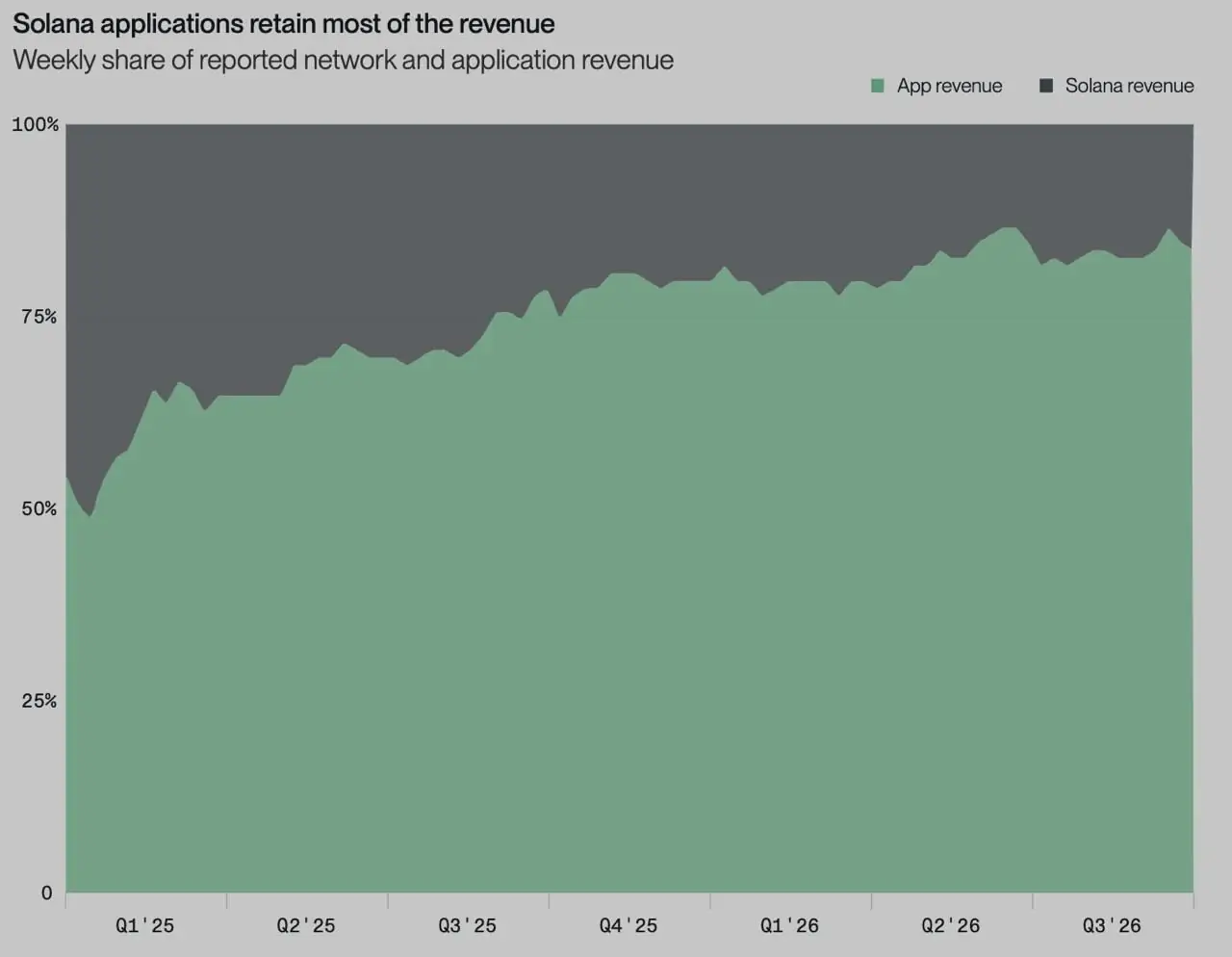
The network's revenue is also a shrinking slice of what Solana activity generates. Bitwise's data shows applications keeping a rising share of combined revenue since early 2025, so more trading does not lift network fees one-for-one.
Three trading inputs produce the revenue figures:
| Input | Bear | Base | Bull |
|---|---|---|---|
| Tokenized share of global stock and ETF volume | 3% | 4% | 5% |
| Solana's share of tokenized stock trading | 30% | 50% | 65% |
| Turnover versus traditional stocks | 2x | 2.5x | 3x |
Values from Bitwise's white paper.
The first input is measured against roughly $235 trillion in annual global stock and ETF trading. Because the three inputs multiply, small changes compound: moving all three from base to bull nearly doubles the trading Solana would handle, which is why bull-case REV comes in close to twice the base case.
Where the fee estimate comes from
To convert trading into fees, Bitwise sampled instructions involving tokenized assets on Solana during the third quarter of 2026. For each successful swap, it counted about three failed transactions and two supporting ones.
The failed transactions are mostly arbitrage attempts that lost the auction for transaction ordering — a normal feature of competitive onchain markets, where several bots chase the same price gap and only one wins. Supporting transactions cover transfers, orders, liquidity provision, and price feeds. Based on Bitwise's counts and average fees, Coindoo calculates a blended fee of about $0.0133 per transaction.
About a third of the modeled fees therefore come from activity around a trade rather than the trade itself. That ratio was measured on venues where anyone can run an arbitrage bot, and applying it to 2031 assumes tokenized stock trading keeps the same open, competitive structure.
The regulated version looks different
The compliant tokenized-equity markets now taking shape restrict who can trade, and that cuts against the conditions behind the fee sample.
The SEC's Innovation Exemption for tokenized NMS stock limits trading to permissioned participants and lets each venue set its own access standards. It also caps the number of symbols and the trading volume, though the fact sheet gives no figures. Holders must receive the same entitlements as owners of the traditional shares, products that only offer synthetic exposure are excluded, and the relief runs for five years.
Galaxy's tokenized GLXY shares already live on Solana as SEC-registered Class A common stock, with Superstate as digital transfer agent. Holders can self-custody them, but transfers run bilaterally between allowlisted entities, and Galaxy has not enabled AMM-based trading.
Nasdaq's product comes later. Its September 10 announcement expects Nasdaq Equity Tokens to launch with Payward, Kraken's parent company, in the second quarter of 2027, alongside a $100 million Nasdaq Ventures investment in Payward. The release names no blockchain.
Bitwise's plan to record its Solana ETF's ownership onchain also keeps transfer limits in place. Fewer participants means fewer bots competing for each trade. If permissioned venues settle on Solana but produce fewer failed and supporting transactions per swap, the same trading volume would yield less REV than Bitwise's sample implies. The exemption's volume cap could also slow progress toward the tokenization share in the model for as long as it applies.
Why the multiple carries so much weight
REV is gross network fees, not profit. Under Solana's fee rules, half of each base fee is burned and half goes to the validator, while priority fees go entirely to validators. Burning shrinks supply for every holder. Validator income pays the operators running the network, and stakers can receive part of it depending on how their validator shares rewards. Unstaked SOL receives none of it directly.
The multiple is Bitwise's judgment of what those fees are worth to a token holder. Holding bull-case revenue and supply fixed, it moves the result as much as any trading input: at the base-case 40x multiple, reaching $1,100 would take about $19.25 billion in annual REV — roughly 69 times the third-quarter run rate.
The figures that would test the scenario
Each input behind Bitwise's top scenario can be checked onchain or in public filings, which makes the model testable from one quarter to the next:
- Quarterly REV against the $278 million Q3 2026 baseline
- The share of REV coming from tokenized assets
- Failed and supporting transactions per tokenized swap
- Whether GLXY or other registered shares gain secondary trading
- The volume and symbol caps set under the SEC exemption
- Which chain Nasdaq Equity Tokens use at launch

