Bitwise to Close Dogecoin ETF as Limited Demand Challenges Altcoin Products
Key Takeaways
- •Bitwise notified NYSE Arca that BWOW will be voluntarily closed, delisted and liquidated, with trading scheduled to stop on October 14.
- •BWOW shareholders will receive cash based on the fund’s October 21 net asset value, and the distributions are expected to be taxable.
- •The fund’s assets declined to $721,815 by September 8, while its cumulative net asset value return stood at negative 45.37% since inception.
- •U.S. Dogecoin ETFs recorded about $300 million in cumulative trading volume, well below volumes reported for Hyperliquid, Zcash and Chainlink products.
- •The SEC’s generic listing standards expanded access for qualifying crypto products but did not guarantee recurring inflows or long-term viability.
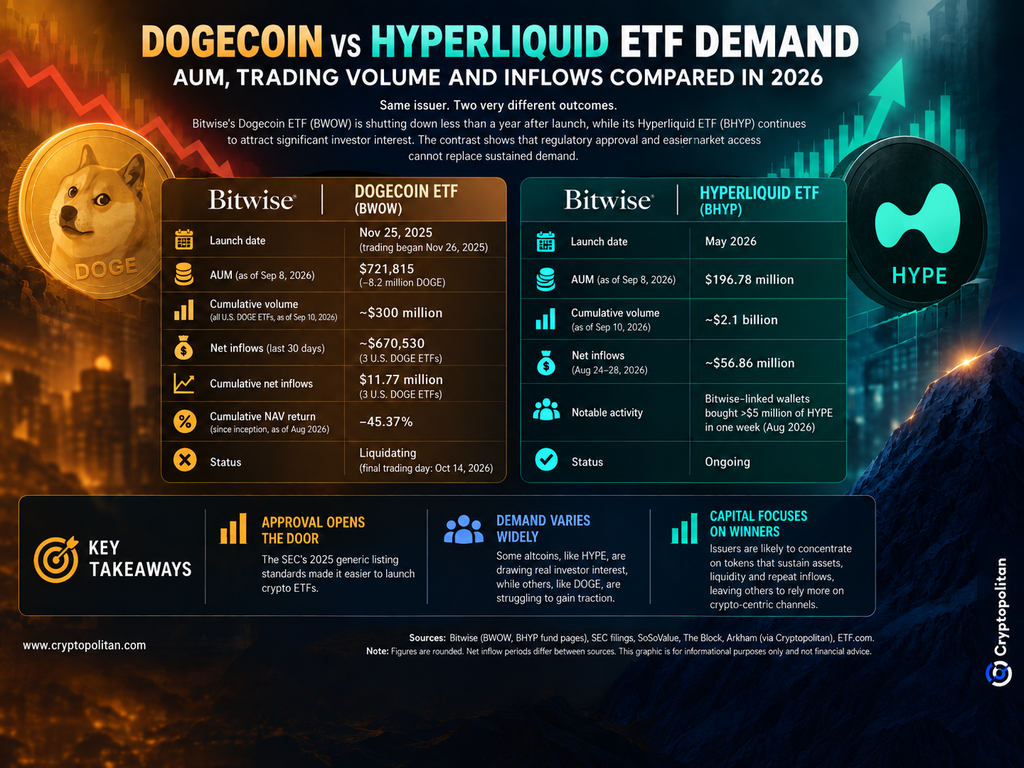
Bitwise will discontinue its Dogecoin exchange-traded fund in October, less than a year after trading began. The decision highlights that regulatory approval and access to brokerage platforms do not guarantee sustained demand for a fund tied to a single crypto asset.
The closure also underscores a growing divide among altcoins: some continue to attract ETF investment, while others remain concentrated in crypto-native trading channels. Bitwise illustrates both sides of that split. Its Bitwise Dogecoin ETF is being wound down, while its Hyperliquid ETF has drawn substantially greater interest.
BWOW wind-down scheduled for October
In a Form 8-K filed with the SEC, Bitwise Investment Advisers notified NYSE Arca of its decision to voluntarily close, delist and liquidate the Bitwise Dogecoin ETF (NYSE: BWOW). Trading is expected to end on October 14.
Investors who continue to hold BWOW after trading ends will not need to take further action. The remaining shares will be redeemed for cash based on the fund’s net asset value as of October 21, with cash distributions expected around October 22. The SEC filing states that the distributions will be taxable events.
Bitwise gave a brief explanation in its liquidation notice: “Bitwise has determined to liquidate the Fund as it continues to optimize its product range to meet evolving investor needs.”
The firm did not identify a specific asset, trading-volume level or amount of incoming capital that led to the closure. Instead, it attributed the decision to its continuing effort to optimize its product range as investor needs change.
Fund data provides context for the decision. BWOW never reached significant scale, and signs of weakness emerged well before Bitwise announced the liquidation.
Fund data points to limited demand
Bitwise announced BWOW on November 25, 2025, and trading began on November 26. By September 8, the fund held only $721,815 in assets and approximately 8.2 million DOGE. Its month-end data for August showed a cumulative net asset value return of -45.37% since inception.
The decline began earlier. BWOW’s second-quarter filing reported that net assets fell from $1.15 million at the end of 2025 to $473,547 on June 30. The fund recorded no share creations during the first half of 2026, while 20,000 shares were redeemed. It therefore failed to build meaningful scale.
Trading activity showed a similar pattern. BWOW reached roughly $3 million in daily volume during its launch week but never approached that level again. By September 10, U.S. Dogecoin ETFs had recorded approximately $300 million in cumulative trading volume, according to The Block.
That total was considerably below the figures for several newer altcoin products. Hyperliquid ETFs had generated $2.1 billion in volume, Zcash products $1.5 billion and Chainlink funds $680 million. The comparison indicates that Dogecoin ETFs have attracted limited secondary-market activity relative to those products.
Bitwise’s Hyperliquid fund draws greater interest
The contrast with Bitwise’s Hyperliquid ETF (BHYP) is pronounced. In August, Cryptopolitan reported that wallets linked to Bitwise ETFs purchased more than $5 million worth of HYPE in one week and had not sold any since July, citing Arkham. The on-chain estimate is not an official Bitwise flow report, but it is consistent with the broader picture of stronger activity involving HYPE ETFs. The report is available here.
Dogecoin ETFs have recorded weaker flows. The three U.S. DOGE funds posted approximately $670,530 in net outflows over the latest 30-day period, bringing cumulative net inflows to only $11.77 million, according to SoSoValue.
The figures do not establish that memecoins cannot function in ETF structures. They show instead that a large community around a token does not automatically produce sustained demand through brokerage platforms.
Easier listings do not ensure demand
The launch of spot crypto products became easier after the SEC approved generic listing standards for commodity-based trust shares on September 17, 2025. Under the standards, qualifying products can be listed without a separate proposed rule change for each fund. The SEC announcement expanded the potential field of products but did not equalize investor demand.
ETF.com estimates that spot Solana products have attracted nearly $880 million in cumulative inflows, while spot XRP products have attracted approximately $1 billion. BWOW’s closure illustrates that easier listing procedures can accelerate product launches without guaranteeing that every fund will remain viable.
The outcome may lead issuers to concentrate on tokens that maintain assets, liquidity and recurring inflows, potentially directing regulated-market liquidity toward a smaller group of altcoins. ETF access is becoming easier, but sustained demand remains dependent on investor participation.
