Bittensor (TAO) Rallies 25% in Five Days on Memecoin Demand, Protocol Upgrades and Rising Futures Activity
Key Takeaways
- •TAO gained 8.33% to close at $264.83 after touching $277, completing a five-day rally of roughly 25%.
- •Futures trading volume jumped 158.61% to $868 million over 24 hours, while open interest hit a three-month high of $434.58 million.
- •Raydium integrated TAO trading pairs on Solana, and the Buttensor memecoin automatically converts transaction fees into TAO purchases.
- •Bittensor's Version 440 introduced an Emission Gate tying subnet rewards to market-driven demand, reducing allocations for underperforming subnets toward zero.
- •Analyst CryptoPatel reaffirmed a $3,000 long-term price target for TAO, citing an 89% rise from the bottom of his accumulation zone.
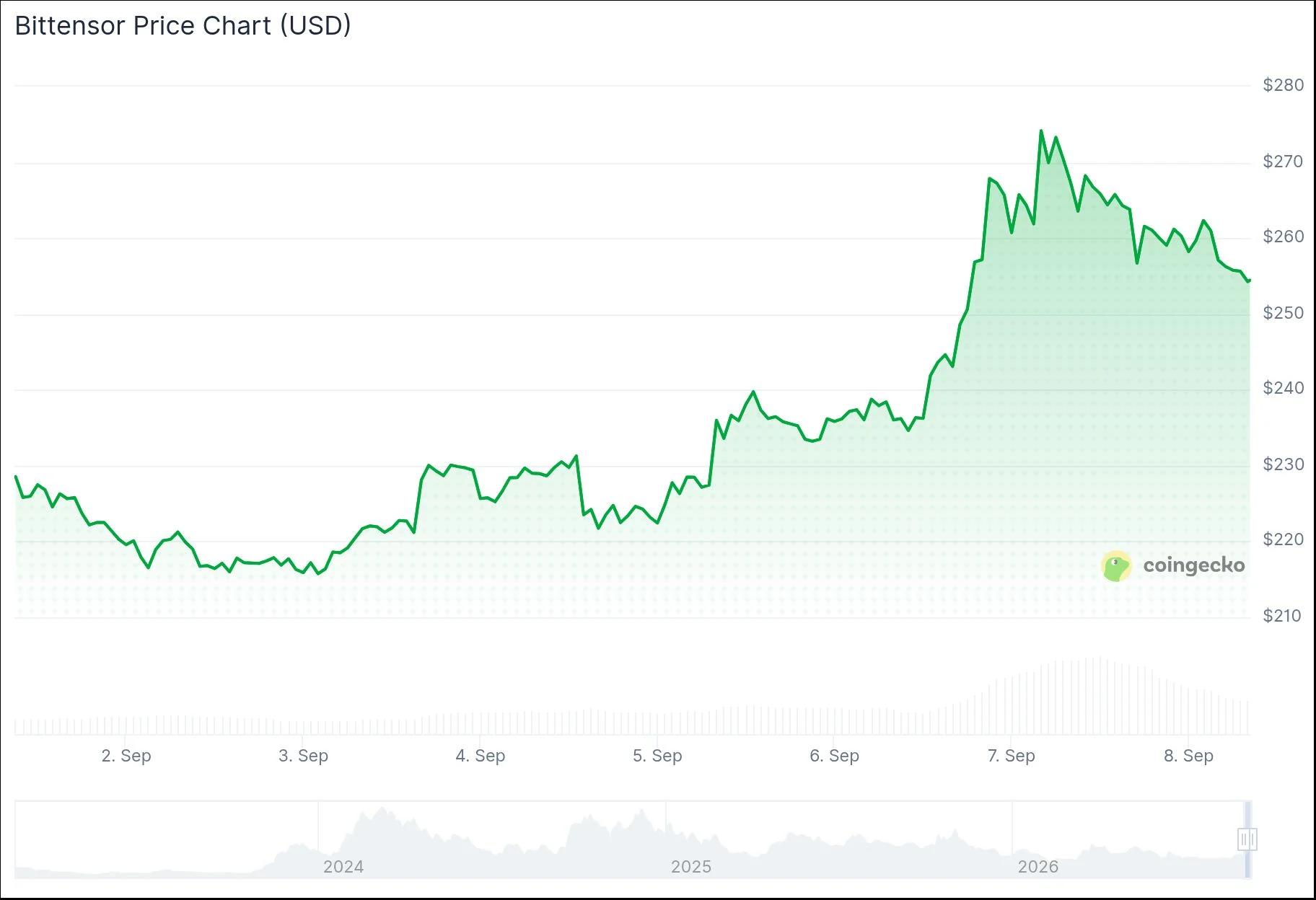
Bittensor's TAO token posted an 8.33% daily gain on Monday, closing at $264.83 after briefly touching $277 during the session. The intraday peak marked the token's strongest level in three months and capped a five-day rally of roughly 25%. Bittensor is a decentralized, open-source network where machine intelligence models are trained and ranked across specialized subnets, with TAO serving as the network's native token — a positioning that has made it one of the most closely watched AI-sector crypto assets.
The advance began from a baseline near $220 on September 1. By September 6, TAO had climbed to $265, and the following session pushed it toward the $277 mark. On the technical side, TAO broke through a downward-sloping trendline that had previously rejected multiple upside attempts. According to CoinGlass data, futures trading volume surged to $868 million over 24 hours — a 158.61% increase — while aggregate open interest climbed to $434.58 million, itself a three-month high.
Raydium Integration and the Buttensor Effect
Raydium, the Solana-based decentralized exchange, recently integrated TAO trading pairs, bridging the AI-focused token with Solana's DeFi ecosystem. The integration was quickly followed by the emergence of Buttensor, a meme-inspired token launched on the same platform. The move echoes a broader Solana memecoin trend in which speculative tokens pair against established assets to borrow liquidity and attention — a pattern that has previously amplified trading activity for the underlying base tokens.
BITTENSOR RIPS AFTER MEMECOINS START PAIRING AGAINST IT! $TAO is near $268 after hitting $277. StonkFun opened Solana memecoin pairs against $TAO, with $BUTTENSOR taking off first. The coin printed millions in volume in hours, and a cut of each transfer is also used to buy… pic.twitter.com/7B5uLNPGBy — Crypto Banter (@crypto_banter) September 7, 2026
Buttensor employs a tokenomics model that automatically converts all transaction fees into TAO purchases, which are then redistributed among BUTT token holders. The structure creates ongoing buying pressure for TAO tied to meme coin trading volumes.
Santiment data shows TAO's social dominance metric expanded from 0.05% to 0.12% following these launches. Further momentum came as the unveiling of ChatGPT-6 Astra redirected market attention toward AI-linked cryptocurrency projects.
Market analyst DamiDefi noted on X that Gittensor's RTX 5090-optimized Qwen3.8-27B model crossed the 500,000 download milestone on Hugging Face this week. He also highlighted the Good Morning initiative's integration of GPT-6 Astra into Bittensor using verifiable access protocols, describing $TAO as "transforming OpenAI into a practical tool for developers."
Protocol Enhancements Underpin Fundamentals
Throughout August and into September, Bittensor rolled out a series of substantial protocol improvements. Version 440 introduced an Emission Gate mechanism linking subnet reward distributions to market-driven demand benchmarks: subnets exceeding the demand threshold maintain price-correlated emissions, while underperforming subnets see allocations reduced toward zero. The shift is part of a wider effort across Bittensor to tie token emissions to real usage rather than raw participation, addressing a long-standing criticism that subnet rewards could flow to activity without demonstrable external demand.
Subsequent releases — V441, V446, V447, and V448 — refined root staking parameters, alpha calculation methodologies, and subnet governance frameworks.
Version 450 advances toward a validator-curated root basket system with a 1/16 concentration limit, designed to distribute exposure more evenly across eligible subnets.
TAO's ecosystem reach also expanded through Chainlink's cross-chain interoperability framework, which now extends to Robinhood Chain. The network has scheduled the Bittensor Exploit Summit for September 28–29, an event likely to provide the next scheduled checkpoint for ecosystem news.
Technical Picture and Price Outlook
Crypto analyst CryptoPatel shared on X that $TAO has appreciated 89% from the floor of his designated accumulation range, reaffirming his long-term price target of $3,000 and identifying $300–$350 as the immediate zone to watch for potential "bullish expansion."
$TAO +89% RALLY | FROM ACCUMULATION TO BREAKOUT | $3,000 STILL POSSIBLE? #TAO Finally Started Moving. We're Already ~89% Up From The Bottom Of Our Accumulation Zone. Hope Your Patience Is Finally Paying Off. Enjoy The Ride. But I'm Not Calling The Top Yet. The Original $3,000… pic.twitter.com/bvwfRIiuIX — Crypto Patel (@CryptoPatel) September 7, 2026
Following the trendline breakout, the $260–$265 range has established itself as support. Immediate resistance sits at $277–$280, with $300 as the subsequent upside reference point. The $434.58 million in open interest — a three-month high — signals heightened leveraged participation in TAO markets, which cuts both ways: elevated open interest can amplify moves in either direction if positions unwind. How the memecoin-driven volume on Raydium sustains, and whether the Emission Gate changes translate into durable subnet demand, are the open questions heading into the September 28–29 summit.
Source: Blockonomi
